

Your AI agent for retail training, you decide, it delivers
How to use an AI agent to manage your retail training
An AI agent does not replace the Maison.
It runs the work around the course: who should learn what, what is late, what to send next, what to report. You set the rules and the brand. The agent executes — paths, reminders, feedback, a first draft of the module — so HQ and the store manager are not chasing completions by hand.
- Brief the agent with approved content and roles only
- Let it propose journeys by door, job and launch
- Use it to chase gaps, not to invent product claims
- Review drafts before anything goes live
- Read the Matrix: who moved, who stalled, which store is behind
- Keep the last word — hybrid: you lead, the agent supports

Human leads. AI operates. That is the hybrid workflow.
The expert keeps the pen. The agent keeps the pace. You set the brief, the sources, the yes.
The agent drafts the course, lines up the path, translates, flags who is late, suggests the next card. You correct tone and claims. Nothing reaches the store until you say so. Hybrid is not half a bot.
It is a clear split: judgment on the human side, execution on the agent side — so retail training moves at launch speed without a second voice.
- Human: strategy, brand, validation, go-live
- Agent: draft, structure, reminders, first-pass translation
- Controlled sources only — no open-web “luxury”
- Review loop before publish
- Same studio: authoring, path, reporting
- You can stop or rewrite any output
- The Maison remains editor-in-chief; the agent is the operations desk
Manage retail training with an AI agent (without losing the brand)
An agent can run the operational side of training: who is behind, which launch is live, what to send next, a first draft of the module.
That only works if the Maison stays in charge. You feed approved content. You set the voice and the rules. The agent executes inside that fence. Speed for HQ and the floor; no second brand invented by a model.
- You own philosophy, claims and templates
- The agent proposes paths by role, store and collection
- Drafts stay drafts until you publish
- Reminders, feedback and next steps — not a new catalogue
- Gaps visible in the Matrix, by door and by team
- Translation and updates without rebuilding the House
- Hybrid by design: you lead, the agent manages the busywork
From catalogue to path: an AI agent in store training
A catalogue is a library. A path is what the associate can actually finish between two clients.
An AI agent turns the first into the second: it reads role and progress, picks the next module, gives feedback, opens a nano card instead of the whole launch pack. The official content stays official. The order becomes personal. That is how store training stops being a list HQ published last season and becomes a journey on the floor.
- Catalogue = everything the Maison has approved
- Path = what this person needs now
- Agent listens, proposes, adapts
- InstaLearn as the door; full course when there is time
- Feedback after the quiz or the video, not only a score
- Less “complete all 40 modules”; more “do this before the shift”
- HQ still sees the network; the store sees the next step

An AI agent that manages the journey — you keep the Maison
The journey is operations: who starts where, what comes next, when to nudge, how to report. An agent can run that.
The Maison is the rest: codes, claims, film, the first screen. You do not outsource the House. You let the agent manage the path inside a universe you already designed. Learners get a guide. You keep the brand.
- Agent: sequence, reminders, feedback, gaps
- You: templates, voice, product truth, publish
- Journey by role and door — not one dump for the network
- Every step still looks like the House
- No second tone invented in the chat
- Measure the path (progress, CSI, attach), not only the library
- Control stays with the brand; pace stays with the agent
Creative authoring: a no-code studio, with AI in the room
The team works in the look of the House type, colour, rhythm without a developer.
The model proposes a draft, a structure, a quiz, an image. The author keeps or cuts. What leaves the studio already looks like the brand, already fits a phone between two guests, and still waits for a human to press publish.
No-code is the canvas. AI is the first pair of hands. The Maison remains the editor.
- No-code studio: design without IT
- Branded from the first screen — templates of the House
- AI draft: structure, copy, quiz, image
- You keep, cut or rewrite — generate is not publish
- Built for mobile and the floor, not only for HQ
- Same tool from storyboard to live module
- Speed of a launch; voice of the brand
Translation at scale - human proofreading. Speed without a flattened Maison.
A launch cannot wait three weeks per language.
The model produces the first pass across markets in hours. Proofreading stays human and local: vous does not become the wrong register, a care note does not soften, a signature line is not replaced by a polite international equivalent. Fast enough for the calendar. Still the House in every language.
- One master module, many markets in hours
- AI first pass — not the last word
- Local proof: register, claims, ceremony
- No flattened “global luxury” tone
- Updates to the master can flow again without a new agency wave
- Same film, quiz and path — spoken as the Maison speaks there
- Calendar of the launch; voice of the House
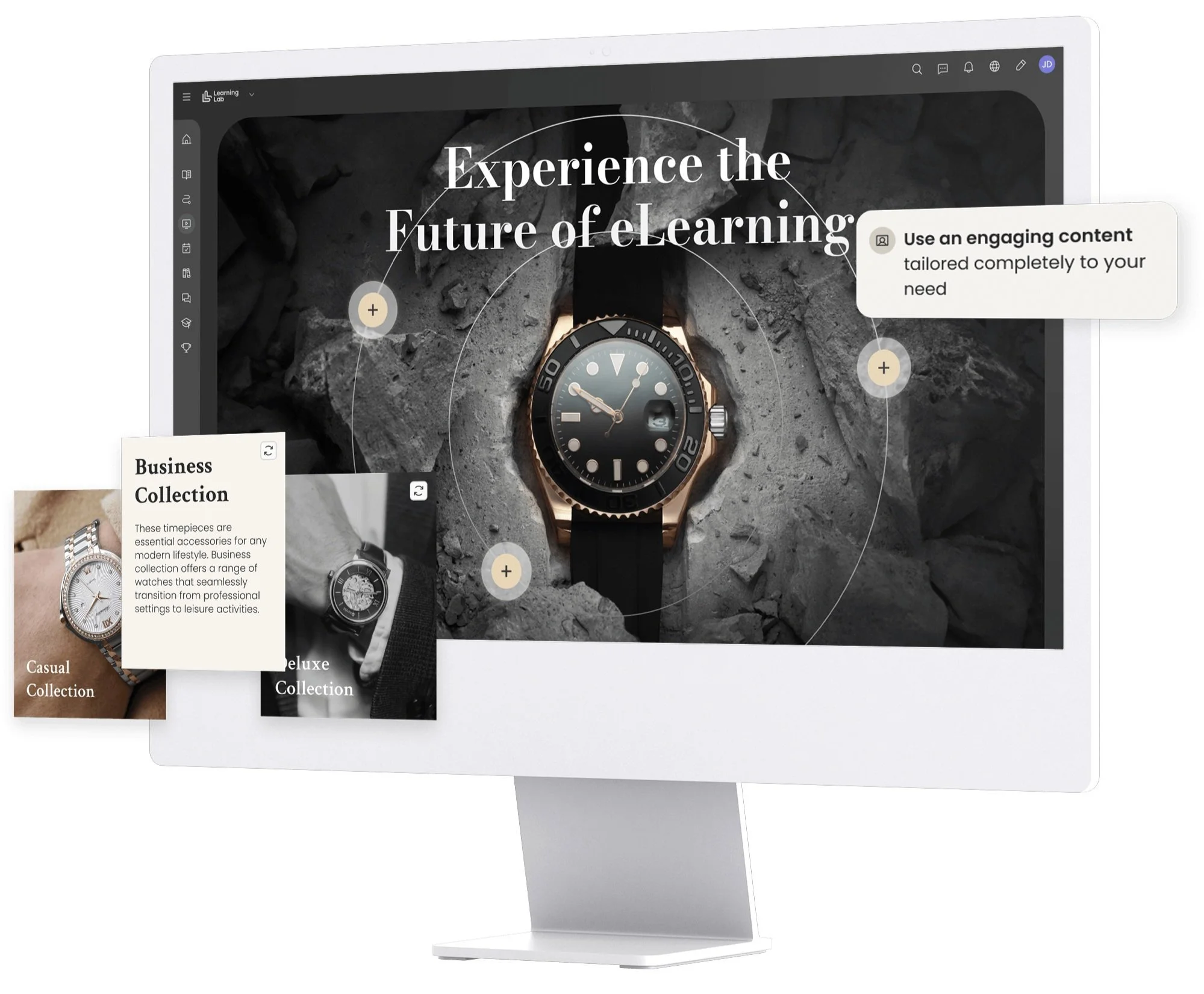
Chatbot trained on the House - answers on the floor, in your voice
Between two guests, the advisor does not open a binder. They ask the bot: contraindication, pairing, how this door explains the ritual.
Answers come from the House library, not from the open web your protocols, your words, your “what not to say.” Support on the floor. Not a second author. Not a tone the Maison would not sign.
- Trained only on approved knowledge: product, policy, ritual
- Voice and register of the brand
- Instant on the phone, between two clients
- Pairing, talk track, “what we never claim”
- No open-web improvisation
- Fewer tickets to HQ for the same question
- Guide to the right module when a chat is not enough
- Always on — still on-brand
Adaptive learning - the path bends to the person
A receptionist, a therapist and a longevity advisor do not need the same module.
A Zurich door and a Milan door do not need the same examples. The path follows the role, the boutique, the language of the floor and the questions the person still misses. What is already known falls away. What fails comes back in a shorter card, on the same ritual, until the standard holds.
- Role first: not one catalogue for the whole network
- Door and market: local examples, same House
- Language of the floor, not only HQ English
- Gaps drive the next card — not the calendar alone
- Mastered content drops out of the way
- Failed steps return shorter, on the same ritual
- Standard stays one; the route becomes theirs
- HQ sees where the network is weak, by role and by door
The Learning Lab - the AI-powered LMS that leads retail training
Retail training is won on the floor, between two clients, in the codes of the Maison.
Generic platforms deliver a catalogue and a completion rate. The Learning Lab leads because it is built as a boutique: the House on the first screen, a no-code studio where AI drafts and the expert publishes, video that trains the gesture, paths that bend to role and door, a chatbot that answers in the brand’s voice, translation at launch speed with a human last look. InstaLearn opens a nano card; the agent manages the journey; you keep the Maison.
One product LMS, authoring, storytelling, community — and the operation behind it. Designed for retail, crafted for brands, powered by AI. That is why it leads: not more modules, but training that still looks like the store it serves.