

8 Authoring Tool features for a Fashion-First LMS
8 Authoring Tool features for a Fashion-First LMS: Designing Learning Like a Brand Experience
In fashion retail, learning is no longer a support function, it is a daily performance tool that must reflect the same standards as the brand itself.
Training needs to be visual, emotional, mobile, and instantly applicable on the shop floor. Modern eLearning trends confirm this shift toward AI-powered, immersive, and highly personalized learning experiences, combined with strong human and brand connection .
A fashion-first LMS therefore requires authoring tools that go beyond content creation—they must enable teams to design experiences that look, feel, and perform like the brand.
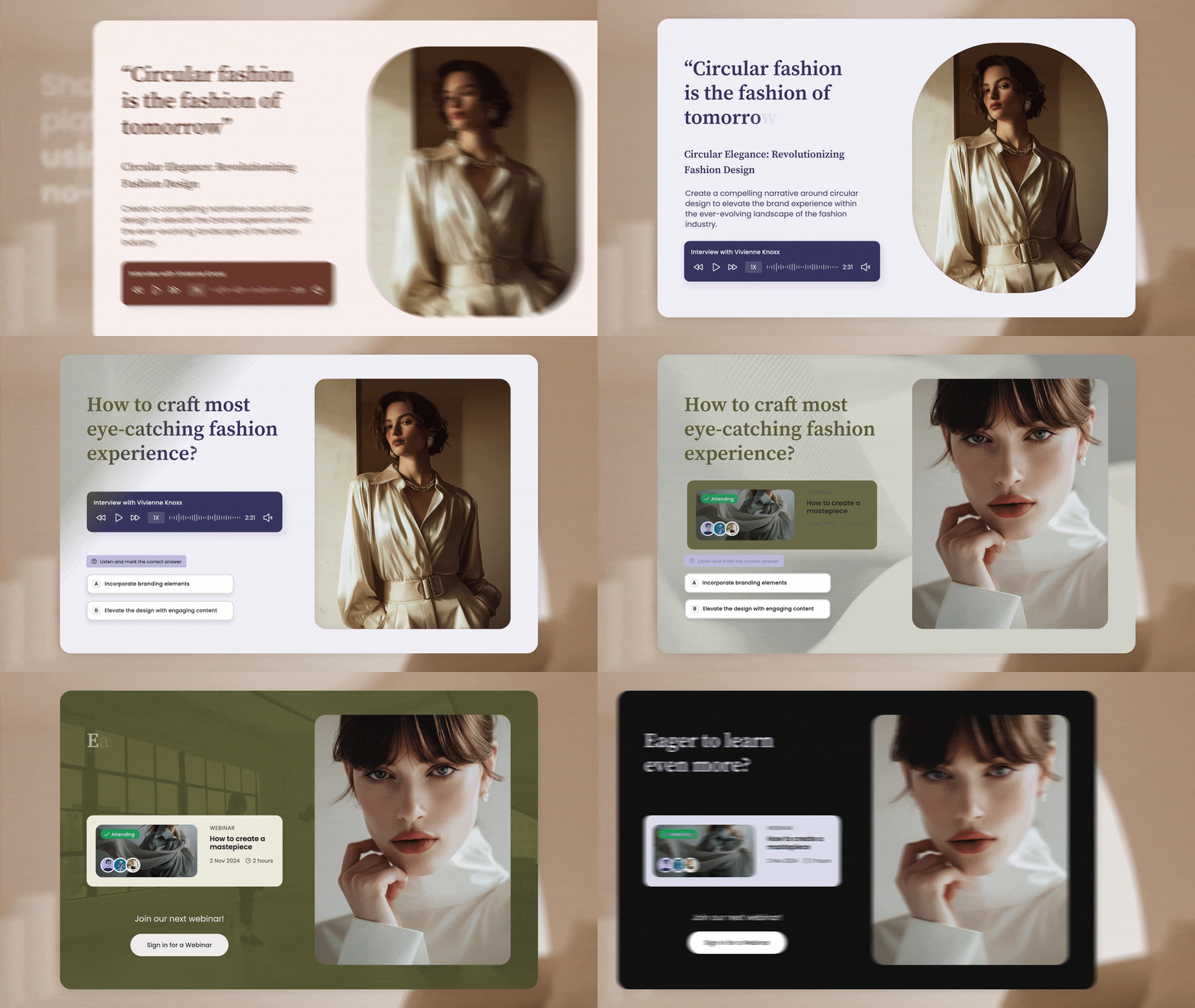
1. Brand-Customizable Layout Builder for Fashion Training
In fashion retail, every detail contributes to brand perception including training.
A brand-customizable layout builder allows learning teams to design courses with the same precision and aesthetic standards as their campaigns or websites. Instead of adapting to rigid templates, teams can define their own layouts, control spacing, apply brand typography, and structure content visually to reflect their identity. This level of creative freedom transforms learning from a generic experience into a fully branded environment, where every module feels consistent with the brand universe and reinforces its positioning.
Why It Matters
Brand consistency across all touchpoints
Training reflects the same visual identity as stores, campaigns, and digital platforms
Stronger brand immersion for learners
Sales teams absorb not just knowledge, but the look and feel of the brand
Increased credibility and perceived quality
Well-designed content builds trust and engagement
Creative freedom for learning teams
No dependency on fixed templates—full control over layout and structure
Alignment with customer experience
Learning mirrors the experience delivered to clients in-store
Fashion brands need full control over their visual identity. Authoring tools should allow teams to design courses like websites—choosing layouts, spacing, typography, and visual hierarchy.
2. Visual Storytelling & Editorial Design
In fashion training, content should inspire as much as it informs.
Visual storytelling and editorial design bring learning closer to the world of campaigns, lookbooks, and magazines—where products are not just presented, but staged, contextualised, and emotionally charged.
By using immersive layouts, strong imagery, and narrative flow, training modules become experiences that reflect the brand’s universe. This approach helps learners understand not only what to sell, but how to express it—translating collections into stories that resonate with clients on the shop floor.
Key Benefits
Stronger emotional engagement
Learners connect with the brand through visuals and storytelling
Better understanding of collections
Products are contextualised within themes, styles, and moods
Higher retention
Narrative-driven content is easier to remember than static information
Alignment with brand communication
Training mirrors campaigns, lookbooks, and in-store storytelling
Elevated learning experience
Moves beyond functional training to a premium, inspiring format
👉 Why it matters: Fashion learning becomes inspirational, not just informational—driving engagement and retention
3. Interactive Video & Styling Demonstrations
In fashion training, seeing is essential but interacting is what drives learning. Interactive video transforms traditional content into an immersive experience where learners actively engage with styling techniques, product details, and service posture.
By embedding hotspots, quizzes, and decision points directly into videos, sales advisors are no longer passive viewers—they are invited to observe, think, and act.
Whether it’s choosing the right styling option, identifying key product features, or reacting to a client scenario, this format brings training closer to real-life situations on the shop floor and reinforces both confidence and retention.
Key Benefits
Active learning through interaction
Learners engage with content via decisions, questions, and exploration
Better retention of styling and product knowledge
Visual + interactive formats improve memory and understanding
Real-life application
Simulates client interactions, styling choices, and selling situations
Stronger engagement
Keeps attention higher than traditional video formats
Immediate feedback and reinforcement
Learners understand instantly if their choices are correct and why
👉 Result: Moves learning from passive viewing to active practice, closer to real store realities

4. Scenario-Based Learning (Styling & Selling)
In fashion retail, performance happens in the moment—face to face with the client.
Scenario-based learning recreates these moments through realistic simulations, allowing sales advisors to practice styling, clienteling, and upselling in a safe environment.
By presenting learners with real-life situations different client profiles, needs, objections, or styling requests—and asking them to make decisions, this approach builds both confidence and judgment. It goes beyond theory, helping teams internalise how to translate brand identity into concrete actions on the shop floor.
Key Benefits
Real-life practice without risk
Learners can experiment with different approaches in simulated client interactions
Improved decision-making skills
Develops the ability to adapt styling and selling strategies to each client
Stronger confidence on the shop floor
Repetition of scenarios prepares teams for real situations
Better understanding of client needs
Encourages empathy and personalised recommendations
Direct impact on sales performance
Reinforces upselling, cross-selling, and storytelling techniques
👉 Benefit: Strengthens confidence and decision-making on the shop floor
5. AI-Assisted Content Creation (Human-Led)
AI is a powerful accelerator in content creation but in fashion training, it must remain an assistant, not the author.
Used correctly, AI can generate first drafts, structure courses, suggest quizzes, analyse content gaps, and support localisation, allowing learning teams to move faster and scale production.
However, the essence of fashion brand voice, storytelling, emotion, and nuance must always be defined and validated by humans. This hybrid approach ensures efficiency without compromising the authenticity and creative direction that make fashion learning impactful and aligned with the brand universe.
Key Benefits
Faster content production
AI supports drafting, structuring, and updating learning materials
Improved consistency and scalability
Standardises formats and supports global deployment
Data-driven optimisation
AI helps identify gaps, suggest improvements, and analyse performance
Support for multilingual content
Accelerates translation and adaptation across markets
Full human control over brand and storytelling
Ensures tone, emotion, and identity remain authentic
👉 Insight: AI accelerates production, but storytelling and brand voice remain human-led
6. Multilingual & Localisation Engine for Fashion Training
In global fashion brands, training must travel fast without losing its meaning.
A multilingual and localisation engine powered by AI allows learning teams to instantly translate content across markets, while human proofreading ensures accuracy, cultural relevance, and brand consistency.
This hybrid approach combines speed and control: AI handles first-pass translation and updates at scale, while local experts refine tone, terminology, and nuances to match each market. The result is training that feels both globally aligned and locally authentic essential in an industry where details, language, and cultural codes matter.
Key Benefits
Instant global deployment
Translate and launch training across multiple markets in minutes
Brand-consistent language
Human validation preserves tone, vocabulary, and storytelling
Cultural relevance
Content is adapted to local markets, not just translated
Efficient updates across languages
Changes can be rolled out simultaneously worldwide
Reduced time and cost
Combines AI speed with targeted human intervention
👉 Outcome: Global consistency with local relevance—essential for international fashion brands

7. Mobile-First Nano and Microlearning Builder
In fashion retail, time is limited and learning must adapt to the rhythm of the store.
A mobile-first microlearning builder enables teams to create short, focused modules typically 2 to 5 minutes—designed for quick consumption between client interactions or during quiet moments on the shop floor.
Optimised for smartphones, these formats deliver essential knowledge in a concise and visually engaging way, making learning easy to access, repeat, and apply immediately. This approach turns training into a daily habit rather than a scheduled task.
Key Benefits
Fits into real store routines
Short modules can be completed during downtime without disrupting sales
Higher engagement and completion rates
Bite-sized content is easier to consume and finish
Immediate application on the shop floor
Learners can quickly apply what they’ve just learned
Optimised for mobile experience
Designed specifically for smartphones, not adapted from desktop
Encourages continuous learning habits
Frequent, short sessions improve retention and consistency
👉 Impact: Fits into daily retail routines and improves engagement in time-constrained environments
8. Design Formatting & Responsive Preview
In fashion training, design quality cannot stop at content creation it must extend to how content behaves on every screen.
An authoring tool with desktop, tablet, and mobile preview allows learning teams to design, test, and validate each module across devices before publication, ensuring a seamless learner experience everywhere.
With responsive layouts that adapt automatically, combined with advanced formatting options such as CSS styling, precise image and video formatting, and layout controls, teams can create polished, highly branded modules that remain visually consistent across screen sizes. This is essential in fashion retail, where aesthetics, clarity, and brand coherence are part of the learning experience itself.
Key Benefits
Responsive design across all devices
Content adapts automatically to desktop, tablet, and mobile screens
Preview before publishing
Teams can validate the learner experience on every format in advance
Professional visual consistency
Layouts, media, and spacing remain polished across devices
Advanced brand control
CSS styling and formatting options allow precise alignment with brand standards
Better learner experience
Clean, well-structured modules improve readability, navigation, and engagement
👉 Impact: Ensures every training module looks polished, works smoothly, and stays fully on-brand—whatever the device.
Conclusion: 8 Authoring Tool features for a Fashion-First LMS: Designing Learning Like a Brand Experience
Designing training for fashion is not about delivering information it is about transmitting a universe.
From visual storytelling to mobile microlearning, from AI-assisted workflows to fully branded layouts, the right authoring tools enable learning teams to create experiences that reflect the same standards as their collections, campaigns, and in-store journeys. When learning is designed with this level of care, it becomes more than training it becomes a daily performance driver, shaping how teams think, feel, and interact with clients.
This is exactly the vision behind The Learning Lab. Over the years, the platform has been built in close collaboration with fashion and luxury brands to deliver one of the most powerful authoring tools dedicated to the sector. Combining full design freedom, AI-assisted capabilities, advanced localisation, and mobile-first experiences, it allows brands to create learning that is not only efficient—but fully aligned with their identity.
Because in fashion, excellence is in the details—and training should be no exception.