

Turning Brand DNA into Training Experiences in Food & Beverage
Why Food & Beverage Brands Need a Dedicated Training Platform
Food & beverage brands operate in one of the most experience-driven industries, where every detail from service style to product knowledge directly impacts customer satisfaction and loyalty.
Yet, many still rely on fragmented or generic training tools that fail to capture the essence of their brand. A dedicated training platform allows F&B brands to deliver consistent, immersive, and scalable learning experiences aligned with their identity, standards, and operations.
It enables teams to not only understand processes, but to embody the brand’s culture, storytelling, and service philosophy.
By centralizing training, improving onboarding speed, and ensuring consistency across locations, a specialized platform becomes a key driver of performance, customer experience, and long-term growth.

What Is Brand DNA in Food & Beverage? Defining Identity, Experience, and Product Philosophy
In the food & beverage industry, brand DNA is what defines how a concept is perceived, experienced, and remembered.
It goes far beyond a logo or menu it is the combination of identity, service experience, and product philosophy that shapes every interaction with the customer.
From the positioning of the brand to the ambiance of the venue and the origin of ingredients, every detail contributes to a cohesive and distinctive universe.
Understanding and translating this restaurant brand identity into training is essential to ensure consistency, engagement, and excellence across all locations. Whether it’s a fine dining restaurant, a fast casual concept, or a luxury hospitality brand, the DNA must be clearly defined and consistently delivered.
Key Components of Brand DNA in Hospitality:
Identity (Concept, Values, Positioning)
Define what the brand stands for—its vision, target audience, and market positioning.
Experience (Service Style, Ambiance, Tone)
Shape how customers feel through service rituals, atmosphere, and communication style.
Product Philosophy (Ingredients, Sourcing, Craftsmanship)
Highlight the origin, quality, and preparation of products as a core part of the brand story.
Examples:
Fine Dining → precision, elegance, storytelling, high-touch service
Fast Casual → efficiency, accessibility, simplicity, consistency
Luxury Hospitality → emotion, personalization, excellence, immersive experience
The Problem with Traditional F&B Training: When Operations Replace Experience
Traditional food & beverage training often focuses heavily on processes menus, procedures, and service steps while overlooking what truly defines the brand: the experience.
This operational approach may ensure basic execution, but it fails to create emotional connection, storytelling, and consistency across teams.
As a result, even with the same menu and guidelines, the customer experience can vary significantly from one location to another.
In a highly competitive and experience-driven industry, this gap becomes a critical weakness, making it difficult for brands to scale while maintaining their identity and standards.
Key Challenges of Traditional F&B Training:
Too Operational (Process-Driven)
Focus on procedures rather than brand experience and storytelling.
Lack of Emotional Connection
Training does not convey the feeling, atmosphere, or brand universe.
Inconsistent Customer Experience
Different teams deliver different experiences despite the same standards.
Difficult to Scale Across Locations
Hard to maintain quality and consistency in multi-site or global operations.
“Same Menu, Different Experience” Problem
Without brand-driven training, execution varies and weakens brand perception.
Why Training Must Reflect Brand Experience: Aligning Teams with the True Essence of the Brand
In food & beverage, training is more than knowledge transfer it is the first moment where employees truly experience and understand the brand from the inside.
As the first internal brand touchpoint, training sets the tone for how teams will think, act, and interact with customers. When aligned with the brand experience, it empowers employees to become true ambassadors, capable of delivering consistent, authentic, and memorable moments. In an industry where customer perception is everything, ensuring consistency across teams and locations is essential to building trust, loyalty, and long-term success.
Key Reasons Why Brand-Driven Training Matters:
Training as the First Brand Touchpoint
Introduce employees to the brand’s identity, values, and experience from day one.
Employees as Brand Ambassadors
Equip teams to embody the brand in every interaction, not just follow procedures.
Consistency Drives Customer Satisfaction
Deliver the same level of experience across all locations and touchpoints.
Stronger Emotional Connection
Help teams understand not just what to do, but how to make customers feel.
Aligned Behavior Across Teams
Ensure service style, tone, and rituals are consistent everywhere.
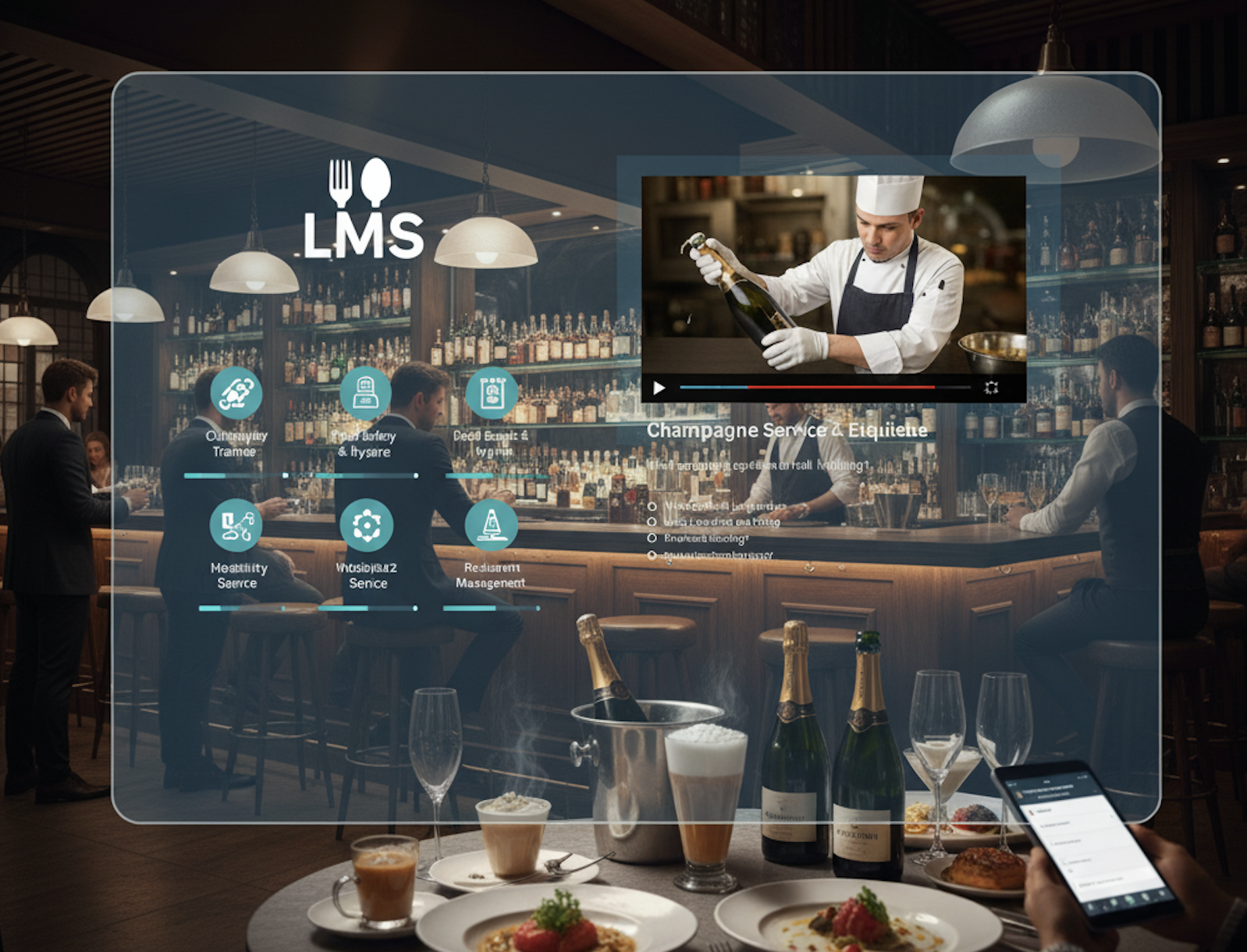
From Brand DNA to Sensory Learning: Bringing Food & Beverage Training to Life
In Food & Beverage, brand DNA is not just a concept it’s an experience.
From the lighting of a fine dining restaurant to the rhythm of service in a fast-casual concept, every detail shapes customer perception.
Training should reflect that same sensory richness. By leveraging visual and immersive formats images, video, sound, and ambiance brands can recreate their unique atmosphere within the learning journey.
This approach transforms training from operational instruction into an emotional, memorable experience, enabling teams to truly embody the brand on the floor. When employees don’t just learn the brand but feel it, consistency, engagement, and performance naturally follow.
Resume with bullet points
Recreate the Brand Environment
Use high-quality visuals and videos to mirror the restaurant’s atmosphere—lighting, table setup, staff posture, and service flow.
Leverage Immersive Video Content
Integrate real-life service scenarios, kitchen moments, and customer interactions to place learners inside the experience.
Engage Multiple Senses
Combine visuals, sound, and storytelling to simulate ambiance—background noise, tone of voice, and pacing of service.
Train Beyond Processes
Move from “how to serve” to “how it should feel”—capturing emotion, energy, and brand personality.
Ensure Consistency Across Locations
Standardize the brand experience globally by showing exactly what “good” looks and feels like.
Increase Engagement & Retention
Sensory-driven learning boosts memory and emotional connection, leading to better on-the-job execution.
Turn Employees into Brand Ambassadors
When teams experience the brand during training, they naturally replicate it with customers.
From Ingredients to Emotion: Crafting Brand Experience Through Storytelling in Food & Beverage Training
In Food & Beverage, every product carries a story where ingredients come from, the inspiration behind a dish, the philosophy of the chef or brand.
Yet too often, training reduces this richness to facts and procedures. By embedding storytelling and product narratives into training, brands can transform knowledge into meaning.
When learners understand the why behind a recipe, the origin of ingredients, and the vision driving the menu, they don’t just serve they connect, recommend, and elevate the customer experience.
Story-driven training turns teams into authentic storytellers, capable of translating brand DNA into memorable moments at the table.
Resume with bullet points
Bring Ingredients to Life
Highlight sourcing, terroir, and craftsmanship to create emotional value beyond the product itself.
Share the Chef’s Vision
Explain the inspiration, creativity, and intention behind dishes to give depth to every plate.
Embed Brand Philosophy
Connect products to the brand’s values, positioning, and identity for a consistent narrative.
Move from Information to Emotion
Replace static descriptions with stories that engage, inspire, and are easy to remember.
Empower Authentic Recommendations
Equip staff with meaningful narratives that enhance upselling and customer interaction.
Create Consistent Storytelling Across Locations
Ensure every team delivers the same brand story, regardless of geography.
Increase Engagement & Retention
Stories are easier to recall than facts, improving long-term knowledge retention and on-floor performance.
Turn Teams into Brand Storytellers
Employees become ambassadors who don’t just present products—they share experiences.

From Service Situations to Brand Moments: Scenario-Based Training in Food & Beverage
In Food & Beverage, excellence is defined in the moment how a server reacts to a complaint, suggests a pairing, or adapts their tone to the guest.
These situations can’t be mastered through theory alone. Scenario-based training brings real customer interactions into the learning experience, allowing teams to practice decisions in context.
By simulating service moments handling complaints, upselling with subtlety, or adjusting communication style employees learn not just what to do, but how to do it in alignment with the brand. This approach builds confidence, sharpens instincts, and ensures that every interaction reflects the desired experience.
Resume with bullet points
Simulate Real Customer Interactions
Recreate everyday service situations to train teams in realistic, high-impact moments.
Master Complaint Handling
Teach how to respond with empathy, professionalism, and brand-appropriate tone under pressure.
Refine Upselling Techniques
Practice suggesting products or pairings naturally, without breaking the customer experience.
Train Service Tone & Behavior
Adapt communication style to match the brand—whether luxury, casual, or experiential.
Develop Decision-Making Skills
Allow learners to explore choices and consequences in a safe environment.
Ensure Consistency Across Teams
Standardize best practices while leaving room for authentic human interaction.
Boost Confidence on the Floor
Employees feel prepared for real situations, reducing stress and hesitation.
Turn Interactions into Memorable Experiences
Equip teams to transform everyday service moments into brand-defining touchpoints.
From Teams to Culture: Activating Social Learning in Food & Beverage Training
In Food & Beverage, culture is lived on the floor not written in manuals.
The way teams interact, share tips, and celebrate great service defines the true brand experience. Social learning transforms training into a collective dynamic, where employees learn from each other as much as from formal content.
By encouraging the sharing of best practices, real service stories, and peer feedback, brands can build a strong internal culture that reflects their identity.
This approach creates alignment, boosts engagement, and turns every team member into an active contributor to the brand experience.
Resume with bullet points
Encourage Best Practice Sharing
Enable teams to exchange tips, service techniques, and success stories from the floor.
Build a Living Learning Culture
Move beyond static training to continuous, peer-driven learning experiences.
Strengthen Team Alignment
Ensure everyone understands and embodies the same service standards and brand values.
Leverage Real Experiences
Use authentic situations from different locations to enrich learning and relevance.
Foster Engagement & Motivation
Create a sense of belonging through interaction, recognition, and shared achievements.
Break Silos Across Locations
Connect teams globally to share insights and elevate overall performance.
Reinforce Brand Identity Daily
Culture becomes visible through everyday behaviors, not just training modules.
Turn Employees into Culture Ambassadors
Empower teams to actively shape and carry the brand’s spirit across every interaction.
Beyond Content: The Role of Technology in Branded Food & Beverage Training
Technology should not be invisible in Food & Beverage training it should elevate the brand experience.
A modern LMS is no longer just a place to store content; it becomes a true experience platform where design, storytelling, and functionality come together to reflect the brand’s identity.
With a boutique, fully customisable LMS and an integrated authoring tool, training can be crafted with the same care as a restaurant concept visually, emotionally, and operationally aligned.
The result is a seamless learning journey that mirrors the brand experience, engages frontline teams, and scales consistently across locations. For brands searching for an LMS for food and beverage training, the difference lies in choosing a platform that doesn’t just deliver content—but brings the brand to life.
Resume with bullet points
LMS as an Experience Platform
Move beyond content storage to create immersive, brand-driven learning environments.
Fully Branded Learning Experience
Customize every detail—colors, typography, layouts—to reflect the restaurant or hospitality identity.
Integrated Authoring Tool
Design and update content directly within the platform, ensuring speed, consistency, and creative control.
Boutique LMS Approach
Prioritize design, flexibility, and brand alignment over generic, one-size-fits-all systems.
Video Learning at the Core
Use immersive video formats to replicate service moments, ambiance, and real-life scenarios.
Microlearning for Frontline Teams
Deliver short, impactful modules adapted to the pace of restaurant environments.
Multilingual Capabilities
Train diverse teams across locations with seamless translation and localized content.
Scalable & Consistent Deployment
Ensure every location delivers the same brand experience, supported by centralized yet flexible technology.
Drive Engagement & Performance
Combine design, storytelling, and technology to boost retention, consistency, and service excellence.

From Training to Performance: The Business Impact of Brand-Driven Learning in Food & Beverage
Brand-driven training is not just about learning it’s a direct lever for business performance.
When training reflects the brand experience, employees engage more, retain knowledge longer, and execute with greater consistency on the floor.
This translates into measurable outcomes: stronger customer satisfaction, more confident upselling, and increased revenue per interaction.
By aligning training with real business KPIs—such as NPS, sales per staff, and consistency across locations Food & Beverage brands can turn learning into a strategic growth driver, not a cost center.
Resume with bullet points
Boost Engagement (+20–35%)
Immersive, brand-aligned content drives higher participation and repeated usage.
Increase Knowledge Retention (+25–60%)
Emotional and experiential learning improves long-term memory and application on the job.
Enhance Customer Experience
Consistent service quality leads to more memorable and satisfying guest interactions.
Drive Upselling & Revenue Growth
Well-trained teams recommend with confidence, increasing average ticket size.
Improve NPS (Net Promoter Score)
Better service and brand consistency directly impact customer loyalty and advocacy.
Increase Sales per Staff Member
Empowered employees perform better, translating training into measurable sales impact.
Ensure Consistency Across Locations
Standardized yet experiential training guarantees the same brand experience everywhere.
Connect Learning to Business KPIs
Track performance through clear metrics to demonstrate ROI and continuously optimize training.
Why The Learning Lab Is Built for Food & Beverage Brands
Food & Beverage brands don’t just deliver products they deliver experiences.
The Learning Lab is designed with that reality at its core. As a retail-first, boutique LMS, it goes beyond traditional training platforms to create fully branded, immersive learning environments that reflect the identity, ambiance, and standards of each concept.
Combined with a creative studio specialised in video and storytelling, and a mobile-first nanolearning approach tailored for frontline teams, The Learning Lab enables F&B brands to transform training into a true extension of their customer experience. It’s not just about learning—it’s about bringing your brand to life at scale.
Resume with bullet points
Retail-First LMS Architecture
Built specifically for frontline environments, aligning training with real service moments and operational realities.
Fully Branded Learning Environments
Every detail—from interface to content design—reflects your restaurant or hospitality identity.
Integrated Creative Studio
Expertise in video, storytelling, and immersive content to translate brand DNA into training experiences.
Mobile-First & Microlearning Approach
Short, impactful formats designed for teams on the floor—accessible anytime, anywhere.
Boutique LMS Philosophy
A premium, flexible solution focused on design, experience, and brand alignment—not generic templates.
Designed for Consistency at Scale
Deliver the same brand experience across all locations while adapting to local needs.
From Training to Experience
Turn learning into a strategic tool that directly impacts service quality, engagement, and revenue.
The Future of Food & Beverage Training: From Learning to Living the Experience
The future of Food & Beverage training is no longer about delivering content it’s about delivering experiences in real time.
As brands evolve, training must become more immersive, adaptive, and seamlessly integrated into daily operations. Experience-driven learning, powered by the balance of AI and human storytelling, allows teams to access the right knowledge at the right moment on the floor, with customers.
This new model transforms training into a continuous, living system where employees don’t pause to learn—they learn as they perform. The result is faster onboarding, stronger brand consistency, and a service experience that continuously improves.
Resume with bullet points
Experience-Driven Learning
Shift from static modules to immersive, brand-aligned experiences that reflect real service moments.
AI + Human Storytelling
Combine AI efficiency (personalization, recommendations) with human creativity to preserve brand voice and emotion.
Real-Time Learning on the Floor
Enable instant access to training during service—product info, scenarios, or quick refreshers.
Adaptive & Personalized Journeys
Deliver the right content based on role, performance, and context.
Continuous Learning Culture
Move from one-time training to ongoing, evolving learning embedded in daily operations.
Faster Time to Competency
Equip teams to perform confidently in less time through contextual and practical learning.
Stronger Brand Consistency
Ensure every interaction reflects the brand, supported by always-available guidance.
From Training to Performance Support
Transform the LMS into a daily tool that supports action, not just knowledge acquisition.
Conclusion Training as a Brand Experience
Training in Food & Beverage should never feel disconnected from the brand—it should be its natural extension.
Every module, every interaction, every piece of content must reflect the same identity, emotion, and standards delivered to guests.
Moving beyond purely operational training, the future lies in creating learning experiences that are immersive, sensory, and aligned with the brand’s DNA. When training becomes emotional and experiential, teams don’t just learn processes—they embody the brand.