

12 Essential LMS Features for Luxury Hospitality Training
Designing Excellence: The Essential LMS Features for Luxury Hospitality Training
In luxury hospitality, training is not just about transmitting standards it’s about shaping behaviors, emotions, and the art of service.
Designing an LMS for this environment requires more than functionality; it demands a platform capable of reflecting the brand’s identity while delivering immersive, experience-driven learning.
From mobile-first nanolearning that fits seamlessly into daily operations, to video-led storytelling, scenario-based training, and real-time performance insights, every feature must contribute to consistency, excellence, and emotional engagement.
The right LMS empowers teams to move beyond procedures and embody the brand at every guest interaction — turning training into a strategic driver of service excellence and unforgettable experiences.

1. Your LMS as a Brand Experience: Fully Branded & White-Label by Design
In luxury hospitality, every detail expresses the brand and training should be no exception.
A fully branded, white-label LMS ensures that the learning environment reflects the same level of elegance, identity, and consistency as the guest experience itself.
From custom layouts and refined visuals to tone of voice and storytelling, the platform becomes a seamless extension of the Maison.
Instead of a generic corporate tool, teams engage with a space that feels familiar, aspirational, and aligned with the brand they represent reinforcing culture, pride, and attention to detail at every step.
Why it matters (with impact data):
+30–50% higher engagement when learning environments reflect brand identity and visual standards
Up to 40% better retention with immersive, emotionally aligned learning experiences
Stronger brand alignment across teams, reducing inconsistencies in service delivery
Higher adoption rates when the platform feels intuitive and visually connected to daily operations
Improved employee pride & belonging, key drivers of retention in luxury environments
A branded LMS doesn’t just train it reinforces the brand internally, ensuring every employee delivers a consistent, elevated guest experience.
2. Bringing Service to Life: Video-First & Storytelling Capabilities
In luxury hospitality, excellence is learned through observation, emotion, and nuance not just instructions.
A video-first LMS enables brands to capture and transmit the true essence of service through high-quality visual content: from service rituals and guest interactions to behind-the-scenes expertise shared by chefs, general managers, and concierges.
Storytelling transforms training into an immersive experience, allowing teams to understand not only what to do, but how it should feel. This approach elevates learning from procedural to experiential — where emotion, tone, and detail define excellence.
Why it matters (with impact data):
+75% higher engagement with video-based learning vs. text-only formats
Up to 60% better knowledge retention through visual and narrative learning
+20–35% improvement in service consistency when behaviors are demonstrated, not described
Faster onboarding with realistic scenarios that accelerate understanding of expectations
Stronger emotional connection to the brand, driven by authentic stories and expert voices
In hospitality, it’s not just about knowing the standards — it’s about feeling them and bringing them to life in every guest interaction.
3. Training Real Moments: Scenario-Based Learning for Guest Situations
In luxury hospitality, the difference between good and exceptional service lies in how teams react in real moments.
Scenario-based learning brings these moments to life through interactive, branching experiences from welcoming a VIP guest to handling a delicate complaint or identifying the right upselling opportunity.
Instead of memorising procedures, teams are placed in realistic situations where they must make decisions, understand consequences, and refine their behavior. This approach builds confidence, judgment, and emotional intelligence — the true foundations of service excellence.
Why it matters (with impact data):
Up to 75% higher retention with active, decision-based learning vs. passive formats
Stronger decision-making skills through repeated exposure to real-life scenarios
+20–30% improvement in service quality when behaviors are practiced, not just explained
Faster readiness on the floor, reducing time-to-competence by up to 30–40%
Better handling of high-value interactions (VIP, complaints, upselling), directly impacting guest satisfaction and revenue
In hospitality, excellence is not scripted — it’s performed. Scenario-based learning ensures teams are ready for every moment that matters.

4. Learning in Motion: Mobile-First Microlearning
In luxury hospitality, time is fragmented and teams are constantly on the move. Training must adapt to this reality.
Mobile-first microlearning delivers short, focused modules that can be accessed on the floor, between shifts, or just before service without disrupting operations.
Designed in 2–5 minute formats, it enables continuous learning in the flow of work, while offline access ensures teams remain connected even in environments with limited connectivity.
The result is a seamless integration of training into daily routines, making learning consistent, practical, and immediately applicable.
Why it matters (with impact data):
+50–70% higher completion rates with short, mobile-friendly formats
Up to 40% reduction in time-to-competence through frequent, bite-sized learning
1.5–2x more repeat engagement with microlearning vs. long-form training
Faster adoption across teams, especially in fast-paced service environments
Greater accessibility for global teams, even with limited connectivity (offline mode)
In hospitality, learning must move at the same pace as service — fast, flexible, and always within reach.
5. Tailored Excellence: AI-Powered Personalisation
In luxury hospitality, every role carries its own standards, rhythms, and guest expectations. A one-size-fits-all approach to training simply doesn’t work.
AI-powered personalisation enables the LMS to deliver role specific learning paths whether for front desk, F&B, housekeeping, or spa teams ensuring that each employee receives the most relevant content for their function.
By adapting to performance, progress, and individual needs, the platform delivers the right content at the right moment, reinforcing strengths and addressing gaps in real time. This creates a more efficient, engaging, and impactful learning experience aligned with the realities of each role.
Why it matters (with impact data):
+35–50% increase in engagement with personalised learning paths
Up to 30% faster skill acquisition through targeted content delivery
Improved performance outcomes by focusing on individual skill gaps
Higher retention of knowledge with adaptive, relevant learning journeys
Greater employee satisfaction, as training feels tailored and meaningful
In hospitality, excellence is personal — and training should be too.
6. Elevating Talent: Certification & Recognition Systems
In luxury hospitality, excellence deserves to be seen and celebrated.
A structured certification and recognition system transforms training into a visible pathway for growth from “Service Excellence Level 1–3” to role-specific expertise across departments.
Through badges, awards, and formal recognition programs, employees are not only trained but acknowledged for their progress and mastery.
By directly linking learning achievements to career progression and promotion, the LMS becomes a powerful driver of motivation, engagement, and long-term talent development.
Why it matters (with impact data):
Up to 2x higher completion rates when certifications are tied to recognition and progression
30–40% faster readiness for promotion with structured learning milestones
+20–30% increase in engagement driven by gamification and recognition
Higher employee retention when clear career paths are visible
Stronger culture of excellence, where achievement is valued and rewarded
In hospitality, recognition is part of the experience — and it should start from within.
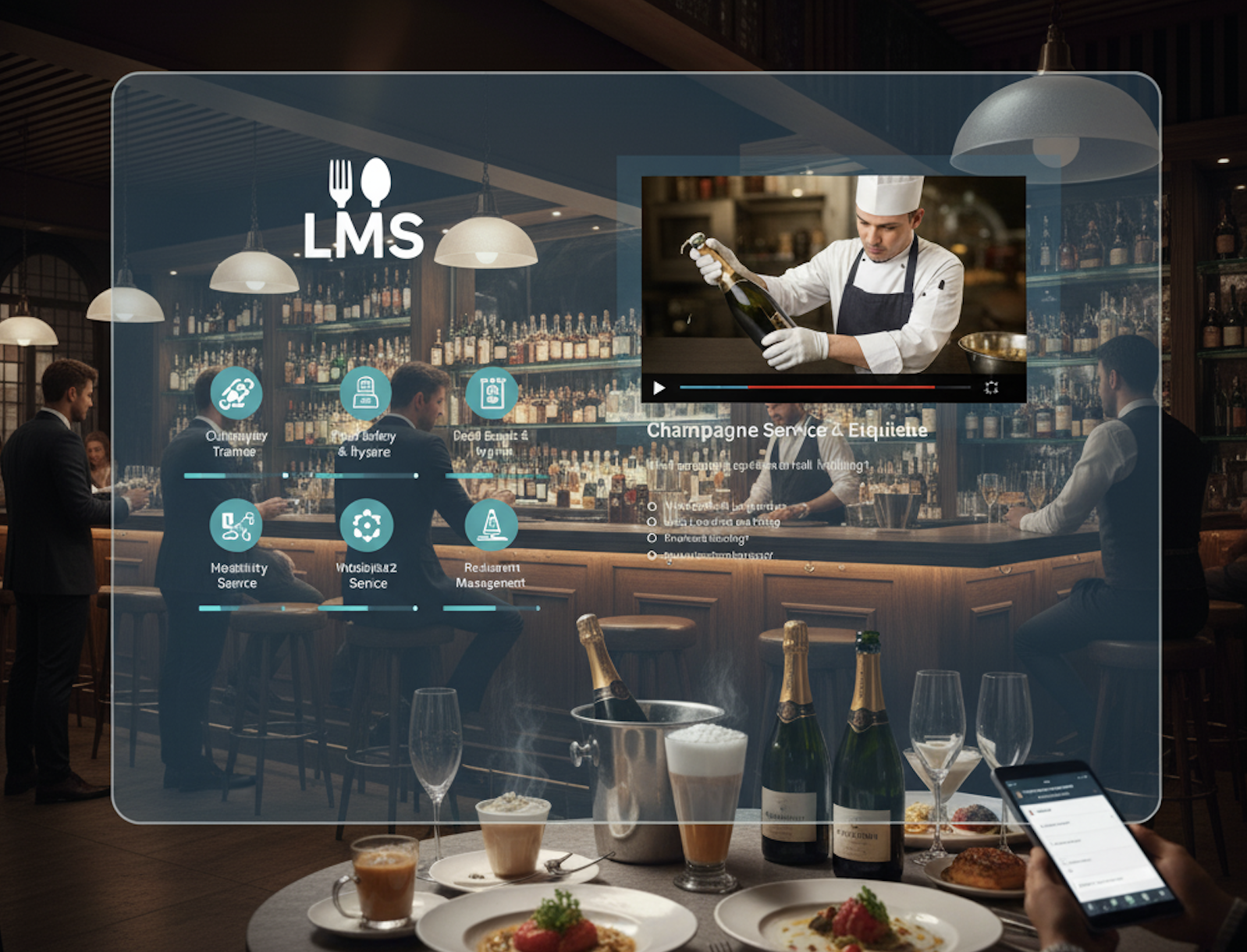
7. Managing Excellence: Real-Time Analytics for Hospitality Leaders
In luxury hospitality, maintaining consistent service across teams, shifts, and properties requires clear visibility.
Real-time analytics give managers immediate insight into training completion, engagement, and performance transforming learning data into actionable decisions.
With simple, intuitive dashboards, hotel and department managers can quickly identify skill gaps, monitor team progress, and ensure that standards are consistently upheld across every touchpoint.
This empowers leadership to move from reactive to proactive management, continuously refining service quality.
Why it matters (with impact data):
Up to 25–35% improvement in training completion with transparent tracking and accountability
Faster identification of skill gaps, enabling targeted training interventions
Up to 30% faster performance improvement with data-driven coaching
Consistent service quality across properties, reducing variability between teams
Better manager engagement, with clear, easy-to-use dashboards tailored for operations
In hospitality, what gets measured gets elevated — and real-time insights turn training into a true performance driver.
8. Global Consistency: Multilingual & Scalable Deployment
In luxury hospitality, brands operate across cultures, languages, and continents yet the guest experience must feel consistently exceptional everywhere.
A multilingual LMS enables seamless global deployment, combining automated translation with human proofreading to preserve nuance, tone, and brand integrity.
It allows training to be adapted locally while maintaining a unified standard, ensuring that every team — from Paris to Tokyo to New York delivers the same level of excellence, aligned with the Maison’s identity.
Why it matters (with impact data):
3–5x faster global rollout of training content with automated translation workflows
Up to 30% higher comprehension when learning is delivered in native language
Stronger consistency across properties, reducing service variation between regions
Faster onboarding of international teams, especially in multi-market operations
Better cultural alignment, ensuring local relevance without losing global brand standards
In global hospitality, consistency is the true luxury — and it starts with training that speaks every language, without losing the brand’s voice.
9. From Learning to Mastery: Blended Learning Integration
In luxury hospitality, true expertise is built both online and on the floor.
Blended learning seamlessly combines eLearning, onsite training, and coaching sessions to create a continuous and holistic development journey.
Digital modules introduce standards and knowledge, while in-person practice and coaching bring them to life in real service situations.
By tracking practical validation through on-the-job assessments, the LMS ensures that learning is not only completed but applied, mastered, and consistently delivered across every guest interaction.
Why it matters (with impact data):
Up to 40% higher retention with blended learning vs. digital-only training
30–40% faster time-to-competence through combined theory and practice
Stronger skill application on the floor, improving service execution
Higher engagement with a mix of digital and human interaction
More consistent service standards, validated through real-world assessments
In hospitality, excellence is practiced, not just learned — blended learning ensures teams are ready to perform at the highest level.

10. Living the Brand: Experience & Culture Modules
In luxury hospitality, service is the expression of a brand’s identity.
Training must go beyond procedures to immerse teams in the heritage, values, and philosophy that define the experience.
Dedicated culture modules bring the brand to life from its history and codes to the mapping of the full guest journey helping employees understand not just what to do, but why it matters.
This deep alignment transforms teams into true brand ambassadors, capable of delivering consistent, emotional, and memorable experiences at every touchpoint.
Why it matters (with impact data):
Up to 40% stronger retention when learning is rooted in storytelling and brand meaning
+20–35% improvement in service consistency across teams and locations
Higher employee engagement and pride, key drivers of retention in luxury environments
More authentic guest experiences, aligned with brand DNA at every interaction
Faster onboarding to brand standards, reducing time to embody service excellence
In hospitality, excellence is not just delivered — it is lived. And it starts with a deep understanding of the brand.
11. Agility at Scale: Fast Content Creation with No-Code Authoring
In luxury hospitality, standards evolve constantly new menus, seasonal concepts, service refinements, and brand initiatives must be deployed quickly and consistently across all properties.
A no-code authoring environment empowers L&D teams to create and update content in real time, without relying on technical resources.
This agility ensures that training always reflects the latest operational reality, allowing teams to stay aligned, confident, and ready to deliver at the highest level.
Why it matters (with impact data):
Up to 70% faster content deployment compared to traditional development cycles
Immediate rollout of new standards across all properties and teams
Higher training relevance, keeping content always up to date
Greater autonomy for L&D teams, reducing dependency on external support
Consistent execution across locations, even with frequent operational changes
In hospitality, timing is everything — and the ability to update training instantly is a key driver of service excellence.
12. Learning That Lives Daily: Smart Notifications & Continuous Engagement
In luxury hospitality, excellence is built through consistency every shift, every interaction, every detail.
Smart notifications and daily learning keep training active and present in the flow of work. By delivering short, timely content before shifts or key service moments, teams are continuously reminded of standards, rituals, and best practices.
This “InstaLearning” approach transforms training from a one-time event into an ongoing habit, reinforcing knowledge exactly when it matters most.
Why it matters (with impact data):
+30–50% increase in daily engagement with timely, push-based learning
1.5–2x higher retention through continuous reinforcement
Improved service consistency with just-in-time reminders before key moments
Higher adoption rates with short, accessible daily content
Stronger alignment across teams, keeping standards top of mind at all times
In hospitality, excellence is a daily practice — and training should be too.
Final Thought
A traditional LMS trains employees.
A Luxury Hospitality LMS shapes behaviors, emotions, and experiences.
👉 If it doesn’t help teams deliver a more refined, consistent, and memorable guest experience… it’s not the right platform.
Conclusion: From Training to True Service Excellence
In luxury hospitality, training is not a support function it is a strategic driver of the guest experience.
The 12 essential features outlined here all point to one core idea: learning must be immersive, continuous, and deeply aligned with the brand.
From storytelling and scenario-based learning to mobile access, real-time analytics, and daily reinforcement, the right LMS doesn’t just transfer knowledge — it shapes behaviors, elevates standards, and builds teams who embody the brand at every interaction.
This is precisely where The Learning Lab stands apart.
Designed from the ground up for premium and luxury environments, The Learning Lab is not a generic platform adapted to hospitality it is a Boutique LMS built around brand experience.
It combines fully white-labeled environments, powerful no-code authoring, video-first learning, and mobile-first microlearning to create training journeys that feel as refined as the service they aim to deliver.
What makes it unique is its ability to merge emotion and performance:
Transforming brand DNA into immersive learning experiences
Enabling fast, global deployment with full consistency
Empowering teams with daily, actionable learning moments
Supporting managers with clear, real-time insights
And connecting learning directly to engagement, recognition, and career growth
In a world where luxury is increasingly defined by experience, The Learning Lab helps hospitality brands ensure that every employee is not just trained — but inspired, aligned, and ready to deliver excellence, every day.