

Why Omnichannel Fashion Needs a Retail First LMS?
An Integrated, Fully Customizable and Brandable LMS Is The Solution
How to train store teams, ecommerce support, and managers around one customer journey instead of disconnected channels
Fashion retail has changed faster than many learning systems have. Customers now move from Instagram to ecommerce, from ecommerce to store visit, from store visit to home delivery, and from mobile browsing to return desk without thinking of those steps as different worlds. Brands like Oniverse openly describe an omnichannel future and continued investment in ecommerce and digital innovation, which shows how central this shift has become for large fashion groups.
That change creates a training challenge as much as a commercial one. If store teams, customer care, ecommerce support, and managers are still trained in separate silos, the customer feels the disconnect immediately. The Learning Lab publicly positions itself as a retail-first LMS, and that framing matters here because omnichannel training only works when the platform understands retail operations, product storytelling, and frontline execution rather than treating learning as a generic corporate process.
The real issue is not whether brands have digital tools. Most do. The issue is whether their people are learning how to create one coherent customer experience across all those touchpoints. A retail-first LMS matters because it helps brands train for continuity, speed, and consistency instead of leaving each channel to invent its own logic.
Why the customer no longer sees store and online as separate
Training teams for click and collect, returns, and assisted selling
Product knowledge across physical and digital touchpoints
How mobile learning supports omnichannel speed
Role based paths for store teams, support teams, and managers
Metrics that show readiness across channels
Why omnichannel learning needs more than a generic LMS

Why the customer no longer sees store and online as separate
The customer journey now flows across screens, stores, and services, so training has to follow that same logic.
Customers do not think in channels anymore. They think in convenience, confidence, and continuity. They may discover a product online, check size availability on mobile, visit a store to try it, order a missing variation later, and return through another touchpoint. From their perspective, it is one relationship with one brand.
That is exactly why fashion learning can no longer be divided into “store training” and “digital training” as if those were separate universes. Omnichannel strategies are not abstract anymore. Large fashion groups are openly building toward them, and that means their training model has to evolve too. Oniverse explicitly presents omnichannel development and ecommerce growth as part of its direction, which is a clear signal of how important integrated retail has become at enterprise level.
If teams are trained in silos, they will naturally protect their own area instead of serving the full journey. A store associate may not understand digital stock logic. An ecommerce support colleague may not understand what happens in the fitting room or at the cash desk. A manager may measure store behavior without seeing where digital friction starts. Omnichannel training closes that gap by teaching everyone to see the same customer across different moments.
The customer experiences one brand, not separate departments.
Channel silos create inconsistent service and weaker trust.
Omnichannel learning helps teams understand the full journey.
Fashion retail now needs shared logic across touchpoints.
The customer already lives in an omnichannel world. Training has to catch up and prepare teams to operate the same way.
Training teams for click and collect, returns, and assisted selling
Operational touchpoints become strategic touchpoints when customers move freely between digital and physical retail.
Click and collect, returns, endless aisle, home delivery from store, and assisted selling are often treated as operational details. In reality, they are moments where the brand either proves its coherence or exposes its internal fragmentation. A return handled badly can damage loyalty. A click and collect experience handled elegantly can strengthen trust. Assisted selling can turn a stock problem into a premium service moment.
That is why these journeys need structured training. Store teams should know how to handle digital orders without seeing them as interruptions. Ecommerce and service teams should understand how their communication shapes the store visit that follows. Managers should know how to coach teams on these hybrid moments, because they often define whether omnichannel feels seamless or clumsy.
The training challenge is practical. Teams need scripts, scenarios, and decision logic. They need to know what to say when a product is unavailable in store but available online. They need to know how to handle a return that began in another channel without making the customer feel they have entered the wrong system. Good omnichannel training makes those transitions feel intentional instead of improvised.
Click and collect is a service experience, not only a logistics process.
Returns are customer trust moments, not merely stock corrections.
Assisted selling protects revenue and strengthens the relationship.
Teams need scenario-based learning for hybrid retail journeys.
In omnichannel fashion, operations are part of the customer experience. Training has to teach them with the same care as product storytelling or service rituals.
Product knowledge across physical and digital touchpoints
A product story should stay consistent whether it is told on a product page, in a fitting room, or through customer support.
One of the most common omnichannel weaknesses in fashion retail is inconsistent product explanation. The website says one thing. The store says another. Customer support uses different language again. The result is confusion, reduced trust, and missed sales. If the brand promises one world to the customer, product knowledge has to support that world everywhere.
This does not mean every team needs identical training depth. It means every team needs aligned product truth. Store teams may need stronger styling and fit language. Ecommerce teams may need clearer written positioning. Support teams may need sharper knowledge about shipping, care, stock visibility, or digital ordering options. But all of them should still work from the same core understanding of what the product is, who it is for, and how it fits the brand promise.
A retail-first LMS becomes especially valuable here because it can organize shared product foundations and then extend them into channel-specific application. That approach is far stronger than creating isolated content libraries that drift apart over time. It keeps the brand message tighter and gives teams more confidence when the customer moves between channels.
Product truth should be shared even when channel roles differ.
Inconsistent product language weakens omnichannel trust.
Teams need both common foundations and channel-specific application.
Strong product knowledge supports smoother customer transitions.
Omnichannel works better when the product story stays stable, even as the customer changes channel, context, or need.
How mobile learning supports omnichannel speed
Retail teams need learning that moves at the same speed as launches, stock shifts, and customer expectations.
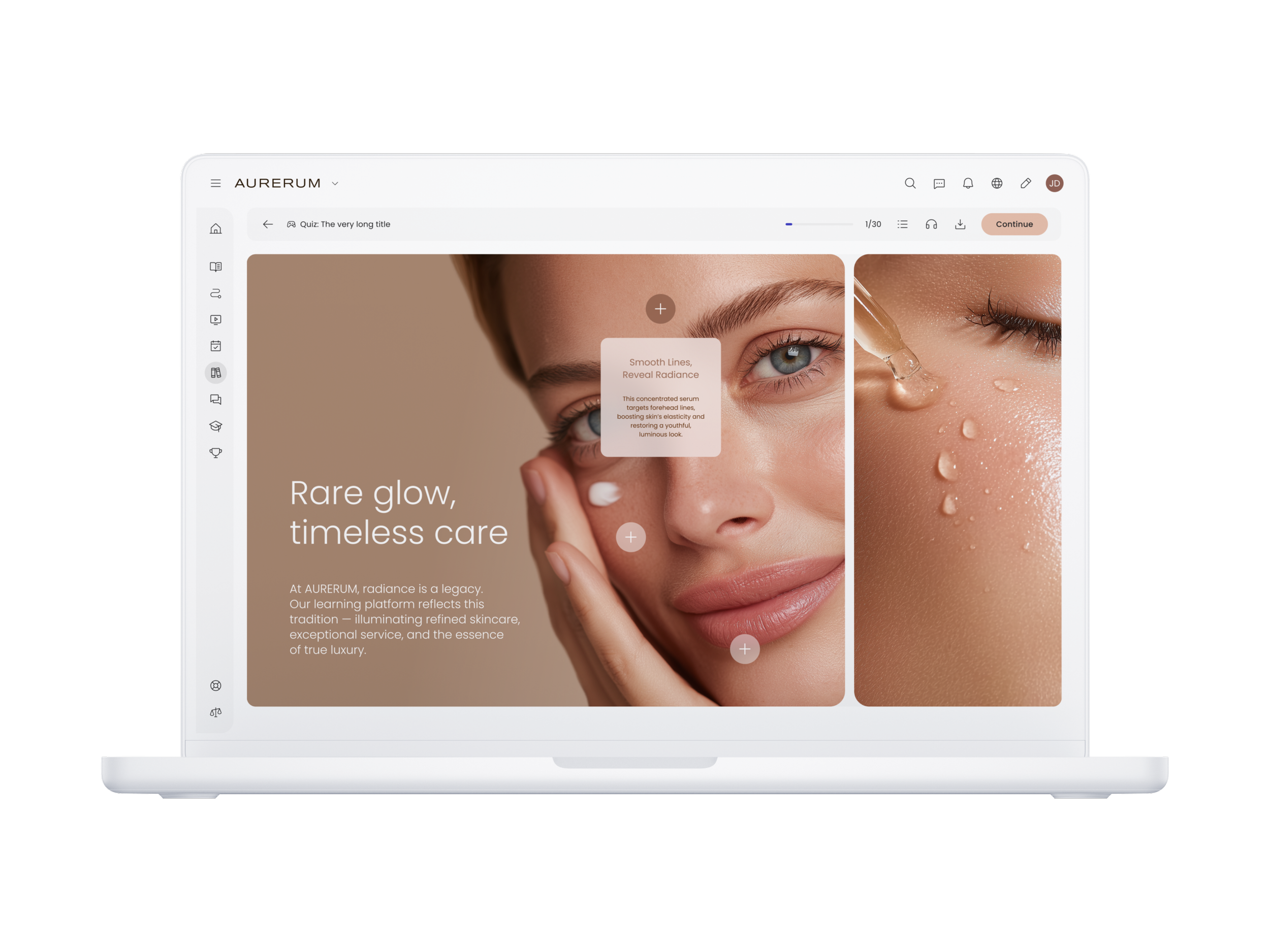
Omnichannel fashion retail creates constant motion. Products change, campaigns shift, fulfilment options evolve, and customer questions adapt quickly. That is why mobile learning matters so much. Retail learning trends published by The Learning Lab highlight mobile learning and more flexible training formats as key directions for modern retail teams.
For omnichannel environments, mobile learning is not just a format preference. It is a response to operational reality. A store associate may need a refresher on assisted ordering before a customer conversation. A manager may need a quick update on a new return flow. A support team member may need a fast module on a launch that is live online but only partially in store. If learning sits too far away from the floor, it arrives too late to help.
Mobile learning also supports adoption. Teams are much more likely to use short, accessible content in the flow of work than long, static training sessions disconnected from real customer moments. In fashion, where timing often shapes conversion, that makes speed a learning advantage as well as a commercial one.
Mobile learning fits the real pace of omnichannel retail.
Quick refreshers are more useful than delayed training in fast-moving situations.
Teams adopt learning more easily when access feels immediate.
Speed of access often improves speed of execution.
If omnichannel retail is dynamic, the learning system has to be dynamic too. Mobile access is one of the clearest ways an LMS supports that reality.
Role based paths for store teams, support teams, and managers
Omnichannel success depends on shared direction, but not on identical training for everyone.
A common mistake in enterprise learning is trying to solve omnichannel complexity with one uniform curriculum. That rarely works. Store teams, ecommerce support, customer care teams, and managers all contribute to the same journey, but they do not contribute in the same way. Each role needs different depth, different examples, and different decisions to practice.
That is why role-based learning paths are essential. A store associate may need stronger learning on assisted selling, click and collect handover, and product-based styling conversations. Ecommerce or service teams may need sharper training on order handling, customer reassurance, and how digital interactions affect store traffic. Managers need visibility into both sides so they can coach consistency rather than protect their own silo.
This is one of the clearest things enterprise retail teams should look for in an LMS. A strong system should not only host content. It should structure it intelligently by role, responsibility, and journey stage. When learning paths are clear, teams stop drowning in irrelevant content and start receiving what actually helps them perform.
Omnichannel training should be shared in purpose, not identical in content.
Role-based paths reduce overload and improve relevance.
Managers need cross-channel visibility, not only store-focused learning.
Better structure improves adoption and practical use.
The same customer journey can involve different roles, but the learning system should help them move toward one standard of service.
Metrics that show readiness across channels
Omnichannel performance improves when brands measure preparedness, not just course completion.
Completion rates are easy to track, but they do not tell a fashion brand whether its omnichannel model is actually ready. A better question is whether teams can execute the customer journey consistently across store, ecommerce, fulfilment, and support. That requires a better measurement mindset.
Readiness metrics might include launch preparedness across channels, click and collect accuracy, return flow confidence, product knowledge consistency, or the quality of assisted selling adoption. The point is not to create endless dashboards. The point is to identify whether the customer experience is likely to feel coherent before the friction appears on the floor.
Retail learning trends from The Learning Lab also point to stronger interest in more adaptive, data-informed learning approaches, which aligns well with this shift from basic activity tracking to real performance visibility. In omnichannel fashion, analytics should help leaders see where the weak spots are, which teams need reinforcement, and whether channel alignment is truly improving.
Completion is useful, but readiness is more valuable.
Omnichannel learning should be connected to execution quality.
Metrics should reveal friction before it becomes visible to the customer.
Better visibility helps managers coach more effectively.
In omnichannel retail, the real question is not whether training happened. It is whether the brand is ready to deliver one seamless experience across channels.
Why omnichannel learning needs more than a generic LMS
The complexity of modern fashion retail requires a platform designed for brand identity, frontline reality, and cross-channel execution.
A generic LMS may be able to store courses, track completion, and assign modules. But omnichannel fashion asks for much more. It asks for branded learning that reflects product world and service tone. It asks for mobile access that works in the rhythm of the store. It asks for role-based pathways, cross-channel coherence, and a design logic that supports operational execution rather than abstract compliance.
That is why a retail-first LMS matters. The Learning Lab explicitly positions itself as a retail-first LMS, and it also frames its offer around prestigious brands and retail-specific learning needs rather than a one-size-fits-all corporate model. That distinction is important because fashion brands do not only need administration. They need a platform that understands launches, merchandising, customer journeys, product stories, and frontline adoption.
A retail-first LMS is also better placed to support brand identity inside learning. In fashion, that matters more than many organizations admit. If the learning environment feels generic, teams often treat it as a task. If it feels connected to the brand and to the realities of omnichannel retail, they are more likely to use it as a tool.
Generic platforms usually manage content better than they support retail behavior.
Omnichannel fashion needs brand-aware and operations-aware learning.
Retail-first design improves relevance, adoption, and consistency.
The LMS decision is strategic because it shapes how the customer journey is taught.
Omnichannel fashion does not need more content alone. It needs a learning environment that understands how retail really works across channels, teams, and customer moments.

The modern approach to LMS through TheLearning Lab offer
One customer journey needs one learning logic, even when many teams contribute to it.
Omnichannel fashion retail only feels seamless when the learning behind it is seamless first. Store teams, ecommerce support, customer care, and managers all shape the same customer relationship, which means they cannot keep learning in isolation. The customer no longer separates store and online, so brands cannot afford to train their people as if those boundaries still define the experience.
That is why the strongest omnichannel learning models focus on the full journey. They train hybrid operational moments like click and collect, returns, and assisted selling. They align product knowledge across touchpoints. They use mobile learning to keep pace with retail reality.
They organize content by role rather than pushing the same material to everyone. They measure readiness, not only completion. Most importantly, they recognize that omnichannel retail needs more than a generic platform.
The Learning Lab is especially relevant in this conversation because it publicly positions itself as a retail-first LMS and as a solution built for brand-led retail environments.
For fashion groups trying to build one coherent customer journey across stores and digital channels, that kind of platform logic matters. It helps learning become part of omnichannel execution, not a disconnected support layer sitting somewhere behind it.
