

How Watch Brands Train Product Complexity
How Watch Brands Train Product Complexity Without Overwhelming Advisors
Luxury watches are among the most complex products sold in retail.
Behind every timepiece lies a combination of engineering, craftsmanship, heritage, innovation, and storytelling that sales advisors must be able to understand and communicate with confidence.
From mechanical movements and complications to materials, finishing techniques, and brand history, the amount of knowledge required can be overwhelming.
As collections continue to expand and new models are launched every year, watch brands face a critical challenge: how do they train retail teams to master product complexity while maintaining engagement and knowledge retention?
1. Why Product Complexity Is a Unique Challenge in Watch Retail
Luxury watches are among the most sophisticated products sold in retail.
Unlike many consumer goods, a luxury timepiece combines advanced engineering, centuries of craftsmanship, innovative materials, and powerful brand heritage within a single product.
Retail teams are expected to master hundreds of references across multiple collections, understand the differences between mechanical and quartz movements, explain complex complications such as chronographs, perpetual calendars, or tourbillons, and communicate the value of specialised materials and manufacturing techniques. At the same time, they must bring the emotional side of watchmaking to life by sharing stories about craftsmanship, innovation, history, and exclusivity.
This combination of technical expertise and emotional storytelling makes watch retail training uniquely challenging. Sales advisors must not only become product experts but also trusted storytellers capable of transforming complex information into engaging customer conversations that inspire confidence and create desire.
Key Challenges of Product Complexity in Watch Retail
Managing hundreds of references across multiple collections
Understanding mechanical, automatic, and quartz movements
Explaining watch complications in a simple and engaging way
Learning the benefits of specialized materials and manufacturing processes
Mastering brand heritage, craftsmanship, and storytelling
Adapting product presentations to different customer profiles
Keeping pace with frequent product launches and collection updates
Understanding regional market expectations and cultural differences
Building confidence when discussing highly technical products
Balancing technical expertise with emotional storytelling
Transforming product knowledge into memorable customer experiences
Maintaining consistent expertise across global retail networks
2. From Product Knowledge to Product Confidence
In luxury watch retail, memorising product specifications is only the first step.
While advisors must understand movements, complications, materials, and technical features, true expertise lies in their ability to transform that knowledge into meaningful customer conversations.
Clients are rarely interested in technical specifications alone; they want to understand the value, craftsmanship, and story behind a timepiece. This requires advisors to confidently translate complex watchmaking concepts into benefits that resonate with different customer profiles.
For example, explaining that a watch contains a chronometer-certified automatic movement is informative, but explaining how that certification reflects precision, reliability, and watchmaking excellence creates a stronger emotional connection. Similarly, complications such as perpetual calendars, moonphases, or tourbillons must be presented in simple, accessible language that inspires curiosity rather than confusion. Advisors must also adapt their approach depending on whether they are speaking with a first-time buyer, an enthusiast, or an experienced collector.
Developing this level of confidence requires more than traditional product training. Retail teams need opportunities to practice conversations, explore customer scenarios, and learn how to communicate technical information with clarity and conviction. The ultimate objective is not simply to create product experts, but to develop trusted advisors who can build credibility, establish trust, and help customers appreciate the true value of a luxury timepiece.
Key Benefits of Moving from Product Knowledge to Product Confidence
Transform technical specifications into meaningful customer benefits
Explain complex watch complications in simple and engaging language
Build trust and credibility during customer interactions
Adapt conversations to different customer profiles and experience levels
Strengthen storytelling around craftsmanship and heritage
Improve confidence when presenting high-value timepieces
Create more engaging and memorable customer experiences
Develop consultative selling skills rather than transactional selling
Increase customer understanding and appreciation of product value
Empower advisors to become trusted experts and brand ambassadors
Bridge the gap between product expertise and sales performance
Drive stronger emotional connections between clients and timepieces
3. Using Video to Simplify Complex Watch Concepts
Luxury watchmaking is filled with intricate mechanisms, technical innovations, and craftsmanship details that can be difficult to understand through text or static images alone.
Many horological concepts are highly visual by nature and become significantly easier to comprehend when learners can see them in action. This is why video has become one of the most powerful learning tools for watch brands seeking to train retail teams, brand ambassadors, and product specialists.
Complex features such as tourbillons, chronographs, perpetual calendars, moonphase displays, and automatic movements involve interactions between dozens—or even hundreds—of components. While written explanations can describe how these mechanisms work, video allows learners to observe the movement of gears, hands, springs, and complications in real time. It transforms abstract technical concepts into clear, visual experiences that are easier to understand and remember.
Video is equally valuable for showcasing craftsmanship and manufacturing processes. Advisors can witness movement assembly, hand-finishing techniques, quality control procedures, and artisanal expertise that would otherwise be difficult to communicate effectively. These visual experiences help retail teams gain a deeper appreciation of the work behind each timepiece, making it easier to explain its value to customers.
By making complex concepts more accessible, video learning accelerates onboarding, improves knowledge retention, and helps employees develop confidence more quickly. Rather than memorizing technical descriptions, learners build a practical understanding of how watches function and why certain complications are so highly valued within the world of haute horlogerie.
Key Benefits of Video-Based Learning for Watch Training
Simplify complex watchmaking concepts through visual demonstrations
Show complications in action rather than describing them theoretically
Improve understanding of tourbillons, chronographs, moonphases, and perpetual calendars
Demonstrate movement assembly and craftsmanship processes
Increase learner engagement and attention
Improve long-term knowledge retention
Accelerate onboarding of new retail advisors
Help employees confidently explain technical features to customers
Bring craftsmanship and heritage to life through storytelling
Reduce the learning curve for highly technical products
Create a more immersive and memorable learning experience
Support global training consistency across retail networks

4. Breaking Complexity Into Microlearning Experiences
The world of luxury watchmaking is rich in technical detail, craftsmanship, and product knowledge.
However, expecting retail teams to absorb large amounts of information in lengthy training sessions is rarely effective. Advisors often work in fast-paced retail environments where time is limited and attention is constantly divided between customers, operations, and learning. To address this challenge, leading watch brands are increasingly adopting microlearning strategies that break complex information into small, focused learning experiences.
Instead of presenting an entire collection or multiple technical concepts within a single course, training can be organized into short, highly targeted modules. One lesson may focus exclusively on a specific complication such as a chronograph or moonphase, while another may explore a single collection, material, or innovation. Short two-minute product capsules, daily watchmaking facts, and bite-sized learning moments make knowledge easier to consume and retain without overwhelming learners.
This approach aligns naturally with how modern employees learn. Small learning experiences can be completed between customer interactions, before a shift, or during a few spare minutes throughout the day. As a result, learning becomes a continuous habit rather than an occasional event.
Key Benefits of Microlearning for Watch Training
Break complex watchmaking concepts into manageable learning moments
Reduce information overload and cognitive fatigue
Increase course completion rates
Support continuous learning and knowledge reinforcement
Enable learning anytime and anywhere
Accelerate onboarding of new retail advisors
Improve retention through repeated exposure to content
Create flexible learning journeys adapted to retail schedules
Support frequent product launches and collection updates
Encourage daily engagement with learning content
Help advisors progressively build expertise and confidence
Make technical knowledge more accessible and enjoyable
5. Interactive Learning for Technical Product Education
Luxury watches are complex products that require more than passive learning.
Reading specifications or watching presentations may provide information, but true understanding often comes from exploration, interaction, and hands-on discovery. This is why interactive learning has become an increasingly important component of modern watch training programs.
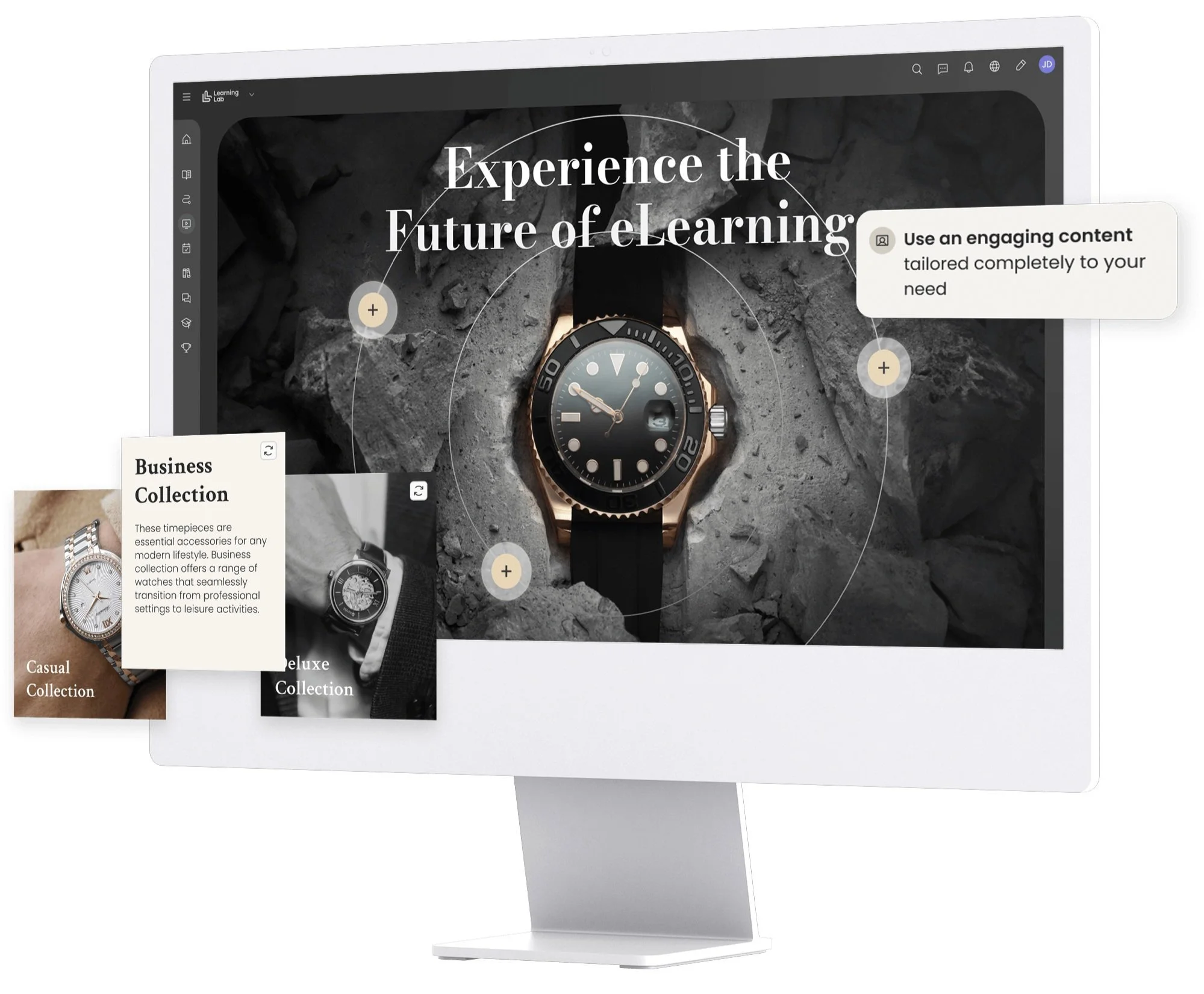
Interactive learning experiences encourage learners to actively engage with products rather than simply consume information. Through formats such as interactive hotspots, product exploration carousels, interactive videos, comparison tools, and knowledge challenges, advisors can investigate watch features, discover complications, compare collections, and test their understanding in a more engaging way.
For example, an interactive hotspot can allow learners to click directly on different areas of a watch to explore details about the movement, case material, dial design, or complication. Product carousels can guide advisors through the unique features of a collection, while comparison tools help them understand the differences between references and models. These experiences transform learning into an active process that promotes curiosity, discovery, and deeper understanding.
By encouraging participation and exploration, interactive learning helps advisors build stronger product knowledge, improve retention, and gain the confidence needed to discuss complex watchmaking concepts with customers.
Key Benefits of Interactive Learning for Watch Training
Transform passive learning into active exploration
Increase engagement and learner participation
Improve understanding of technical watchmaking concepts
Support discovery of product features and complications
Enable interactive exploration of collections and references
Enhance retention through hands-on learning experiences
Encourage curiosity and self-directed learning
Simplify complex information through visual interactions
Support product launches and collection updates
Help advisors compare models and identify key differentiators
Build confidence in customer-facing conversations
Create a more memorable and enjoyable learning experience
6. Training Through Storytelling Rather Than Specifications
In the world of luxury watchmaking, customers rarely purchase a timepiece based solely on its technical specifications.
While movement performance, materials, and complications are important, what often creates desire is the story behind the watch. Clients are drawn to heritage, craftsmanship, innovation, rarity, and the emotional connection that a timepiece represents. A luxury watch is not simply an instrument for measuring time—it is a symbol of achievement, passion, identity, and tradition.
For this reason, effective watch training must go beyond teaching specifications and product features. Advisors need to understand the stories that bring each collection and each reference to life. They should be able to explain the origins of a maison, the watchmaking traditions that have shaped its reputation, the artisans who contribute to its creation, and the innovations that distinguish it from competitors. Whether discussing a historic model inspired by aviation, a limited-edition collector’s piece, or a groundbreaking technical innovation, storytelling helps transform information into emotion.
Storytelling is also essential when communicating the value of luxury watches. Customers may forget a list of technical specifications, but they often remember a compelling narrative about a watchmaker’s pursuit of precision, the heritage of a collection, or the craftsmanship behind a hand-finished movement. These stories create emotional engagement and help clients understand why a timepiece deserves its place within the world of haute horlogerie.
The objective of modern watch training is therefore not only to create product experts but also to develop confident storytellers. Advisors who can connect technical knowledge with heritage, craftsmanship, innovation, and emotion are better equipped to build trust, inspire desire, and create memorable customer experiences.
Key Benefits of Storytelling-Based Watch Training
Transform product knowledge into emotional customer experiences
Bring brand heritage and watchmaking traditions to life
Highlight craftsmanship and artisanal expertise
Communicate innovation through engaging narratives
Increase perceived value of luxury timepieces
Help advisors create stronger emotional connections with clients
Differentiate products beyond technical specifications
Support the promotion of limited editions and collector pieces
Improve customer engagement and product memorability
Build advisor confidence in customer conversations
Strengthen brand consistency across global retail networks
Develop advisors into true ambassadors of the brand and its story

Learning Lab LMS for Watch Training
7. Using AI to Support Continuous Product Learning
Luxury watch brands manage an extraordinary amount of product knowledge.
Retail advisors must understand hundreds of references, multiple collections, technical specifications, watch complications, materials, heritage stories, and frequent product launches. Keeping this knowledge current can be challenging, especially in fast-paced retail environments where employees need immediate access to information while serving customers. Artificial Intelligence is transforming this challenge by making product knowledge more accessible, personalized, and available on demand.
AI-powered learning tools can act as intelligent assistants for retail teams, providing instant answers to product-related questions whenever they arise. Instead of searching through lengthy manuals or multiple training documents, advisors can simply ask a question and receive a relevant answer within seconds. Whether comparing two collections, understanding the benefits of a specific movement, reviewing the characteristics of a limited edition, or preparing for a client appointment, AI dramatically reduces the time required to access information.
Beyond instant Q&A, AI can also personalize the learning experience. Intelligent learning paths can recommend relevant content based on an employee’s role, knowledge level, interests, or previous learning activity. AI-powered search capabilities help learners find exactly what they need without navigating complex content libraries, while continuous recommendations encourage ongoing learning and knowledge reinforcement.
Importantly, AI is not designed to replace expertise—it helps accelerate its development. By removing barriers to information access and supporting continuous learning, AI allows advisors to spend less time searching and more time building confidence, mastering product knowledge, and creating exceptional customer experiences.
Key Benefits of AI-Powered Product Learning for Watch Brands
Provide instant access to product knowledge and technical information
Enable natural language questions and answers through AI chatbots
Support quick comparisons between collections and references
Deliver personalized learning recommendations based on individual needs
Reduce dependence on manuals and static documentation
Accelerate onboarding of new retail advisors
Improve access to information during customer interactions
Support continuous learning and knowledge reinforcement
Help employees stay up to date with new launches and collections
Simplify navigation through large product portfolios
Increase confidence when discussing technical watchmaking topics
Create a more efficient and engaging learning experience
Allow advisors to focus more on customers and less on searching for information
8. Certification Programs for Product Mastery
Luxury watchmaking is a highly specialised field where expertise is developed over time.
With hundreds of references, multiple collections, sophisticated complications, and rich brand heritage to master, expecting advisors to become experts overnight is unrealistic. This is why leading watch brands increasingly rely on structured certification programs that guide employees through a progressive learning journey, transforming product knowledge into recognized expertise.
Rather than overwhelming learners with large amounts of information at once, certification programs break learning into clearly defined stages. New advisors may begin with a foundational certification covering brand history, core collections, and essential product knowledge. As they gain experience, they can progress toward more advanced certifications focused on specific collections, technical complications, or specialized customer segments. Ultimately, the most experienced advisors may achieve expert-level certifications or become official brand ambassadors capable of representing the maison at the highest level.
This structured approach provides employees with clear goals and a sense of progression throughout their career. It also helps organizations ensure consistent standards of expertise across boutiques, markets, and regions. By linking learning achievements to certifications, badges, recognition programs, or career development opportunities, brands can significantly increase engagement and motivation while encouraging continuous learning.
Beyond knowledge validation, certification programs help build confidence. Advisors who earn certifications feel more prepared to discuss complex products, answer customer questions, and represent the brand with credibility. For luxury watch brands, certifications create a culture of excellence where expertise is recognized, rewarded, and continuously developed.
Key Benefits of Certification Programs for Watch Training
Create a structured path from beginner to expert
Break complex product knowledge into manageable learning stages
Support progressive skill development and career growth
Validate expertise through recognized certifications
Increase learner motivation and engagement
Encourage continuous learning and improvement
Develop collection specialists and complication experts
Strengthen confidence in customer-facing conversations
Ensure consistent product knowledge across global retail networks
Recognize and reward employee expertise
Support talent development and succession planning
Transform advisors into trusted experts and brand ambassadors
Build a culture of excellence within the retail organization
9. Measuring Product Knowledge Effectively
Training programs only create value when brands can clearly understand their impact.
In luxury watch retail, where product knowledge directly influences customer confidence, brand perception, and sales performance, measuring learning effectiveness is essential. Without meaningful data, organizations cannot identify knowledge gaps, recognize top performers, or ensure that retail teams are truly prepared to represent increasingly complex collections and timepieces.
Modern learning platforms provide far greater visibility than traditional training methods. Beyond simple course attendance, brands can track completion rates, assessment results, certification achievements, and engagement levels across individuals, boutiques, regions, and markets. This data allows learning teams to identify which collections or concepts are well understood and where additional support may be required.
Assessment strategies should also go beyond multiple-choice quizzes. Video assessments can evaluate an advisor’s ability to present a timepiece, explain a complication, or communicate brand stories effectively. Confidence scores and self-assessments can provide valuable insights into how prepared employees feel before engaging with customers. Product certifications help validate expertise and establish clear standards across global retail networks.
By combining these metrics, brands gain a comprehensive view of learning performance and readiness. More importantly, they can connect learning outcomes to business objectives. Better-trained advisors are often more confident, more credible, and more effective at creating engaging customer experiences. This can lead to stronger product presentations, improved customer satisfaction, increased conversion rates, and ultimately higher sales performance.
Measuring product knowledge is therefore not simply about tracking training activity—it is about understanding how learning contributes to retail excellence and business success.
Key Metrics for Measuring Watch Training Effectiveness
Course completion rates and learning participation
Knowledge assessment scores and progression
Video assessments evaluating presentation and storytelling skills
Product certification achievements
Confidence scores and learner self-assessments
Engagement with collections, launches, and learning content
Performance comparisons across boutiques and regions
Identification of knowledge gaps and coaching opportunities
Tracking expertise development over time
Validation of readiness for product launches and new collections
Recognition of top-performing advisors and experts
Alignment between learning performance and business outcomes
Business Benefits of Effective Learning Measurement
Improve customer experience through better-prepared advisors
Increase confidence in customer-facing interactions
Strengthen credibility and trust with clients
Support more effective product storytelling
Accelerate onboarding and time-to-competence
Drive higher sales performance and conversion rates
Ensure consistent expertise across global retail networks
Enable data-driven learning and talent development decisions
Maximize the return on training investments
Create a culture of continuous learning and excellence
10. The Future of Watch Product Training
The luxury watch industry is evolving rapidly.
New collections, increasingly sophisticated complications, changing customer expectations, and the growing influence of digital technologies are transforming how retail teams learn and develop expertise.
Traditional training methods alone are no longer sufficient to support the level of knowledge and agility required in today’s competitive retail environment. As a result, watch brands are embracing new learning technologies and approaches designed to make training more accessible, engaging, and effective.
Artificial Intelligence is expected to play a major role in the future of watch training. AI-powered assistants can provide instant answers to product questions, recommend personalized learning content, and help employees access knowledge precisely when they need it. Rather than replacing human expertise, AI acts as a continuous learning companion that accelerates knowledge acquisition and reinforces learning over time.
Interactive product simulations are also becoming increasingly important. Instead of simply reading about complications or technical features, learners can explore virtual watches, interact with components, and experience how mechanisms function through immersive learning environments. These experiences help simplify complex concepts while increasing engagement and retention.
At the same time, learning is becoming more mobile, visual, and personalized. Retail advisors increasingly expect to access knowledge from their smartphones, consume short video-based learning content, and follow learning journeys adapted to their individual needs and experience levels. Personalized recommendations help learners focus on the most relevant content while reducing information overload.
Another major trend is the growth of community-based learning. Retail teams no longer learn exclusively from formal training materials. They increasingly benefit from sharing best practices, customer success stories, product insights, and expertise with colleagues across boutiques, regions, and markets. This collective intelligence helps create stronger learning cultures and accelerates the spread of knowledge throughout the organization.
The future of watch product training will therefore be defined by a combination of technology, personalization, and human collaboration. Brands that successfully embrace these trends will be better positioned to develop knowledgeable advisors, accelerate expertise, and deliver exceptional customer experiences across their global retail networks.
Emerging Trends Shaping Watch Training
AI-assisted learning and intelligent product knowledge support
AI chatbots providing instant answers and recommendations
Interactive product simulations for complex watchmaking concepts
Mobile-first learning accessible anytime and anywhere
Video-first content to simplify technical information
Personalized learning journeys based on individual needs
Adaptive learning experiences that evolve with expertise
Community-based knowledge sharing and collaboration
Microlearning for continuous product education
Interactive assessments and practical skill validation
Data-driven learning analytics and performance insights
Global knowledge distribution with local relevance
The Future Impact on Retail Teams
Faster onboarding and time-to-competence
Improved understanding of complex products and complications
Greater confidence in customer-facing conversations
More engaging and enjoyable learning experiences
Continuous access to up-to-date product knowledge
Stronger collaboration across boutiques and markets
Higher levels of expertise and brand representation
Better customer experiences and sales performance
Increased agility during product launches and collection updates
A culture of continuous learning and watchmaking excellence
Conclusion: Complexity Can Become a Competitive Advantage
The complexity of luxury watches should not be viewed as a training obstacle—it is one of the industry’s greatest strengths.
When retail teams are equipped with the right learning tools, they can transform technical knowledge into engaging customer conversations, build trust, and create memorable brand experiences. Through a combination of video, microlearning, interactive content, storytelling, AI support, and structured certification programs, watch brands can empower advisors to master product complexity and deliver the level of expertise that luxury clients expect.