

Multi Brand Showroom Storytelling in Automotive Retail
How a showroom sales LMS can help automotive brands differentiate better, handle objections and train teams consistently across markets.
Multi brand automotive retail is one of the hardest environments to train well because teams are expected to represent different vehicle identities, explain competing strengths with clarity, and still deliver a consistent customer experience inside one showroom. In that context, product knowledge alone is not enough. Teams need storytelling, objection handling, structured content access, and a platform that can adapt training by brand, market, and audience without becoming chaotic.
The Learning Lab positions its automotive offer around mobile first design, multilingual capabilities, interactive video, scenario based modules, and real time analytics, while its platform features add branching, automatic translation, gamification, custom course structure, and content access controls. That combination makes it especially relevant for multi brand showroom sales, where the challenge is not just learning more information, but delivering the right brand story to the right customer at the right moment.
Why storytelling matters more in a multi brand showroom
How to train brand differentiation without confusing the customer
How objection handling becomes stronger through scenario based storytelling
Why translation matters for global automotive retail teams
How branching and content access rules protect showroom clarity
How gamification widgets can improve engagement without cheapening the brand
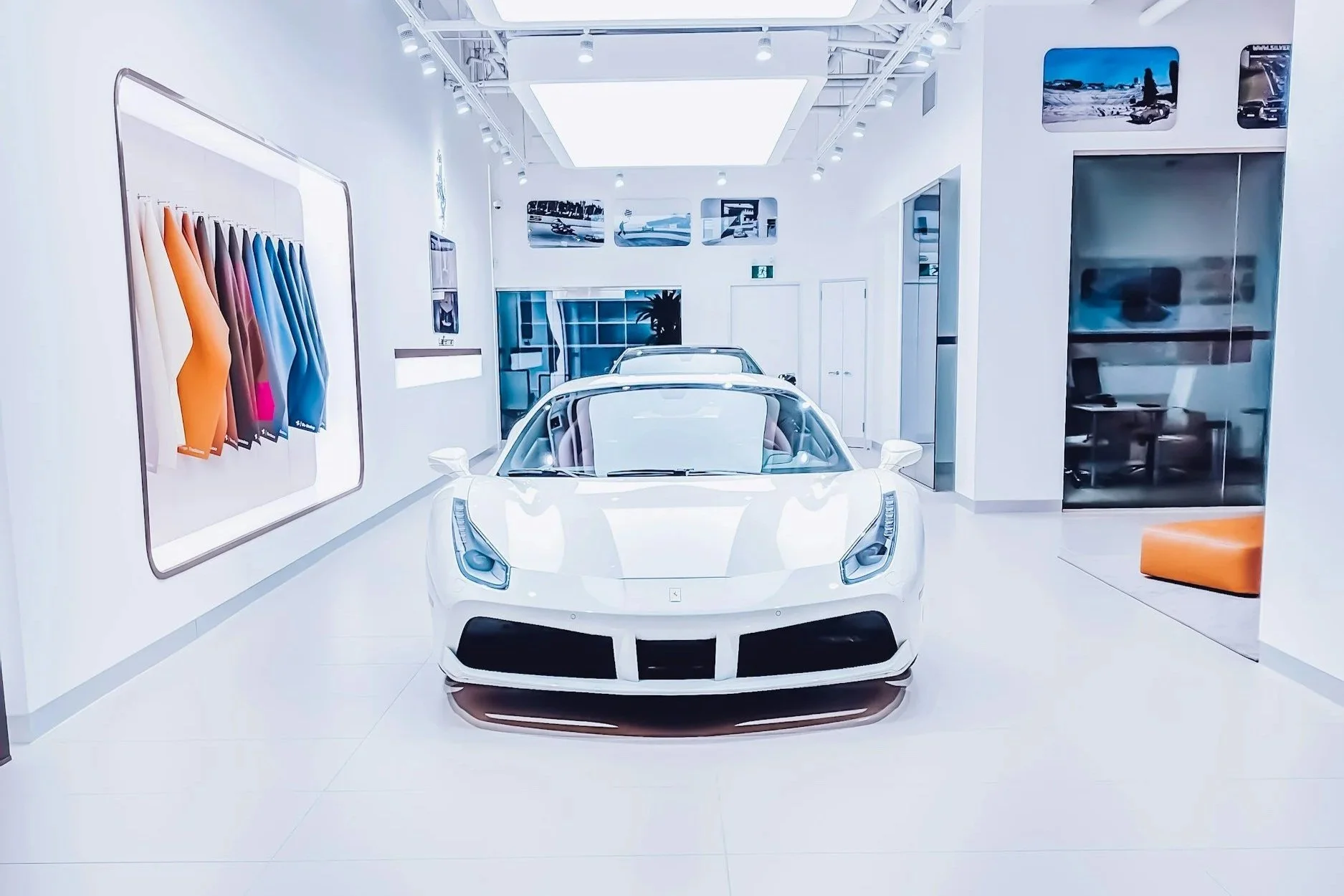
Why storytelling matters more in a multi brand showroom
When several vehicle brands share the same retail space, the story has to work harder.
In a single brand environment, the customer journey is usually built around one brand universe, one design language, and one product logic. In a multi brand showroom, that unity disappears, and teams must create clarity through the way they explain each offer. The Learning Lab automotive retail content explicitly argues that teams should train with stories, not specs, because storytelling helps employees connect vehicles to customer life rather than only listing technical features.
That is especially relevant when customers are comparing an electric family car with a hybrid SUV, a city vehicle with a premium model, or one mobility promise with another. A strong showroom sales LMS should help staff move beyond horsepower, warranty, or isolated specs and instead explain how each vehicle fits a lifestyle, a need state, and a brand identity. Storytelling turns comparison into orientation. It helps the seller guide rather than overwhelm.
The Learning Lab broader storytelling content supports this idea by describing storytelling as a way to make complex information more digestible, more memorable, and more directly applicable to daily customer interactions. In automotive, that matters because multi brand teams need to remember not only facts, but also how each brand should sound and what emotional space each vehicle occupies.
Storytelling makes technical content easier to remember.
It helps staff explain fit, not just features.
It reduces confusion in environments where customers are comparing multiple brands.
It helps teams align product knowledge with customer emotion and intent.
In a multi brand showroom, the brand that gets remembered is often the brand that gets explained best. Storytelling is what makes that explanation coherent, persuasive, and human. Building one core story for every brand in the showroom, then connect each model family to a clear customer life context rather than a list of isolated specifications.
How to train brand differentiation without confusing the customer
The goal is clarity, not internal competition between brands.
Multi brand showrooms create a real training risk. If teams are not guided carefully, they can flatten the differences between brands, overcomplicate the customer conversation, or default to generic sales language that makes every product sound the same. Brand differentiation training needs to show staff how each marque should be positioned without encouraging unhelpful comparison habits inside the same sales floor.
The Learning Lab automotive content highlights immersive customer scenarios, brand driven learning, and dynamic visual training as ways to strengthen product expertise and customer engagement. That is important because differentiation in automotive retail is not only verbal. It also depends on tone, sequence, confidence, and the ability to present one model as the right answer for a particular type of customer rather than simply the better answer in abstract terms.
A good showroom sales LMS should therefore organize content by brand, category, and audience. The platform features page supports this through custom course structure and learning paths, allowing brands to order content by their own catalogue and assign it by audience. In practical terms, that means a global automotive group can train one showroom on several brands while still giving each team a clear route through brand story, product logic, hero differences, and customer fit.
Brand differentiation works best when each marque has a clear narrative territory.
Staff need guided learning paths so they do not mix messages across brands.
Differentiation should focus on relevance to the customer, not internal product rivalry.
Structured content makes multi brand knowledge easier to navigate and apply.
Audit your showroom training and identify where brands currently sound too similar, then rebuild the content around the unique promise, tone, and use case of each one.
Customers do not need ten memorized arguments. They need one clear reason why a particular brand or vehicle fits them best. Differentiation training should make that reason obvious.
How objection handling becomes stronger through scenario based storytelling
Most showroom objections are not technical tests. They are moments of uncertainty.
Objection handling in automotive retail usually sounds product based on the surface, but the real concern is often emotional. A customer may talk about price, range, charging, practicality, resale, or complexity, but beneath the question there is often anxiety about making the wrong decision. That is why scenario based training is so useful. It gives sales teams a way to practice how to respond in context, with the right brand tone and the right level of explanation.
The Learning Lab automotive content repeatedly emphasizes scenario based modules, activity based learning, and immersive customer stories. In a multi brand environment, this becomes even more important because objections may differ by brand and by powertrain. A premium electric vehicle may trigger questions about value and charging. A hybrid model may invite comparison questions. A family car may create concerns around practicality, space, or daily routine. The right LMS should help teams rehearse these moments by brand and by customer type, rather than giving one generic objection script to everyone.
Interactive assessments, branching scenarios, video tests, and hotspot based content all support this approach. They allow teams to choose responses, see consequences, and strengthen decision making under realistic pressure. That is how objection handling becomes part of confidence building rather than a memorized appendix to the sales training.
Scenario based learning helps sellers practice judgment, not just recall.
Different brands and powertrains create different objection patterns.
Branching scenarios are useful because they mirror real choice and consequence.
Video assessments make it easier to train tone, pace, and confidence.
A strong objection response is rarely about having more facts than the customer. It is about using the right facts at the right moment in a way that protects trust and keeps the conversation moving. Collect the most frequent objections by brand, then build short scenario modules that train both the factual answer and the emotional tone expected in the showroom.
Why translation matters for global automotive retail teams
Multi brand automotive groups often lose consistency first through language.
If a showroom network spans different countries or language groups, translation is not a side issue. It is one of the main reasons training either scales well or fragments quickly. The Learning Lab feature set includes automatic translation and multilingual export options, while its automotive positioning highlights multilingual capabilities for global automotive networks.
This matters for showroom storytelling because poor translation does not just distort product facts. It can distort tone, positioning, and the subtle language that separates one brand from another. In multi brand environments, that is especially risky. If the translated language feels generic or imprecise, the brands start to sound less distinct, which weakens both differentiation and customer confidence.
A strong electric car LMS or showroom sales LMS should make multilingual delivery fast enough for global launches but controlled enough to preserve brand intent. Automatic translation helps accelerate rollout, while language based content packaging and export options support distribution at scale. That creates a more inclusive learning experience and improves comprehension across geographically distributed teams.
Automatic translation helps global teams move faster.
Multilingual access improves comprehension and learner engagement.
Translation quality matters because tone and brand difference live in language.
Global showroom training needs speed and linguistic control at the same time.
In multi brand automotive retail, translation is not only about understanding the words. It is about preserving the distinct voice of each brand everywhere the showroom story is told. Prioritize translation for launch modules, objection handling scenarios, and brand story content before expanding to the rest of the library.
How branching and content access rules protect showroom clarity
Not every learner should see the same content in the same way.
Branching is one of the most important features for multi brand showroom training because it allows the creation of distinct LMS instances with their own branding, communities, and content. In practice, that means a dealer group, brand franchise, region, or market can have its own learning environment while headquarters still maintains central logic and oversight. This is especially useful when a retail group operates several automotive brands under one corporate umbrella but needs clear separation in messaging and priorities.
Content access rules matter just as much. The Learning Lab features page includes content access settings, roles and permissions, landing pages for different groups, and user manager structures that help control who sees what and when. In a multi brand showroom, that protects clarity. A premium sales team should not be distracted by irrelevant content from another brand. A local manager should be able to activate the right materials for the right audience. A product specialist should have deeper access than a general learner.
This is where a showroom sales LMS becomes more than a content library. It becomes a governance system. It keeps training relevant, prevents overload, and supports cleaner execution across brands, functions, and markets. That kind of structure is essential when the same organization needs both flexibility and brand discipline.
Branching creates separate learning spaces for different brands or regions.
Content access rules keep learning relevant to each audience.
Roles and permissions improve control over publishing and visibility.
Cleaner access reduces confusion in multi brand environments.
In multi brand retail, clarity is built as much through what people do not see as through what they do. Branching and content access controls make that clarity sustainable. Separate your showroom training by brand, role, and market, then review whether each learner only sees the content needed to perform well in their exact context.
How gamification widgets can improve engagement without cheapening the brand
Motivation matters, but it has to feel credible in automotive retail.
Gamification is often misunderstood in premium or technical categories because people assume it automatically makes training feel childish. The Learning Lab describes gamification as a way to boost engagement, motivation, and knowledge retention by turning learning into an interactive and rewarding experience. Across its related training content, the platform also highlights badges, awards, certifications, leaderboards, and interactive challenge logic as ways to encourage progress and reinforce knowledge.
In a multi brand showroom, gamification works best when it supports professionalism rather than entertainment for its own sake. A showroom sales LMS can use badges for launch readiness, certifications for brand mastery, or awards for strong completion and scenario performance. Widgets such as carousel based challenges, video tests, flashcards, quizzes, and hotspot interactions can make learning more active while still staying aligned with an automotive brand environment.
This matters because knowledge retention is a real issue in complex showrooms. If a team has to remember several brands, powertrains, and objection patterns, motivation tools can help keep repetition high enough for real confidence to develop. The key is governance. Gamification should reinforce expertise, not distract from it.
Gamification can increase motivation and retention when used well.
Badges, certifications, and awards fit automotive training better than gimmicky mechanics.
Interactive widgets such as quizzes, hotspots, and video tests help reinforce recall.
Brand aligned gamification should reward competence and consistency.
Good gamification does not make automotive training less serious. It makes serious learning easier to repeat, easier to track, and more satisfying to complete. Choose two or three gamification elements that match your showroom culture, then link them to real milestones such as launch readiness, brand certification, or objection handling excellence.
Why theLearning Lab LMS is pefect?
Authoring tool, no-code, white label and much more.
Multi brand showroom storytelling in automotive retail works best when it is supported by a platform that can differentiate brands clearly, train objections contextually, localize language accurately, control content access intelligently, and keep learners engaged over time. That is the real challenge of a modern showroom sales LMS. It is not just about hosting training. It is about helping teams represent different brands with precision, confidence, and consistency in one shared retail environment.
Storytelling matters because it helps teams explain fit rather than overwhelm customers with specs. Brand differentiation matters because each marque needs a distinct narrative territory. Scenario based objection handling matters because real showroom concerns are contextual and emotional. Translation matters because global consistency depends on language that preserves brand tone. Branching and access control matter because relevance protects clarity. Gamification matters when it strengthens motivation and retention without undermining professionalism.
The Learning Lab is well suited to support this type of automotive retail training because its automotive positioning and platform features align closely with the realities of multi brand showrooms. It can support branded training environments, structured learning paths, multilingual rollout, branching, content governance, interactive video, assessments, and engagement tools that make complex showroom learning easier to scale. For automotive groups that want cleaner brand differentiation, better objection handling, and more consistent execution across markets, The Learning Lab provides the kind of infrastructure that can turn showroom storytelling into a repeatable commercial advantage.
