

AI LMS Assistant as a Creative Partner:
AI LMS Assistant as a Creative Partner: How Retail Learning Program Stay On-Brand When Humans Keep Control of the Story
In retail, a learning path is not a generic course. It is a brand experience: the same voice, the same codes, the same emotion that the store is expected to deliver.
That is why AI only creates real value when it works as an assistant never as an unsupervised author. At The Learning Lab, intelligence is built into a hybrid model: the human sets the storyboard, the tone, the pedagogical choices and the guardrails; the agent accelerates production inside those limits.
The authoring tool helps create content faster, but with predefined options and sliders so teams choose the path, the rhythm and the format before the AI writes a line.
Translation can be automated and still respect a brand glossary, so preferred vocabulary is not diluted market by market. Images and animations can be generated with tight control over the output. A chatbot answers only from validated, well-defined knowledge, in short and precise replies.
Adaptive learning then offers the next step based on each learner’s results — complementary, targeted, never random. The result is not “more AI.” It is a richer, faster, still fully storyboarded experience: unique voice, controlled storytelling, and a learning journey that management can stand behind.
Brand Voice First: AI Should Accelerate Production, Never Rewrite the Story
In retail learning, the brand voice is the product. It is how a house speaks about craft, service, product and emotion and it cannot be outsourced to a model.
AI is valuable when it supports production: drafting faster, translating at scale, proposing variants, generating media, answering simple questions. It is damaging when it starts to invent the narrative, flatten the tone or replace creative direction.
The right model is therefore simple and non-negotiable: humans keep authorship. They define the story, the codes, the words that matter and the experience the learner should feel. The AI LMS assistant then works inside that frame.
That is how The Learning Lab approaches authoring, translation, visuals, chatbot and adaptive paths — assistance with guardrails, so every module still sounds like the brand, not like generic intelligence.
Summary
- Voice is strategy, not decoration. In retail, how you speak is part of how you sell, onboard and train.
- AI supports; it does not author. The assistant speeds production. Creative direction stays with the brand team.
- Storytelling remains human. Plot, emotion, codes and point of view are set before any generation.
- Guardrails before output. Sliders, templates, approved options and brand rules frame what the agent is allowed to do.
- Preferred vocabulary is protected. Glossaries and validated language keep signature words from being “optimised” away.
- One tone across markets. Localisation can be automated without turning every language into the same bland voice.
- Visuals follow the same rule. Generated images and animations serve the brand look; they do not invent a new aesthetic.
- Chatbot on a leash. Answers come from approved content, short and precise — no improvisation on brand meaning.
- Adaptive, still on-message. Personalised next steps follow learner needs without leaving the brand’s narrative.
- Management keeps the final cut. What goes live is reviewed, storyboarded and signed off — not auto-published because it was fast.
Hybrid by Design: When the Team Directs and the AI Executes Inside a Framed Brief
The most useful AI in an LMS is not autonomous. It is hybrid: a human–agent pair in which the team keeps direction and the model stays inside a framed brief.
That is the only way retail brands can gain speed without losing authorship. Authors, L&D and brand teams decide the story, the pedagogical path, the tone and the limits. They review and validate.
The AI then executes drafting, translating, proposing visuals, answering from approved knowledge, suggesting the next step. The Learning Lab authoring environment is built for that handshake: predefined sliders and structured options tell the agent what kind of path to produce, so generation is assisted, not free-wheeling.
The result is operational: faster production, lighter localisation, more consistent support for learners — and a learning experience that still belongs to the brand, because every output has a human owner.
Summary
- Hybrid is the method, not a slogan. Human + agent work as one workflow: direction first, generation second.
- The team holds the brief. Objectives, voice, storyboard and pedagogical choices are set by people, not by the model.
- The agent executes, it does not decide. AI drafts, localises, generates and assists inside limits already chosen.
- Review is part of the design. Nothing meaningful goes live without human validation.
- Framed authoring. Sliders and predefined path options constrain the assistant before it writes.
- Less improvisation, more precision. A tight brief produces usable drafts instead of generic “AI content.”
- Creative control stays upstream. Taste, uniqueness and brand codes are inputs — not afterthoughts to correct later.
- Operations get lighter. Repeatable tasks move to the agent; judgement stays with the team.
- Learners still meet the brand. Chatbot, media and adaptive follow-ups all run on approved rules and content.
- Accountability remains clear. Management can stand behind the experience because the process was directed, not delegated to the model.
Authoring Under Control: An Assistant That Helps You Write — Without Taking the Pen
Content creation is where brand voice is won or lost. That is why The Learning Lab authoring tool is built as an assistant, not an autopilot.
It helps teams produce faster structure a module, propose wording, generate variations, assemble media while authors keep the pen and the final say. In retail, a learning path must feel designed: the right rhythm, the right codes, the right story.
The tool supports that craft with predefined options and pedagogical sliders, so the agent works inside choices the team has already made. Authors steer the brief, edit the output, reject what is off-voice and publish only what they approve.
Speed becomes useful because control stays visible: every screen can still be storyboarded, refined and signed off. The result is premium learning content that looks and sounds like the brand — produced with AI in the room, never in charge.
Summary
- Assist, don’t replace. The authoring tool accelerates creation; authors remain the writers and decision-makers.
- The pen stays human. Drafts are proposals. The published version is chosen, edited and owned by the team.
- Control before generation. Sliders and predefined pedagogical options set the path, tone and format first.
- Storyboard-friendly. Modules can still be designed as a directed experience, not a pile of auto-generated slides.
- On-brand by construction. Templates, rules and brand frames keep visuals and language inside the house style.
- Edit in the flow. Real-time review means the assistant works with the author, not around them.
- Creative signature protected. Uniqueness, emotion and storytelling are not optional extras to “add later.”
- Retail-ready output. Product stories, service rituals and campaign training stay precise, beautiful and governable.
- Final say is explicit. Nothing goes live until someone accountable validates it.
- Faster without flattening. Production gains time; the brand does not lose its voice.
Predefined Pedagogical Sliders: Choose the Learning Path First — Then Let the Assistant Generate
Pedagogy should never be an accident of generation.
With predefined sliders, teams decide the learning design before the AI writes a word: format, intensity, depth, rhythm and path. That is how The Learning Lab keeps the agent in its place.
Authors are not prompting into the void. They select structured options — a short floor-ready burst or a richer branded journey, more practice or more storytelling, a linear path or a guided sequence and only then does the assistant produce content inside that frame. The pedagogy is chosen, not invented.
For retail, this matters: seasonal staff, store managers and brand ambassadors do not need the same intensity or the same format. Sliders make those choices explicit, repeatable and controllable by L&D and management. The AI accelerates execution. The team remains the instructional designer.
Summary
- Pedagogy first, generation second. Sliders lock the learning design before the agent starts producing.
- The agent does not invent the path. Format, intensity and structure are selected by the team.
- Clear creative brief. Each slider setting is a constraint: what kind of module, for whom, at what depth.
- Formats on purpose. Micro-learning, campaign story, product deep-dive or onboarding sequence — chosen, not guessed.
- Intensity under control. Teams decide how dense, how long and how demanding the experience should be.
- Paths that fit the role. Store, HQ, seasonal or expert journeys can be framed before content is drafted.
- Repeatable quality. The same pedagogical choices can be reused across collections, markets and launches.
- Less prompt chaos. Structured options replace vague instructions that lead to generic courses.
- Brand experience stays designed. The storyboard remains a directed journey, even when production is assisted.
- Human instructional design. AI fills the frame; L&D still owns how people learn.
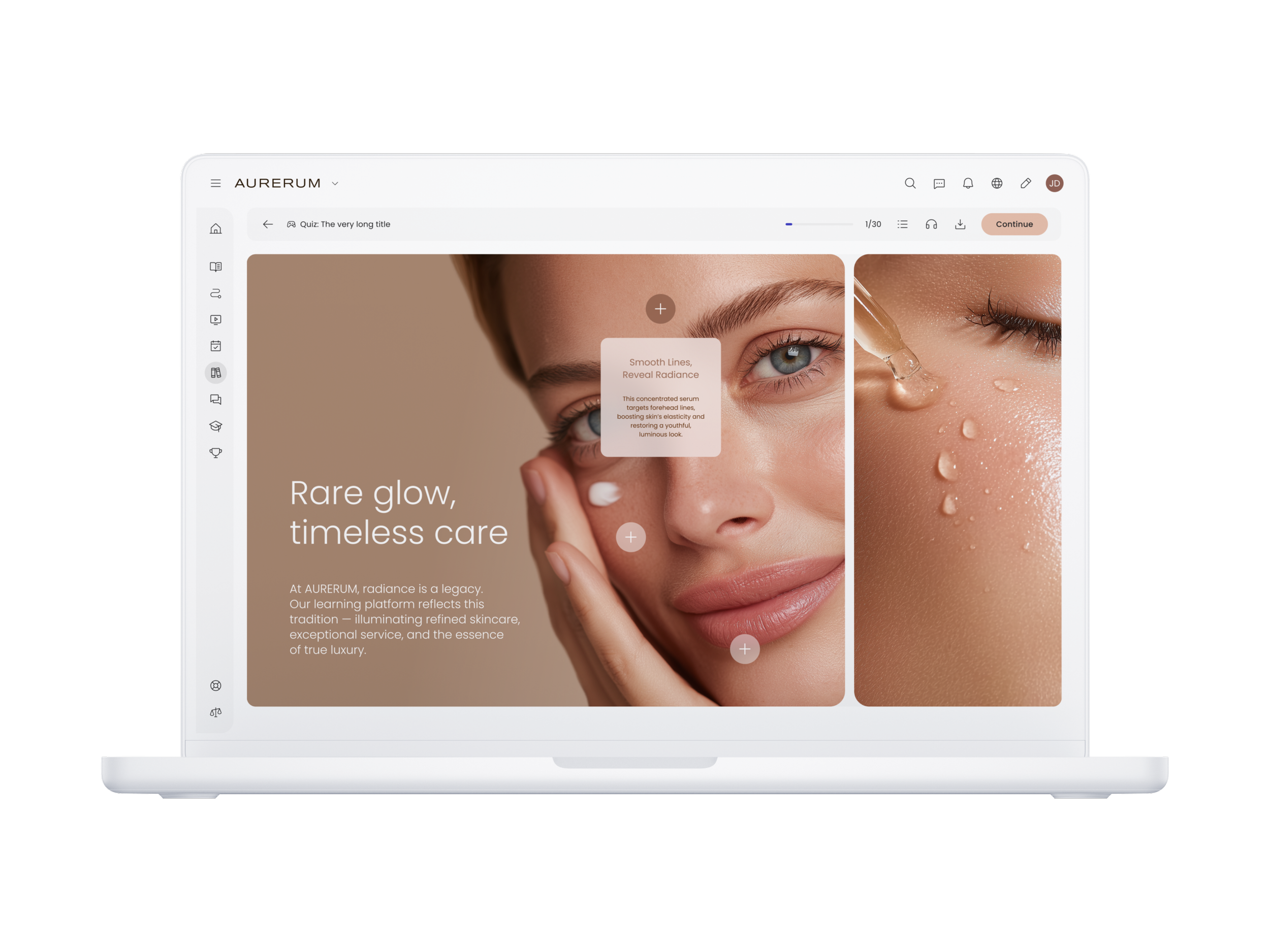
The Storyboard Stays in Management’s Hands: Retail Journeys Designed, Sequenced and Approved
A retail learning journey is a directed experience, not a playlist the AI assembles on its own.
Sequence matters: what the learner sees first, how the brand story unfolds, when product knowledge appears, when practice lands. That storyboard belongs to management and to the teams who own brand, training and the shop-floor reality. AI can help fill each scene faster.
It must not shuffle the film. The Learning Lab model keeps journeys defined in advance objectives, chapters, tone, moments of emotion, moments of precision — then uses the assistant inside those frames.
Content is generated, translated or illustrated under a plan that has already been approved. Nothing important is auto-assembled at random. The learner still walks a path that was storyboarded like a campaign: coherent, premium and accountable from HQ to store.
Summary
- Storyboard is governance. Who learns what, in which order, and why, is a management decision.
- Journeys are designed, not generated. Sequence, chapters and narrative arc are set before production.
- No random assembly. The agent does not invent the order of the experience.
- Retail logic first. Launch, onboarding, product, service and culture follow a planned dramaturgy.
- Approval before scale. Paths are validated, then produced and rolled out — not the other way around.
- AI fills the scenes. Drafting, media and localisation happen inside an already directed structure.
- Same story, many markets. Local versions can move faster without breaking the global narrative.
- Brand experience stays intentional. Every step should feel staged, not algorithmic.
- Accountability stays visible. If the journey is live, someone owned the storyboard.
- Control is the luxury standard. In fashion and retail, the path is part of the brand — it cannot be left to chance.
Glossary-Led Translation: Localise at Speed Without Diluting the Brand’s Words
Global retail training fails when every market starts speaking a slightly different brand. Names, product codes, service rituals, claims and signature phrases are not interchangeable.
That is why translation in The Learning Lab is glossary-led: automation handles volume, the brand glossary protects meaning. The assistant can localise modules quickly across languages, but it is guided by the vocabulary the house has already chosen preferred terms, locked expressions, words that must never be “creatively” replaced.
Tone stays consistent. Terminology stays stable from Paris to Milan to New York. Human teams still review what matters; the machine does the heavy lifting without inventing a parallel language. Localisation becomes an operational advantage, not a slow leak in brand voice.
Summary
- Vocabulary is brand equity. Preferred words, names and claims must travel intact from market to market.
- Automation with a dictionary. AI translates at scale; the glossary tells it which terms are non-negotiable.
- Tone survives localisation. The goal is the same voice in another language — not a generic rewrite.
- No parallel brand. Stores should not learn one story in English and another in Italian or Chinese.
- Locked terms stay locked. Product names, collections, rituals and legal phrasing are protected by design.
- Faster global rollouts. Campaigns and launches can be localised without waiting weeks for every line.
- Lighter operations, same standard. Repeat translation work moves to the assistant; quality rules stay human.
- Review where it counts. Teams validate nuance; they do not retype entire modules from scratch.
- Consistency is the feature. One glossary, many languages, one recognisable house language.
- Worldwide, still unmistakably yours. Localisation expands reach without flattening the brand.
Controlled Visual Generation: Faster Images and Animation — Still On-Code, Still On-Brand
In retail learning, visuals are not decoration. They carry the house: light, material, gesture, casting, pace.
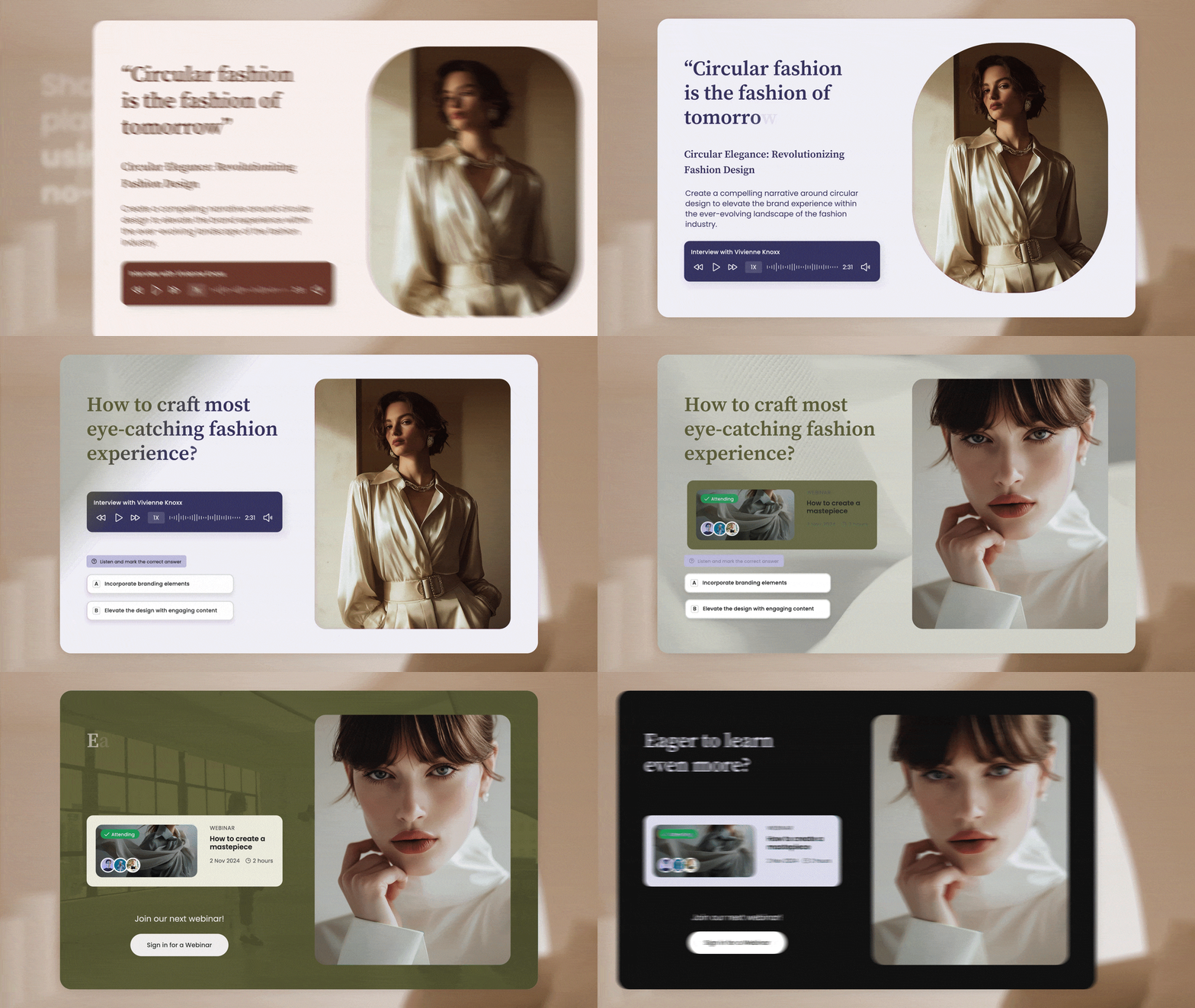
Uncontrolled generation produces content that looks “AI” — off-style, off-casting, off-world. Controlled visual generation does the opposite. Images and animations can be produced at speed, but only inside strong constraints on look, style and brand codes.
The team defines the frame: colour, atmosphere, product truth, what can appear and what cannot. The assistant then accelerates production of scenes, motion and supporting visuals for modules, launches and store-ready paths.
Authors keep direction and the final say, just as they do with copy. The result is a learning experience that still feels art-directed — faster to produce, never visually generic.
Summary
- Visuals are brand language. In fashion and retail, how it looks is part of how it teaches.
- Speed with constraints. Generation is useful only when style, codes and limits are set first.
- No default “AI look.” Output must follow the house aesthetic, not a generic model style.
- Codes before pixels. Colour, framing, materials, casting and mood are directed by the team.
- Animation under the same rule. Motion supports the storyboard; it does not invent a new visual world.
- Product truth matters. Generated scenes should respect the object, the gesture and the retail reality.
- Authors keep art direction. The assistant proposes; the brand validates what goes on screen.
- Faster campaigns. Launch modules and seasonal paths can be visualised without waiting on every asset from scratch.
- Consistency across the journey. Slides, loops and short animations stay in one visual system.
- Premium means controlled. A luxury learning experience cannot look accidental — even when AI helps produce it.

Validated Chatbot: Answers the Learner Can Trust Because the Brand Already Approved Them
A chatbot in retail training is not a free conversation with a model. It is a branded service point. If the bot improvises, it can invent product facts, soften a ritual or speak off-voice.
A validated chatbot works the other way: it is fed only with approved information the same knowledge the brand has already signed off. Answers stay short, targeted and on-message.
The learner on the floor can ask a direct question and get a precise reply, not a long generic essay.
The assistant is useful because it is limited: it retrieves, it does not rewrite the brand. That is how The Learning Lab treats conversational support — as a controlled layer on top of a defined knowledge base, so speed for the learner never means loss of control for management.
Summary
- Approved knowledge only. The bot is nourished with content the brand has defined and validated.
- No improvisation on facts. Product, service and brand answers stay inside what was authorised.
- Short by design. Replies are concise and usable on the shop floor — not padded AI paragraphs.
- Targeted to the question. The learner gets the point they asked for, not a tour of the whole catalogue.
- On-message, always. Tone and wording follow the same voice as the rest of the learning journey.
- A service, not an oracle. The chatbot assists navigation and recall; it does not invent policy or storytelling.
- Control sits upstream. Quality comes from the brief and the knowledge base, not from hoping the model “behaves.”
- Safer for global teams. The same validated answers can support many markets without local drift.
- Human fallback remains. When the question sits outside the frame, the path back to a person or a module stays clear.
- Trust is the feature. People use the bot because they know the brand stands behind the answer.
Direct Learner Questions: Instant Help on the Floor Still Inside the Brand Experience
Frontline teams do not have time to hunt through a catalogue of modules when a client is in front of them.
They need to ask a direct question and get a usable answer now without leaving the branded learning environment, and without landing on a generic reply that could have been written for any retailer.
That is the point of a well-framed assistant inside the LMS: the question stays in the brand universe, the answer stays short and specific, and the experience still looks and sounds like the house.
The bot does not send people into another tool or another tone. It works from validated knowledge, so product, service and ritual stay precise. Instant help becomes part of the same storyboarded journey: fast for the store, controlled for the brand.
Summary
- Questions at the moment of need. Advisors and store teams ask now, not after the shift.
- No exit from the brand. Help happens inside the LMS experience — same look, same voice, same world.
- Not a generic chatbot. Replies are built for this house, this product, this ritual — not “any retailer.”
- Short enough for the floor. Answers fit a live selling moment, not a long study session.
- Direct, then done. The learner gets the point and returns to the client or the task.
- Validated source. Instant does not mean invented: content comes from approved knowledge.
- One continuous journey. Search, chatbot and modules stay inside the same branded path.
- Less friction, more confidence. Teams use the platform because it actually helps in the store.
- Global consistency. The same precise answers can support frontline teams across markets.
- Speed with authorship. The brand still owns what is said; the assistant only delivers it faster.
Adaptive Follow-Up: The Next Step Fits the Result and the Role — Not a Standard Next Module
Learning does not end when the quiz is submitted.
The valuable moment is what happens after: who needs more product depth, who needs service practice, who is ready to move on. Adaptive follow-up uses those results to offer complementary options targeted, role-aware, still inside the brand path. It is not a one-size-fits-all “next module” pushed to everyone.
A seasonal advisor and a store manager do not share the same gaps, and a luxury house should not train them as if they did. The assistant can propose the next step from performance and profile; the journey itself remains designed and approved.
The Learning Lab approach keeps adaptation useful and controlled: personalised continuation, not a random playlist. The learner feels seen. Management still owns the map.
Summary
- Results drive the next step. Follow-up starts from what the learner actually did, not from a fixed sequence alone.
- Gaps, not averages. Complementary options target weak points instead of repeating the whole course.
- Role-aware paths. Store, manager, HQ or seasonal profiles do not receive the same default module.
- Complementary, not chaotic. Extra activities extend the storyboard; they do not replace it with a random feed.
- No one-size-fits-all. Personalisation means the right depth for this person, in this job, after this score.
- Still a branded journey. Adaptive suggestions stay inside the approved universe and voice.
- Human design underneath. Rules and options are set by L&D; the assistant applies them.
- Better use of time. Strong performers move forward; others get practice where it counts.
- Retail reality. Floor teams get short, relevant follow-ups they can actually complete.
- Control with relevance. Adaptation improves the experience without giving the model the map.
Faster Operations, Same Quality Bar: Automate the Repeatable Keep Creativity Human
AI creates value in an LMS when it takes the weight off operations, not when it tries to become the creative director.
Heavy, repeatable work translation volume, first drafts, formatting, versioning, routine updates, simple Q&A can move to the assistant.
That is where speed compounds. What cannot move is the part retail brands are actually buying: uniqueness, taste, storytelling, the sentence only this house would write. The Learning Lab model keeps that split explicit. Automation is reserved for tasks that should be fast and consistent.
Authors, brand and L&D keep the work that should feel designed. The quality bar does not drop because production got quicker. It holds because the machine is assigned labour, and people keep authorship. Faster rollouts, lighter teams, same premium standard.
Summary
- Speed on the right tasks. Automate volume and repetition — not the brand’s creative signature.
- Quality bar does not move. Faster production is only a win if the experience stays on-voice and on-story.
- Repeatable vs. unique. Translation batches, drafts and updates can be assisted; the idea and the tone cannot be outsourced.
- Creativity stays human. Emotion, codes, narrative and “only we would say this” remain team work.
- Operations get lighter. L&D spends less time on mechanical production, more time on design and validation.
- Campaigns ship sooner. Launches and seasonal paths can be localised and updated without lowering the finish.
- Assistant = labour. The agent executes framed tasks; it does not set the standard.
- Review where uniqueness lives. Humans concentrate on the lines and scenes that define the brand.
- Consistency at scale. Automation protects sameness where sameness is required — terms, structure, versions.
- Premium is the filter. If it must feel crafted, a person still owns it. If it must be done a thousand times, the assistant can help.
One Coherent Palette: Authoring, Translation, Media, Chatbot and Adaptive Learning as One System
AI in learning fails when it arrives as a pile of add-ons: one tool to write, another to translate, a third to generate images, a chatbot bolted on the side, recommendations that do not know the course.
The learner feels the seams. The brand loses one voice. The Learning Lab approach is a single palette. Authoring, glossary-led translation, controlled visuals, a validated chatbot and adaptive follow-up work inside the same LMS, the same storyboard, the same brand rules.
The assistant that helps draft a module is part of the same system that localises it, illustrates it, answers a floor question and proposes the next step from results. Nothing important lives in a disconnected plugin with its own tone. For retail, that coherence is the product: one journey, one universe, one standard of control — from first slide to last follow-up.
Summary
- One system, not a toolkit collage. Features serve the same branded journey instead of competing as separate AI products.
- Same voice everywhere. What is written, translated, shown and answered follows one set of brand rules.
- Authoring is the source. Content created under control feeds translation, media, chatbot and adaptive paths.
- Translation stays in the flow. Localisation is not an export to another universe; it remains glossary-led inside the LMS.
- Media belongs to the storyboard. Generated images and animations illustrate the same path, not a parallel visual world.
- Chatbot reads the same truth. Instant answers come from the approved knowledge of the platform, not an external model.
- Adaptive follow-up knows the course. Next steps refer to modules and results in this journey — not generic recommendations.
- No plugin tone. Learners never jump from a premium module into a generic AI widget.
- Simpler governance. One brief, one validation logic, one quality bar for the whole palette.
- Retail-scale coherence. Global teams meet one experience — assisted, hybrid, still unmistakably the brand.
Retail-Ready Experience: Training That Feels Like the Brand — From HQ Storyboard to Store Floor
Retail training works when it feels like walking into the brand: immersive, precise, enjoyable and still governable from headquarters to the last boutique.
That is the standard The Learning Lab is built for.
The LMS is not a back-office tool with a logo on it. It is a branded journey: voice, visuals, rhythm and story aligned with how the house wants to be lived on the floor. AI helps only as a partner inside that frame authoring, translation, media, chatbot, adaptive follow-up so teams can produce and localise faster without breaking the experience. Management keeps the storyboard, the glossary, the validation.
The advisor still gets something beautiful and useful between two clients. Pleasure is not a gimmick; it is how attention holds. Control is not bureaucracy; it is how a global network stays one brand.
Summary
- Feels like the brand. Login to last module, the experience carries the same codes as the store and the campaign.
- Immersive on purpose. Story, image, motion and path pull the learner into the universe — they do not tick a compliance box.
- Precise where retail needs precision. Product, service and ritual stay exact, including when AI assists production.
- Enjoyable enough to finish. Pleasure in the journey is a performance tool, not an extra.
- Governable from HQ. Storyboard, voice, glossary and approvals remain in management’s hands.
- Usable in the store. Short answers, mobile-ready paths and adaptive follow-ups fit real floor time.
- One standard, many doors. Boutiques, markets and roles share the same quality bar.
- Hybrid without the seams. Human direction plus assisted production still read as one crafted experience.
- Launch-ready. Seasonal and collection training can move fast and still look art-directed.
- From HQ to store, same signature. What is designed at the centre is what the advisor meets — immersive, controlled, unmistakably yours.
Conclusion : The Learning Lab AI Assistant
The Learning Lab LMS is built for a simple idea: in retail, training is brand experience.
It should immerse teams in a unique voice, a directed story and a standard of quality that headquarters can stand behind — from the first slide to the last question on the shop floor.
That is the benefit of the platform. It is not a generic catalogue of modules with a logo added on top. It is a white-label environment where look, language and journey belong to the house. Authors keep the pen. Management keeps the storyboard. AI sits beside the team as a creative partner, not as an unsupervised writer.
The practical gains follow from that design. Content is produced faster through a controlled authoring tool, with pedagogical sliders that set format and intensity before generation. Localisation scales through glossary-led translation, so preferred vocabulary does not dissolve across markets. Images and animations can be generated under brand codes. A validated chatbot answers short, targeted questions without leaving the branded world. Adaptive follow-up then offers the next step from real results and real roles — complementary, not one-size-fits-all.
Together, these capabilities form one palette, not a stack of disconnected add-ons. Heavy, repeatable work can be automated. Creativity, uniqueness and storytelling stay human. The quality bar does not fall because operations got lighter.
For fashion, luxury and lifestyle retail, the outcome is concrete: campaigns and onboarding that ship on time, a global network that still speaks with one voice, frontline teams who actually enjoy the path — and a learning system that remains governable from HQ to store. The Learning Lab does not ask brands to choose between speed and authorship. It is built so they can have both.