

AI as Your Retail Copilot: Collaborate, Don't Delegate.
Managers master personalization and paths while owning human decisions.
Learn how to use AI to personalize retail learning paths, speed up content production, and support managers without diluting brand culture. Practical frameworks for luxury, fashion, beauty, and premium retail.

AI in retail learning: the promise and the trap
AI is entering retail L&D with the same seductive pitch every new technology brings: faster content, smarter personalization, and instant scale. The promise is real but so is the risk of pushing automation so far that learning becomes generic, culturally flat, and disconnected from the brand experience. The Learning Lab explicitly warns about "Over-Automated Learning" and how AI can "dilute brand culture in luxury retail."
That's why the most useful framing for AI in premium retail training is not "replace humans," but augment performance. Think of AI as a copilot that supports your managers, trainers, and subject-matter experts while your humans stay accountable for judgment calls, cultural nuance, and the final brand expression.
Copilot vs autopilot
AI-as-autopilot tries to remove humans from decisions: it generates courses, pushes assignments, and optimizes paths based on signals—without contextual checks. That might work for compliance refreshers, but it's dangerous for luxury retail behaviors where tone, posture, and storytelling matter.
AI-as-copilot does something different:
It suggests options
It drafts and accelerates
It helps you see patterns faster
It never owns the final call
In luxury retail especially, you don't want "optimized training." You want brand-consistent learning experiences that reinforce the standards customers feel in-store. We promote and set out our premium retail learning as a branded, experience-driven discipline rather than generic corporate training.
What managers should own
The subtitle of this article says it plainly: managers master personalization and paths while owning human decisions. In practice, managers must remain accountable for:
Brand interpretation: What does "excellence" mean for your Maison today, in this market, with this clientele?
Behavior standards: The non-negotiables in client approach, clienteling, storytelling, and service recovery.
Ethical choices: What data is used, how it's used, and what's appropriate to automate.
Communities: Store constraints, staffing, and cultural context.
AI can support all of these but should not replace them.
Where does AI actually come into play and how is it becoming fundamental by supporting the work of managers in retail training?
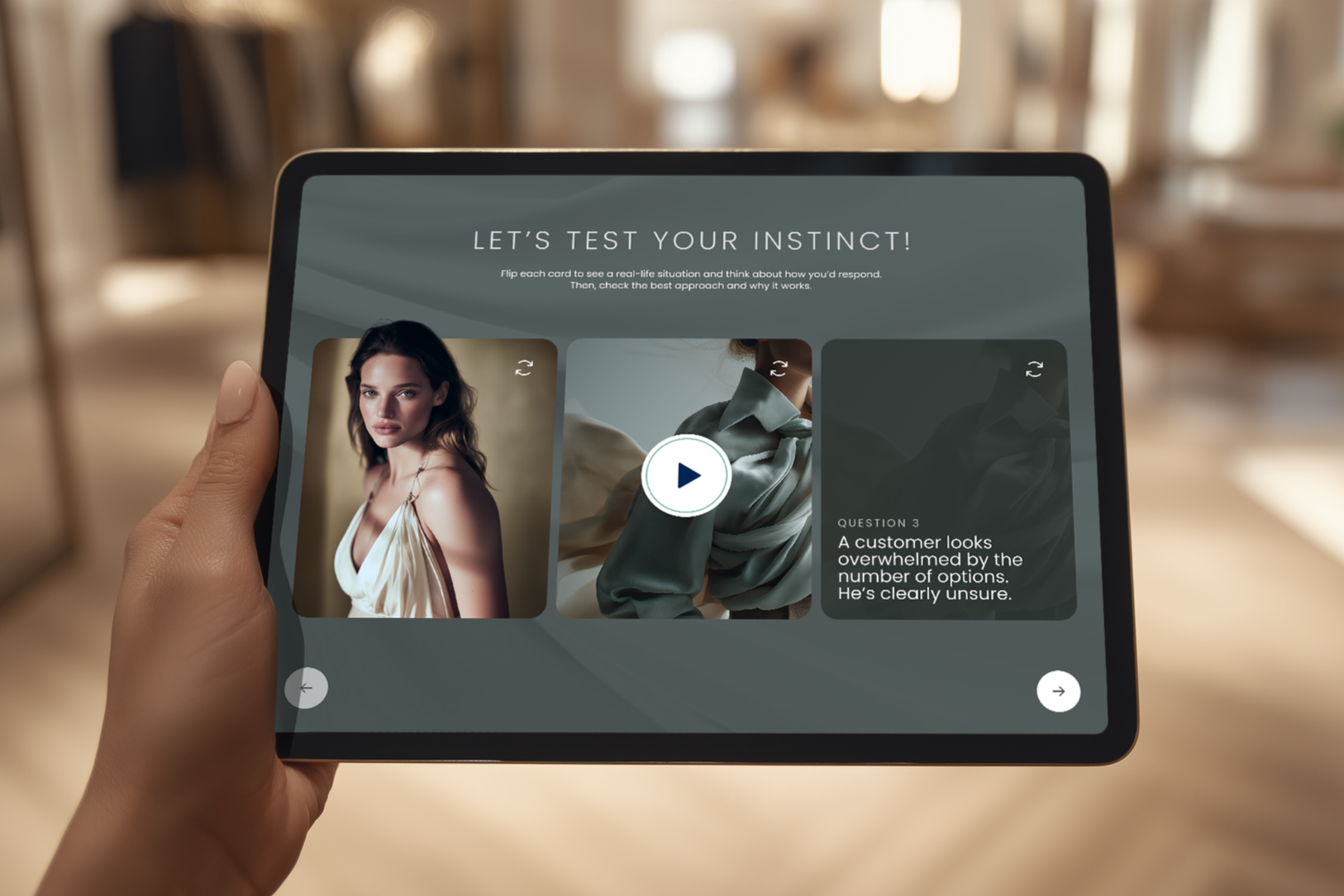
Here are 3 practical, high-impact ways to apply AI without delegating critical decisions.
AI Copilot applied in the personalization suggestions, the Learning Paths flow
AI can propose learning paths by role, tenure, performance gaps, and product category. Based on the data received, it can generate and automate a structure that a learner is invited to follow as it suggests the most impactful way to enhance his or her work performance, by product knowledge, brand heritage and culture, as well as for soft-skills and other characteristics that store personnel could improve. It's important to underline that in premium retail environments, the Retail Excellence team should define with the support of Brand image and store performance teams, what "personalization" is about, respecting the brand interpretation.
Example of pathways:
New advisor → foundations + service rituals
Senior advisor → advanced storytelling + complex objections
Team lead → coaching scripts + performance routines
This kind of application is viable within an existing framework, as the Retail Performance and Excellence Teams have already defined benchmarks for learning by establishing an onboarding and sales process. However, the team has also developed a proven data performance methodology, which is an advanced approach. It is designed by professional training managers, not AI prompting.
We frame retail eLearning as a "performance engine," emphasizing that effectiveness is measured in behavior and performance, not just completions.
Once operationalized inside the LMS, this strategy will enable AI to recommend a path, but it's important to maintain the human seal of approval. Direct managers or supervisors should also provide coaching, observations, and feedback to maintain the human touch and foster knowledge retention.
2. Faster training content drafting
AI is excellent for generating initial drafts, such as product quiz questions, role-play branching scenarios and translation suggestions, as well as creating different versions of a module. However, your brand voice cannot be improvised. It is therefore essential that professionals check the content aligns with the brand guidelines. AI can improve and facilitate most processes nowadays, but it is especially important in the luxury retail sector to ensure that content is not automated. This helps to avoid misinformation and maintain the highest standards of the Maisons.
Where AI accelerates:
Drafting module structures
Generating question banks
Creating scenario variations
What's missing from AI alone are the human nuances that characterize every brand and culture and that learners recognize. These include tone of voice, storytelling, cultural nuances, luxury etiquette, precise language, and the final visual and interactive design. Automated processes cannot lose or dilute any of these characteristics.
We also want to emphasize that it is the connection between brand guidelines and training methods that makes our work so exciting and interesting. By connecting the correct dots, we can develop a genuine learning experience and a training culture.
We consistently emphasize the importance of design and experience in premium retail learning.
3. Smarter measurement and signal detection
AI can flag patterns across regions: low completion in one store cluster, repeated wrong answers for one product line, or drop-offs at one lesson moment. But here's where the human intellect becomes irreplaceable—the interpretation of what those signals mean.
AI detects the signal. Humans decode the story.
Use AI to spot patterns, but keep the human step that asks critical questions:
Is the issue content quality, timing, store workload, or manager follow-up? A low completion rate at a flagship Paris location during peak holiday season tells a different story than the same metric at a secondary market. AI might flag both as "gaps." Your store manager knows the real context.
Are we seeing skill gaps or motivation gaps? Repeated mistakes on a product knowledge quiz could indicate unclear content, insufficient practice time, or low engagement with that particular product line. Only experienced trainers can distinguish between these without oversimplifying the data.
Is the experience "on-brand," or just informational? If advisors are completing modules but failing to apply luxury service rituals in client interactions, the learning isn't working. AI can measure completions; humans measure brand integrity.
Measurement philosophy: Don't chase "time spent." Chase behaviors.
One of the strongest arguments for modern retail learning is that short, interactive modules can outperform long courses. We signal that "Short, interactive, mobile-first modules boost completion rates to 65–90%, compared to just 30–40% for traditional long courses”. and that "learners return to nano/micro content "1.5–2× more often when gamification or peer interaction is part of the journey."
If AI helps you shorten cycles, increase interactivity, and reinforce practice great. If it helps you generate 200 pages of generic content faster your teams will ignore it, and your brand will feel it.
A practical governance model: "Human Decisions, AI Assistance"
To use AI responsibly in luxury/premium retail, define three layers.
Non-negotiables (no AI autonomy)
Brand voice and tone approvals
Sensitive client scenarios (complaints, discrimination, security, high-value client interactions)
Certification standards and evaluation criteria
Assisted creation (AI drafts, humans decide)
Outlines, quizzes, scenario variations
Translation drafts (human review required)
Content tagging and lesson summaries
Automation allowed (low-risk)
Reminders and nudges
Search and knowledge retrieval inside the LMS
Analytics clustering (patterns, not decisions)

The Human Future of Premium Retail Learning
We stand at a crossroads in retail learning. One path leads toward delegated learning where algorithms optimize, personalize, and deliver training at scale, leaving humans to watch dashboards and chase completion metrics. The other path leads toward augmented excellence where AI becomes a strategic partner that amplifies human judgment, accelerates creativity, and frees your managers to focus on what algorithms cannot: cultural protection, behavioral coaching, and brand storytelling.
The Learning Lab's warning about over-automation in luxury retail is not a caution against technology. It is a call to intentionality. AI should make your retail learning more human not less.
In premium retail, your competitive edge has never been technology. It is culture. It is the way an advisor reads a client and adjusts their approach. It is the studio director who shapes her team's character month by month. It is the brand excellence team that holds the line on what "luxury service" means in a world of shortcuts. These human powers cannot be automated. They can be enhanced.
When you position AI as a copilot not an autopilot you unlock three transformations:
You protect brand integrity at scale. Personalization without context becomes generic. AI helps you scale learning across 500 stores worldwide, but your managers own the cultural translation. The result: a Parisian boutique and a Tokyo flagship both deliver excellence distinctly, authentically, on-brand.
You reclaim manager authority. The best retail leaders today are drowning in dashboards and compliance checklists. AI handles the noise the pattern detection, the content drafting, the administrative sorting. Your managers reclaim time for what they were hired to do: develop people, reinforce culture, and drive performance. They become coaches, not administrators.
You build learning that sticks because it matters. Short, interactive, branded learning experiences outperform generic courses by 2–3×. When AI helps you iterate faster, your teams can respond in real time to market changes, new product launches, and client behavior shifts. When your brand voice stays intact throughout, advisors don't just complete modules they embody your standards.
The path forward is neither "AI everywhere" nor "AI nowhere." It is "AI where it accelerates, humans where it counts”.
Your retail excellence teams define what personalization means.
Your store managers interpret signals and lead coaching.
Your trainers craft experiences, not just content.
This is not a future where technology replaces human judgment. It is a future where human judgment is amplified by tools intelligent enough to listen, agile enough to adapt, and humble enough to know their place.
The Maisons that win in the next decade will not be the ones with the most advanced AI. They will be the ones with the clearest culture and the strongest people. AI is simply how they scale it.
Your move now is clear: define your three governance layers, equip your managers with a copilot mindset, and protect what makes your brand irreplaceable. Speed matters. Culture matters more.
The choice is yours. The time to decide is now.
