

Preparing Beauty Advisors and Retail Partners for a Product Launch: From Accurate Product Knowledge to Confident Demonstrations
A beauty product launch comes to life through the people who introduce it to customers.
Advisors and retail partners need to understand the product’s purpose, explain its benefits using approved claims, and demonstrate its application appropriately.
Preparation should connect accurate product knowledge with realistic practice: asking about customer preferences, explaining usage instructions and recognising when a question requires specialist guidance. A structured learning journey can bring together approved launch materials, short demonstrations, knowledge checks and coached practice, with local review for language and market differences.
The aim is to help every advisor present the product clearly, respond honestly to questions and deliver a demonstration that reflects both the brand’s standards and the customer’s needs.

Design Beauty Training Around the Customer Experience
A customer approaches the counter and asks, “Is this new product right for me?” The advisor needs to explore their preferences, explain relevant benefits using approved claims and offer an appropriate demonstration.
Build the training programme around this interaction, giving learners opportunities to experience the brand story, make decisions and practise their responses. A branded learning journey can connect storytelling, interactive video, customer scenarios and coached demonstrations, with each activity preparing advisors for a specific part of the conversation.
AI can assist with drafting activities from approved information, while education and product experts validate the content. The aim is to help advisors combine accurate knowledge, thoughtful recommendations and a natural expression of the brand.
Storytelling — give the product meaning: Introduce its inspiration, place within the range and approved benefits. Ask advisors to retell the story in their own words while preserving its meaning and brand tone.
Branching scenarios — practise decisions: Present a customer conversation that develops according to the learner’s choices. Include discovery questions, recommendations and moments where checking information is the appropriate response.
Blended learning — connect preparation with practice: Combine digital lessons with trainer-led workshops, counter demonstrations and manager coaching. Use in-person sessions to apply and discuss the online material.
Activity-based learning — turn information into action: Ask advisors to compare approved product descriptions, organise application steps or identify an unsupported claim. Give feedback that explains the reasoning.
Video-based learning — make technique visible: Use close-up demonstrations, expert explanations and video quizzes to explore application, presentation and common questions.
Gamified challenges — reward meaningful progress: Create challenges around accurate explanations, sound judgement and improved demonstrations. Recognise progress without encouraging speed at the expense of care.
Role-play — rehearse realistic conversations: Practise with different preferences, levels of product familiarity and questions. Include situations where recommending no product or seeking guidance is the responsible outcome.
Sensory exploration — connect learning with the product: Where suitable, let advisors examine texture, fragrance, packaging and application alongside approved guidance. Distinguish personal impressions from substantiated product claims.
Peer learning — share useful approaches: Invite advisors to exchange effective questions and explanations, with trainers moderating contributions for accuracy and consistency.
Teach-back — check understanding: Ask learners to explain a benefit or demonstrate a technique to a colleague. Use questions and feedback to reveal gaps.
Spaced reinforcement — revisit essential decisions: Follow the launch with short scenarios and targeted refreshers, informed by recurring questions and manager observations.
Manager coaching — assess the customer experience: Observe accuracy, relevance, technique and brand expression. Agree on specific improvements and provide another opportunity to practise.
Make Your Beauty Academy an Extension of the Brand Experience
A beauty academy should introduce advisors to the same creative world customers discover through packaging, campaigns and retail spaces.
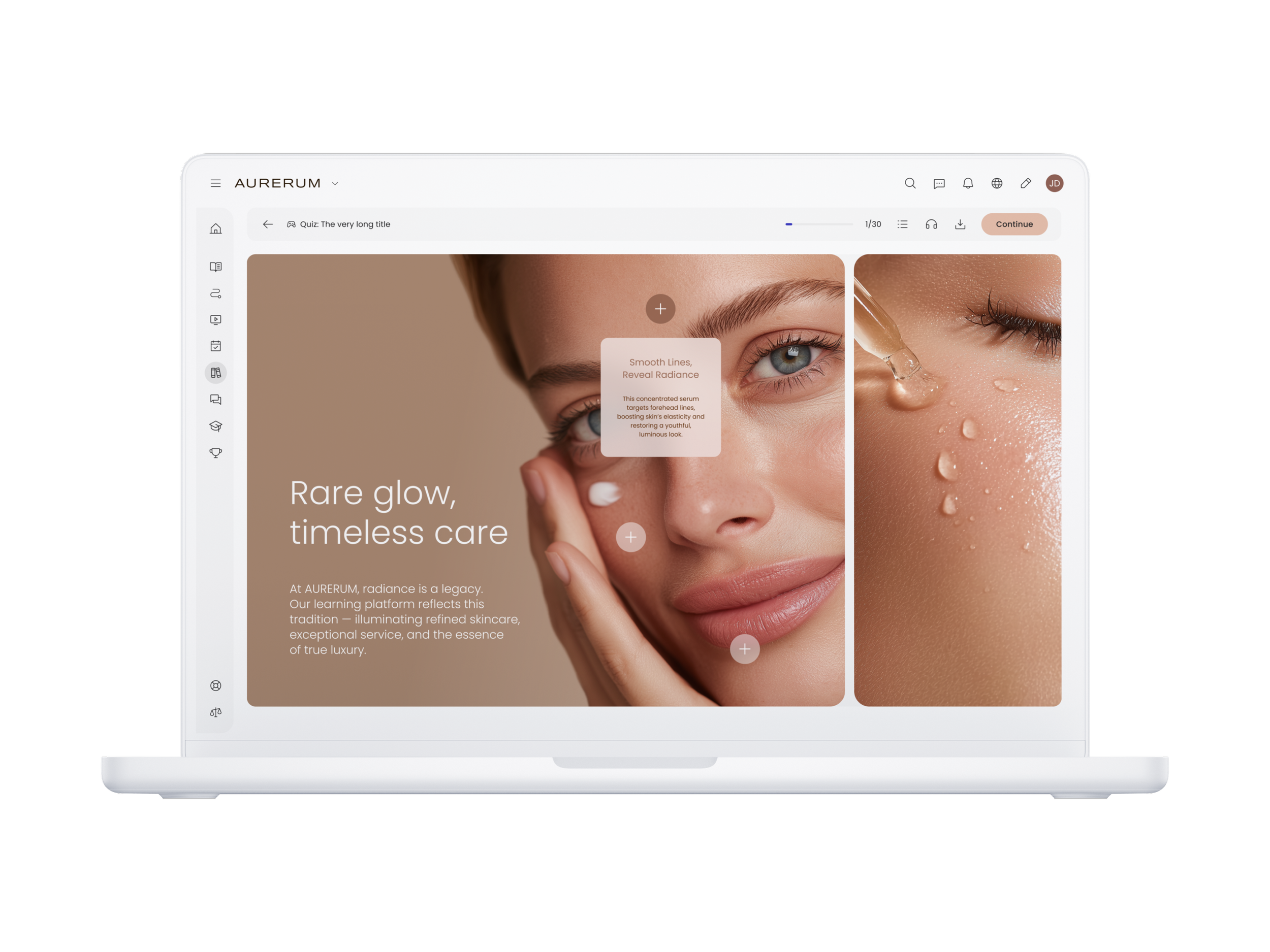
Its visual identity, language and learning activities should express the brand’s personality while helping teams understand its product philosophy and service expectations. The Learning Lab’s fully branded LMS and AI-powered creative authoring tools can support this approach, bringing branded templates, multimedia content and structured learning journeys together.
Design the training methodology around how advisors will apply that identity: telling a product story, demonstrating with care and responding thoughtfully to questions. For example, introduce a launch through an approved campaign visual, explore its message and supporting product facts, then ask advisors to explain the story naturally in a customer conversation. Brand and product experts should review AI-assisted drafts to preserve both accuracy and tone.
Fully branded LMS — create a recognisable environment: Carry the brand’s colours, typography, imagery and tone through the academy, with clear navigation and accessible content.
Branded templates — give authors a consistent foundation: Develop reusable layouts for product stories, demonstrations, scenarios and assessments. Adapt them to each launch while preserving a coherent experience.
AI-powered creative authoring — support content development: Use approved sources and brand guidance to draft lessons, scripts and questions. Review every output for factual accuracy, language and relevance.
Visual identity — teach advisors what to notice: Use campaign imagery, packaging details and product photography to explore the creative choices behind a launch and how they connect to its approved story.
Tone of voice — practise natural brand expression: Give examples of appropriate language, then ask advisors to develop their own explanations. Coach them towards a consistent tone without requiring identical scripts.
Product philosophy — connect purpose with explanation: Help advisors understand the thinking behind the product and communicate it using validated information.
Service behaviours — make brand values observable: Translate qualities such as care, expertise and attentiveness into actions: listening, asking relevant questions, explaining clearly and respecting customer preferences.
Designed training methodology — connect discovery, practice and feedback: Build a purposeful sequence from brand immersion to product learning, customer scenarios and coached demonstrations.
Campaign-to-conversation activity — check practical application: Show an approved visual, ask advisors to identify its central message, then record a short customer-facing explanation. Assess accuracy, clarity, relevance and brand expression.
Build Beauty Training on Approved Product Knowledge
Reliable beauty education begins with validated source material. Before authoring lessons, training teams should gather the information advisors need to explain a product accurately, demonstrate it appropriately and answer questions within their role.
Establish an approved reference set covering product purpose, benefits, ingredients, application guidance and market-specific requirements. Assign named owners to validate facts, approve claims and maintain current versions. This foundation also guides AI-assisted authoring: generated explanations, quizzes and scripts must remain faithful to approved sources and pass expert review before publication.
Cosmetic explanations should stay within their authorised scope, without turning an ingredient description or product benefit into an unsupported therapeutic promise.
Product purpose and intended use: Define what the product is designed to do, who it is intended for and where it fits within the range.
Approved benefits and claims: Gather authorised wording, supporting explanations and relevant conditions or limitations. Identify which statements advisors may use and which require further guidance.
Ingredients and terminology: Provide validated explanations of relevant ingredients and technical terms. Avoid assuming that evidence about an individual ingredient establishes the same benefit for the finished product.
Application instructions and precautions: Confirm the approved steps, quantities, frequency and precautions, along with demonstration and hygiene guidance.
Approved imagery and scripts: Use current product visuals and reviewed demonstrations. Check that images, captions and spoken explanations represent the product accurately.
Market-specific information and FAQs: Validate local product details, permitted wording, availability and recurring questions. Include an escalation route for questions outside the advisor’s knowledge or role.
Approval responsibilities: Assign product experts to factual validation, brand teams to storytelling and visuals, and appropriate regulatory reviewers to claims and precautions. Training teams manage instructional quality and publication.
Updates and version control: Record the source version, approval date, owner and next review date. When information changes, identify affected lessons, translations, quizzes and chatbot resources, then review them before release.
Turn Approved Product Information into a First Draft with AI-Assisted Authoring
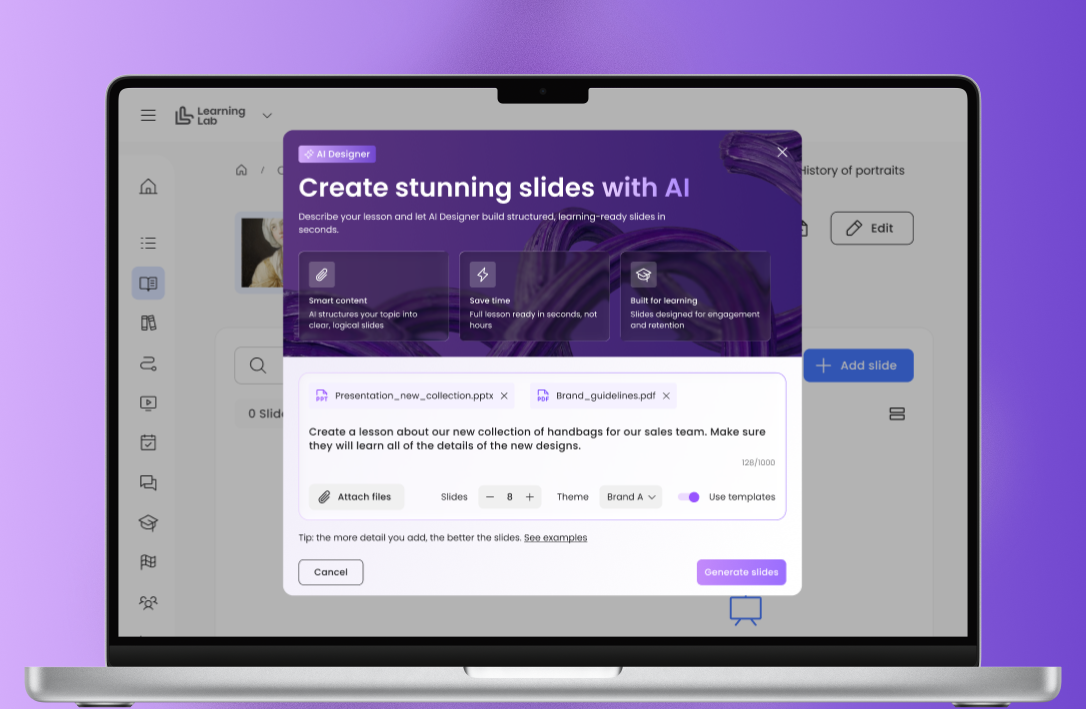
The AI Content Assistant can help training teams transform approved beauty product information into lessons, demonstration scripts and quizzes.
Within The Learning Lab’s creative authoring environment, authors can combine AI-assisted drafting with branded templates and multimedia activities to build a coherent learning experience. Give the assistant a defined audience, observable learning objectives and clear brand guidance so the draft serves a specific purpose.
Product experts must then validate every claim, while brand and training teams review tone, presentation and instructional quality. AI can help organise and adapt information, but a polished explanation is never a substitute for a reliable source.
1. Supply approved source material: Begin with validated product documentation, authorised claims, application instructions and precautions. Identify the product version and market, and instruct the assistant to flag missing information rather than fill gaps.
2. Define the audience, objectives and brand voice: Specify whether the lesson is for new advisors, experienced teams or retail partners. Describe what learners should be able to explain or demonstrate, and provide approved examples of the brand’s language.
3. Draft a focused learning sequence: Generate a short lesson, demonstration script and quiz around one objective. Use a branded template to organise the material, with questions and feedback that test meaningful understanding.
4. Review facts and learning quality: Check every claim against its source, including benefits, ingredient explanations, application steps and precautions. Review quiz answers for ambiguity and ensure the demonstration follows approved guidance.
5. Approve before publishing: Obtain the required product, brand and local approvals. Record the approved version and owner, then publish through the agreed process.
Adapt with the same controls: When revising content for another audience, format or language, preserve essential meaning and limitations. Treat each adaptation as a draft requiring review.
Bring Beauty Product Training to Life with Interactive Demonstrations
A visual demonstration should help advisors understand what to do, why each step matters and how to respond to customer questions.
Consider a fictional moisturiser, “Maison Lumière Daily Cream,” with application instructions created specifically for this illustrative exercise. Introduce its place within the brand’s collection, then show the technique described in the exercise’s approved product brief. Use The Learning Lab’s interactive video and video quiz tools to pause at meaningful moments, ask learners to make a decision and explain the reasoning through feedback.
Extend the sequence with supporting activities that move from recognition to practical judgement. Each interaction should prepare advisors to explain or demonstrate something accurately, with proposed formats checked against the platform’s available authoring options.
Collection introduction — establish the product’s role: Present the fictional product alongside a simple collection overview. Ask learners to identify its intended use using only the information provided.
Video quiz — check an application decision: Pause the demonstration before a key step and ask what should happen next. Explain the answer using the approved instructions rather than general assumptions about skincare.
Video hotspot — explore a relevant detail: Where supported, let learners select areas of the packaging or demonstration to examine instructions, terminology or handling guidance. Follow with a question that requires them to use that information.
Branching scenario — respond thoughtfully: Present a customer asking, “Will this treat my eczema?” Give learners choices and feedback that guide them to avoid unsupported treatment claims and follow the brand’s escalation guidance.
Flashcards — reinforce essential knowledge: Pair common questions with approved explanations. Include prompts asking learners to explain the answer in their own words before revealing the reference response.
Sequence activity — organise the demonstration: Ask learners to arrange the application steps in order, then explain why the sequence matters according to the product brief.
Claim-check activity — recognise overstatement: Show several product explanations and ask which are supported by the source material. Give specific feedback on wording that changes or exaggerates the claim.
Find-the-answer activity — practise using reliable sources: Ask a question the lesson does not answer directly. Have learners locate the relevant approved resource or recognise when expert guidance is needed.
Recorded demonstration — apply the learning: Ask advisors to introduce the product, demonstrate its use and answer one customer question. Review accuracy, technique, clarity and brand expression.
Feedback and retry — improve the response: Identify a specific strength and a priority improvement, then offer another attempt. Use mistakes to guide coaching and follow-up activities.
6. Offer Relevant Learning for Different Roles
Distinguish the needs of:
New advisors: Brand foundations, essential terminology and guided practice.
Experienced advisors: Product differences, launch updates and more demanding scenarios.
Retail partners: Focused product education and easy access to approved resources.
Managers: Observation criteria, coaching guidance and follow-up responsibilities.
Discuss personalised learning journeys without assuming that every adjustment is automated.
Support Beauty Advisors with AI-Guided Answers and Practice
An AI chatbot connected to approved product knowledge can help beauty advisors revisit explanations, locate instructions and prepare for customer conversations.
Questions such as “How can I explain this benefit more simply?” or “Which product differences should I check?” can become opportunities to reinforce understanding. AI-enhanced search helps learners find relevant resources, while coaching prompts can encourage them to explain their reasoning and practise a response. Where supported, adaptive learning can recommend follow-up activities based on demonstrated gaps.
These functions should work within clear boundaries: answers must reflect current approved sources, limitations must be visible, and unsupported questions should be referred to an expert. Practice prompts should use fictional situations without identifiable customer information.
AI chatbot — clarify approved knowledge: Help advisors revisit product explanations and application guidance. Preserve authorised claims and important qualifications when simplifying language.
AI-enhanced search — locate reliable resources: Guide learners towards current lessons, demonstration videos and product documents. Make the source, version and relevant market clear.
AI coach — encourage thoughtful practice: Use prompts such as “What would you ask the customer first?” or “Which approved information supports your explanation?” Keep coaching focused on learning rather than diagnosis or medical advice.
Adaptive learning — suggest targeted reinforcement: Where available, use assessment evidence to recommend a refresher, scenario or demonstration. Allow trainers to review recommendations and retain required learning.
Useful learner questions — make support practical: Include “Where can I find the approved application instructions?”, “How can I explain this benefit more simply?” and “Which differences between these products are documented?”
Current sources — maintain the knowledge base: Assign content owners, review dates and an update process. Remove superseded material and check that responses use the correct product and market information.
Clear limitations — acknowledge uncertainty: The assistant should state when information is missing or conflicting, rather than generate a plausible answer.
Expert escalation — provide a dependable next step: Refer unresolved product, claims or precaution questions to the designated specialist. Human reviewers remain responsible for approving product information.
Privacy-conscious practice — use fictional examples: Exclude names, contact details, photographs and identifiable customer histories from learning prompts.
Assess Beauty Demonstrations Through Video and Human Feedback
A recorded demonstration gives managers a practical way to assess how advisors combine product knowledge, application technique and brand expression.
Ask each advisor to record a short product introduction and demonstration using an approved fictional customer scenario, current instructions and suitable demonstration materials. Share the assessment criteria in advance so learners understand what readiness looks like.
Review the recording through The Learning Lab’s video assessment and feedback tools, identifying specific strengths and areas for improvement. Managers or qualified trainers should make the readiness judgement, with product experts resolving technical questions. Where further practice is needed, provide focused coaching and invite another attempt.
Accuracy — is the information correct? Check product descriptions, benefits and claims against approved sources. Address exaggeration, missing qualifications or unsupported advice.
Technique — are the steps appropriate? Observe application, product handling, hygiene and precautions against the approved demonstration guidance.
Relevance — does the response fit the scenario? Assess whether the advisor considers the customer’s stated preferences, asks useful questions and recognises when more information is needed.
Brand expression — does the presentation reflect the brand? Review language, tone and care in presentation while allowing advisors to speak naturally.
Clarity — is the explanation easy to follow? Look for a logical sequence, accessible wording and a clear view of the demonstration.
Manager feedback — what needs attention? Refer to specific moments in the recording, distinguish factual corrections from presentation advice and agree on one or two priorities.
Practice and reassessment — has the guidance been applied? Offer another attempt and assess it against the same criteria. Record any remaining coaching needs before confirming readiness.
Deliver a Consistent Beauty Brand Experience Across Markets
Global launch training should preserve the brand’s identity while helping advisors communicate naturally in their local language.
Automated translation can prepare an initial version of lessons, scripts and quizzes, but qualified local reviewers must validate meaning, terminology and approved claims before release. Keep the core product story and service expectations consistent, while adapting phrasing and examples to the market.
Check each version against the products, instructions and availability relevant to that location. Assign named reviewers and approval deadlines, coordinate release dates, and give retail teams scheduled learning time so localisation becomes part of launch preparation.
Use automated translation as a first draft: Prepare local versions from approved source content, preserving important qualifications and instructions. Treat every translation as material requiring review.
Verify product names and terminology: Check official names, ingredient terms, pronunciation and technical language against approved local references.
Validate claims and precautions: Ask the appropriate local product or regulatory reviewer to confirm permitted wording, application guidance and precautions.
Review captions and multimedia: Check subtitles, voiceovers, on-screen text and quiz feedback for accuracy, timing and consistency with the demonstration.
Confirm local relevance: Verify market-specific ranges, launch dates and instructions. Direct learners to current resources for changing availability information.
Allow natural local expression: Maintain the brand’s personality and intended meaning while giving advisors language that feels appropriate in conversation.
Name reviewers and release owners: Record who approves product facts, claims, language and brand expression, with clear deadlines and version status.
Coordinate learning with the launch: Publish approved content early enough for practice, manager feedback and reassessment. Schedule learning during working hours with suitable access and support.
Communicate updates clearly: Identify affected markets, replace superseded versions and tell managers what has changed and what their teams need to revisit.
Why The Learning Lab Is an Ideal LMS for Beauty Training
Beauty training needs to capture the identity of the brand while preparing advisors to explain products accurately and demonstrate them with care. The Learning Lab brings these priorities together through fully branded learning environments, AI-assisted content creation and interactive multimedia. Education teams can build learning journeys that connect product stories with approved information, customer scenarios and practical assessment. From preparing a launch to reinforcing knowledge across retail partners, the platform supports a consistent approach while leaving factual approval and readiness decisions with qualified experts.
A learning experience that reflects your brand: Create an academy with your visual identity, tone and product imagery, making education a natural extension of the brand experience.
AI-assisted creative authoring: Turn approved material into lesson drafts, scripts and quizzes, with product and brand experts reviewing content before publication.
Interactive product demonstrations: Combine video and questions to explore application techniques, product explanations and customer decisions.
Practice with meaningful feedback: Use recorded demonstrations and video assessments to help managers identify strengths, provide coaching and check progress.
Support for learner questions: Give advisors access to approved knowledge through AI chatbot support, with clear limitations and expert escalation.
Learning across languages and locations: Prepare translated content for local review and deliver mobile learning to distributed teams and retail partners.
Visibility into learning progress: Use reporting alongside manager observations to identify knowledge gaps and plan reinforcement.
The Learning Lab helps beauty brands bring their identity, product expertise and training practice into one connected academy—preparing advisors for confident, accurate and thoughtful customer conversations.
Bring Your Brand to Life Through Every Advisor
A beauty product launch succeeds when advisors can turn approved knowledge into accurate explanations, thoughtful recommendations and appropriate demonstrations.
Preparing teams for that moment takes a connected learning journey: brand storytelling, reliable product information, realistic practice and clear feedback. Consistent standards should guide every market, with room for natural local expression and individual customer needs.
AI can support this work by helping teams draft content, adapt explanations and guide learners towards relevant resources. Its value depends on expert review and a clear learning purpose. Interactive video makes techniques visible, while practical assessment gives managers evidence of how advisors apply their knowledge. After launch, recurring questions and observations help education teams refine content and provide targeted coaching.
The Learning Lab brings these elements together within a branded academy, helping beauty brands connect creative identity with practical preparation. The goal is for every advisor and retail partner to represent the product honestly, demonstrate it with care and deliver an experience that feels true to the brand.
Explore how The Learning Lab can help you prepare your teams for your next beauty launch through AI-assisted creation, branded learning and practical assessment.