

The Best LMS for Multi-Brand Fashion Groups
The ideal solution for companies with numerous brand portfolios
Why retail groups need one learning ecosystem that protects each brand’s voice, service style, and product story.
Large fashion groups live with a tension that becomes stronger as they grow. On one side, they need scale. They need shared systems, clearer governance, faster onboarding, and better visibility across markets. On the other side, they need each brand to feel alive, specific, and emotionally distinct. A lingerie brand cannot sound like a cashmere label. A value driven youth concept cannot train its teams the same way as a premium boutique. A lifestyle brand with a sensual service ritual cannot use the same learning language as a hospitality driven concept. That is where many enterprise learning strategies start to fail.
The problem is usually not ambition. The problem is over standardization. Groups often centralize learning with good intentions, lower cost, faster rollout, easier reporting, and cleaner control. But when that centralization becomes too rigid, training starts to flatten the portfolio. Teams receive the same structure, the same tone, the same visual logic, and the same way of speaking to customers, even when the brands they represent are supposed to feel completely different. The result is efficiency on paper and dilution on the shop floor.
That is why multi brand fashion groups need a different kind of LMS strategy. They do not need one generic learning portal that treats every brand as a variation of the same retail formula. They need one learning ecosystem that can support many identities without losing central coherence. The strongest retail first LMS models are built around branded environments, role based learning paths, mobile accessibility, multilingual delivery, interactive content, and strong governance tools that help companies scale without making every brand sound identical. The Learning Lab positions itself exactly in that space, with a retail first approach, branded LMS environments, and a platform designed for product knowledge, mobile learning, learning paths, discussion boards, interactive video, and global retail training needs.
The real opportunity is bigger than operational efficiency. A well designed multi brand learning ecosystem can help enterprise fashion groups protect brand DNA, improve manager visibility, accelerate onboarding, and create a more coherent customer experience across direct stores, franchise networks, and international markets. It can also help the group build one stronger learning culture, not by making every brand identical, but by making quality, clarity, and relevance consistent across the whole portfolio.
Why group level efficiency often damages brand distinctiveness
One LMS, many brand voices
How to structure learning by brand, role, and market
Shared foundations versus brand specific modules
Store culture, service rituals, and visual identity in training
Governance from headquarters without overcontrolling local teams
What enterprise fashion groups should expect from a retail first LMS

Group level efficiency needs to respect brand distinctiveness
The same central system that improves control can also weaken what makes each brand memorable.
Enterprise groups usually start centralizing learning for rational reasons. They want common reporting, easier compliance, lower content duplication, and more efficient onboarding. All of that makes sense. But in fashion retail, the danger appears when system efficiency starts replacing brand expression. If every course uses the same language, same visual structure, same customer logic, and same selling rhythm, the group may save time while quietly erasing the differences that matter most in store.
This happens more often than people admit. Brand teams may still create campaigns and store concepts with care, but training becomes a bland internal layer that does not reflect the world the customer is supposed to feel. A premium knitwear brand needs a different pace, vocabulary, and emotional atmosphere than a younger fast moving brand. A bridal experience requires different service behaviors than an everyday essentials concept. If the learning does not respect those differences, the store team is forced to carry the whole brand distinction alone, without support from the training system.
A multi brand group should therefore treat efficiency as a condition, not the goal. The goal is to create shared infrastructure without creating shared blandness. That is a very different design challenge, and it is exactly where the LMS decision becomes strategic.
Centralization helps scale, but can damage nuance.
Brand identity is often lost when tone and training logic become too uniform.
Fashion retail depends on emotional differences, not only operational ones.
The group should aim for coherence without creative flattening.
Efficiency becomes dangerous when it starts to erase meaning. In multi brand fashion retail, the LMS should reduce duplication while protecting difference.
One LMS, many brand voices
A single learning ecosystem can support many brands, but only if it is built to carry different identities inside one structure.
The answer is not to build a separate LMS for every brand. That usually creates fragmentation, duplicated costs, weaker governance, and poor visibility across the group. The better model is one LMS with the flexibility to host many brand voices. This is where branded environments become more than a design preference. They become a structural requirement. The Learning Lab describes branded LMS environments as a way for retail companies to reflect distinct identity and strengthen training relevance across teams.
For a multi brand fashion group, that means each brand should be able to express its own visual language, customer tone, service codes, and product storytelling inside a common platform architecture. The group needs one backbone, but the learner should feel the difference between brands. When a team member opens content for one brand, the experience should already signal where they are, who the customer is, and what kind of service behavior is expected. That sense of difference increases credibility. It tells the learner that the brand matters internally, not only in marketing campaigns.
This is one of the most important things enterprise retail teams should look for in an LMS. Not just central administration, but multi layer brand expression inside one governed ecosystem. Without that capability, the platform may be technically efficient and culturally weak.
One platform is usually better than many disconnected systems.
Brand expression inside the LMS improves relevance and adoption.
Visual identity, tone, and service logic should vary by brand.
The learner should feel the brand difference from the start.
The right enterprise LMS does not ask brands to disappear into the platform. It gives them room to stay visible inside a stronger shared structure.
How to structure learning by brand, role, and market
The complexity of a fashion group does not come only from brands. It also comes from who is learning and where they work.
One of the biggest mistakes in enterprise learning is assuming that brand is the only layer that matters. In reality, multi brand fashion groups need at least three layers of structure at the same time. Brand, role, and market. A store advisor needs different learning from a store manager. A visual merchandiser needs different learning from a district leader. A flagship team in one country may need different examples and emphasis than a franchise team in another market.
That is why the LMS should allow content to be segmented intelligently. Learning paths are especially important here because they help groups guide different audiences without flooding everyone with the same material. The Learning Lab emphasizes structured learning paths, mobile delivery, discussion boards, and flexible retail learning design, which are highly relevant in this kind of enterprise setting. A strong structure might include group onboarding, then brand specific identity, then role specific capability, then market specific adaptation. That kind of sequence makes learning feel more relevant and more usable.
This is also where enterprise scale becomes an advantage rather than a burden. When learning is well structured, the group can support internal mobility, leadership development, and faster cross brand movement without losing local precision. The LMS becomes a platform for capability building across the whole business.
Brand alone is not enough as a learning structure.
Role based and market aware pathways improve relevance.
Learning paths help large groups avoid content overload.
Better structure supports mobility and growth across the portfolio.
The smarter the structure, the less the learner feels the complexity of the enterprise. That is one of the clearest signs of a well designed retail learning system.

Shared foundations versus brand specific modules
The strongest learning ecosystems know what should be common and what should remain distinct.
Not everything in a multi brand group needs to be reinvented brand by brand. Some foundations are stronger when shared. Core onboarding principles, ethics, compliance, leadership basics, health and safety, and group level values can often live in one common layer. That shared layer creates efficiency and helps people understand the enterprise they belong to. It also reduces unnecessary duplication across teams.
But the mistake comes when groups push too much into the shared layer. Product storytelling, selling rituals, visual standards, consultation style, clienteling approach, and emotional brand language should usually stay closer to the brand. Those are the elements that shape the customer experience most directly. If they are standardized too heavily, the portfolio loses texture. The answer is not full separation or full standardization. It is a thoughtful split between common foundations and brand specific excellence.
This is another major point enterprise retail teams should consider when evaluating an LMS. The platform should make it easy to reuse what should be shared and customize what should remain unique. That balance is more important than the raw number of features.
Shared foundations improve efficiency and group cohesion.
Brand specific modules protect customer facing differentiation.
Groups need a clear logic for what is common and what is unique.
The best LMS supports reuse without forcing sameness.
Multi brand learning works best when the group is selective about sameness. Shared basics create strength, but brand specific layers create meaning.
Store culture, service rituals, and visual identity in training
Fashion brands are not only product systems. They are behavioral systems, and training should reflect that.
Store culture is often discussed as if it were invisible, but in strong brands it is extremely concrete. It lives in greeting style, consultation rhythm, styling language, fitting room behavior, product handling, visual sensitivity, and the energy of the floor. These are not minor details. They are part of what the customer is actually buying when they walk into a branded store.
That is why fashion groups should look for an LMS that can support more than static product content. They need a platform that can carry visual identity, service rituals, storytelling, and practical customer interactions. The Learning Lab’s focus on interactive video, branded design, learning paths, webinars, and retail specific content formats matters here because these are exactly the tools that help store culture become teachable and repeatable. A ritual is easier to teach through demonstration than through a paragraph. A visual standard is easier to remember when it is seen. A consultation style becomes clearer when it is modeled with the right tone.
This is especially important in multi brand groups because store culture is one of the main places where brands become distinct. The LMS should help preserve that difference, not blur it.
Store culture is expressed through repeatable behaviors.
Service rituals should be taught as part of brand identity.
Visual learning is critical in fashion and premium retail.
The LMS should help make soft standards easier to teach and scale.
When culture is not built into training, it becomes dependent on informal imitation. A stronger LMS makes brand behavior more visible, more teachable, and more consistent.
Governance from headquarters without overcontrolling local teams
Central teams need visibility and standards, but local teams need room to adapt and apply.
Headquarters usually wants three things from a learning system. Control, consistency, and visibility. Local teams usually want three different things. Relevance, speed, and freedom to adapt. Both sides are reasonable. The real question is whether the LMS can support both without forcing one side to lose. In large fashion groups, that balance becomes critical because too much control creates local resistance, while too much freedom creates fragmentation.
Good governance does not mean centralizing every decision. It means defining what should be protected at group level and where local teams can respond to reality on the ground. Headquarters may own brand standards, mandatory pathways, reporting logic, launch priorities, and quality thresholds. Local teams may need room for examples, cultural nuance, market specific product emphasis, and different pacing based on local operations. A strong LMS makes that division manageable rather than chaotic.
This is one reason retail first platforms matter so much in enterprise settings. They are more likely to understand that adoption depends on relevance. The Learning Lab frames retail learning around practical use, brand alignment, and scalable structure, which is exactly the kind of balance large groups need.
Governance should create clarity, not local frustration.
Headquarters needs standards, while markets need relevance.
The LMS should support controlled flexibility.
Adoption improves when local teams feel the content fits their reality.
The goal of governance is not to prove that headquarters is in charge. It is to make high quality learning possible at scale without killing local usefulness.
What enterprise fashion groups should expect from a retail first LMS
The best platform choice is the one that understands both portfolio complexity and store reality.
Enterprise fashion groups should expect more from an LMS than course hosting and basic administration. They should expect branded learning environments that allow each brand to stay visually and culturally distinct. They should expect learning paths that organize content by role, market, and level. They should expect mobile access because store teams learn in motion. They should expect interactive formats such as video, quizzes, and collaborative features because fashion training is visual and behavioral. They should expect multilingual capability and scalable governance because international growth creates complexity quickly. The Learning Lab presents these capabilities directly through its retail first LMS model, branded platform design, mobile access, learning paths, discussion boards, and interactive content approach.
They should also expect a platform that helps adoption, not one that simply stores training. In enterprise fashion, adoption depends on relevance. If the platform feels generic, overloaded, or disconnected from the brand world, teams will use it minimally. If it feels designed for the job, designed for the brand, and designed for the pace of retail, it becomes part of daily performance.
Finally, enterprise groups should expect the LMS to support both efficiency and identity. That is the real test. If the system makes scale possible but weakens the brand portfolio, it is not solving the right problem.
Branded environments should be a core requirement, not a cosmetic extra.
Learning paths, mobile access, and interactive formats are essential for adoption.
International groups need multilingual scalability and clear governance.
The platform should support both operational efficiency and brand distinctiveness.
The right LMS for a multi brand fashion group is not the one with the most features. It is the one that helps the enterprise grow without making its brands feel interchangeable.
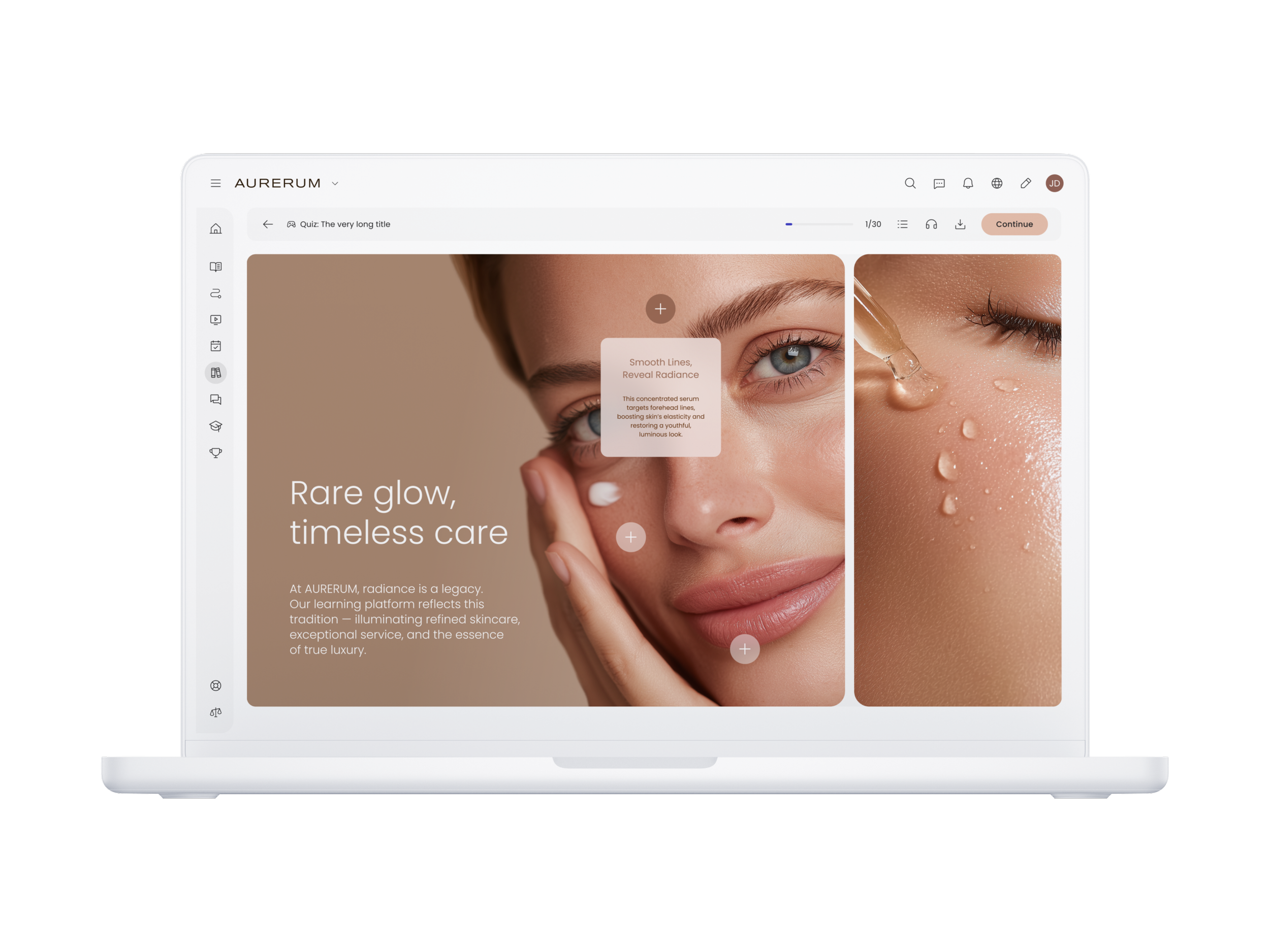
How TheLearning Lab LMS is the solution for Multi-brand corporations
A boutique LMS that respct scale and identity.
Multi brand fashion groups do not need to choose between scale and identity. They need to design for both. That is the central lesson behind this article. Group level efficiency is important, but it becomes harmful when it erases the very differences the customer is meant to feel.
One shared LMS can work, but only if it supports many brand voices. Learning should be structured not only by brand, but also by role and market. Shared foundations are useful, but customer facing excellence should stay close to each brand. Store culture, service rituals, and visual identity should be visible inside training, not left to chance. Governance should create standards without suffocating local relevance.
This is also what enterprise retail teams should look for in an LMS when they are choosing a platform for multiple brands. They need branded environments, role based learning paths, mobile access, multilingual structure, interactive formats, clear governance tools, and a design logic that respects how fashion retail actually works.
A generic learning platform may centralize content, but it rarely protects brand nuance well enough. A retail first LMS is far more likely to understand the real challenge, which is how to scale one learning culture without turning the portfolio into one generic retail voice. The Learning Lab is especially relevant here because its public positioning is built around branded LMS environments, retail first learning, interactive content, learning paths, and practical support for distributed retail networks.
For enterprise fashion groups, that makes the decision much clearer. The learning system should not only make training easier to manage. It should make the brand portfolio easier to protect. When the LMS helps each brand remain distinct while giving the group stronger structure, visibility, and adoption, learning becomes more than a support function. It becomes part of how the enterprise grows without losing itself.
Data consistently shows that when learning is aligned with brand experience and retail reality, the impact is significant:
+40% improvement in knowledge retention with blended and experiential learning approaches
+20–35% increase in engagement when using interactive and social learning formats
1.5–2x higher revisit rates with microlearning and mobile-first content
+18–25% uplift in sales performance when training is directly linked to retail execution
30–40% faster onboarding for new retail employees with structured learning paths
This is where The Learning Lab makes the difference:
Multi-brand white-label environments preserving each brand’s identity
Central governance with local flexibility by market and role
Retail-first design aligned with real store operations
Interactive, video-driven learning to support storytelling and product mastery
Scalable architecture for global, multi-language deployment
