

Beauty Training: Why Product Knowledge Alone Is No Longer Enough
The beauty retail landscape has changed dramatically over the past decade.
Empowered by social media, beauty influencers, online reviews, ingredient databases, and AI-powered recommendations, today’s consumers often arrive in-store with more information than ever before.
What they seek is no longer simply product information they can find that online in seconds. Instead, they are looking for guidance, reassurance, personalization, and human connection. They want advisors who can understand their unique needs, recommend tailored solutions, and help them navigate an increasingly complex beauty market. As a result, the role of the beauty advisor is evolving from product expert to trusted consultant.
Success now depends not only on knowing what a product does, but on the ability to create memorable experiences, build relationships, tell compelling brand stories, and seamlessly connect the physical and digital customer journey. For beauty brands, this shift represents both a challenge and an opportunity: developing a new generation of advisors capable of delivering the personalized, experience-driven service that modern consumers expect.
While product expertise remains essential, today’s beauty consumer expects far more than a product recommendation.
They expect personalization.
They expect consultation.
They expect inspiration.
They expect a seamless experience across physical and digital channels.
As customer expectations evolve, the role of the beauty advisor is undergoing a profound transformation.
The most successful advisors are no longer simply product experts. They are becoming beauty consultants, storytellers, community builders, and brand ambassadors.
The question for beauty brands is no longer:
“Do our advisors know our products?”
But rather:
“Are our advisors equipped to create meaningful customer experiences?”
Product Knowledge Is Now the Starting Point, Not the Destination
For decades, product knowledge has been the foundation of beauty advisor training.
Advisors were expected to master product benefits, ingredients, formulations, application techniques, and brand collections. While these competencies remain essential, they are no longer enough to differentiate the in-store experience.
Today’s beauty consumers are more educated and empowered than ever before. Before visiting a store, many have already spent hours researching products online. They have watched tutorials and reviews on TikTok and YouTube, followed beauty influencers on Instagram, compared ingredient lists, read customer feedback, and even used AI-powered tools to receive personalized skincare or makeup recommendations.
As a result, customers often arrive with a shortlist of products already in mind. The challenge is no longer providing information that is readily available online. The challenge is helping customers make sense of that information.
Consumers are faced with an overwhelming number of choices, conflicting opinions, and complex ingredient claims. They may know what a product promises, but they are often unsure whether it is the right solution for their specific needs, lifestyle, skin type, or beauty goals.
This is where the modern beauty advisor creates value. Rather than acting as a source of information, they become a trusted guide who can interpret, personalize, and contextualize information. They help customers navigate complexity, build confidence in their decisions, and ultimately find solutions that feel right for them.
The most successful advisors understand that expertise is no longer measured solely by what they know. It is measured by their ability to transform knowledge into meaningful guidance and create an experience that customers cannot replicate online.
Before stepping into a boutique, they may have:
Watched product reviews on TikTok
Followed beauty influencers
Compared ingredients online
Read customer reviews
Received AI-generated skincare recommendations
Consultation Skills Have Become a Competitive Advantage
As beauty consumers become more informed, their expectations for personalized service continue to rise. No two customers are the same.
Each individual brings a unique combination of skin concerns, beauty goals, lifestyle habits, budget considerations, and personal values. Some may prioritize clean beauty and sustainability, while others are looking for performance-driven solutions or the latest innovations. In this environment, a one-size-fits-all recommendation is no longer sufficient.
This shift has elevated consultation skills from a desirable competency to a critical business advantage. Today’s beauty advisors must be able to uncover customer needs through meaningful conversations rather than simply presenting products. They need to ask thoughtful questions, listen actively, identify underlying concerns, and adapt their recommendations accordingly. The ability to understand a customer’s unique situation is often what separates an average interaction from an exceptional one.
Successful consultation is also about building trust. Customers are increasingly seeking guidance from advisors who demonstrate genuine interest in helping them achieve their goals rather than simply making a sale. When advisors take the time to understand a customer’s needs and provide tailored recommendations, they create confidence in both the product and the brand.
The most effective beauty advisors understand that the consultation process should never begin with a product. It should begin with the customer. By focusing first on understanding the individual, advisors can create more relevant recommendations, stronger emotional connections, and ultimately a more memorable and valuable customer experience.
Every customer has different:
Skin concerns
Beauty routines
Lifestyle preferences
Budget expectations
Sustainability priorities
Modern beauty advisors must be able to:
Ask the right questions
Listen actively
Diagnose customer needs
Recommend tailored solutions
Build trust quickly
The best advisors don’t start with products.
They start with the customer.
Storytelling Creates Emotional Connection
In a world saturated with product claims, ingredient lists, and marketing messages, storytelling has become one of the most powerful tools available to beauty advisors.
While customers may forget technical specifications or scientific terminology, they are far more likely to remember how a product made them feel and the story that brought it to life.
The most effective beauty advisors understand that consumers do not buy ingredients—they buy outcomes, experiences, and emotions. A customer is rarely excited by the mention of a specific active ingredient alone. What resonates is understanding how that ingredient can help them achieve healthier-looking skin, greater confidence, or a more enjoyable beauty routine.
This is where storytelling creates value. By translating technical information into relatable and meaningful narratives, advisors help customers connect product benefits to their personal goals. Instead of focusing solely on what a product contains, they explain how it can fit into a customer’s lifestyle, solve a specific concern, or enhance a daily ritual. The conversation becomes less about features and more about transformation.
Storytelling also plays a critical role in communicating brand identity. For luxury and premium beauty brands, products are often built upon a rich heritage, unique craftsmanship, scientific innovation, or a distinctive vision of beauty. Advisors who can confidently share these stories help customers understand what makes a brand unique and create a deeper emotional connection with it.
Ultimately, storytelling transforms a transactional interaction into a memorable experience. It allows customers to see themselves in the story, imagine the results, and feel more confident in their purchase decision. In an increasingly competitive beauty market, that emotional connection can be the difference between a one-time purchase and long-term brand loyalty.
Instead of saying:
“This serum contains hyaluronic acid.”
They explain:
“This serum helps your skin retain moisture throughout the day, making it feel smoother and more radiant.”
Storytelling helps customers understand not just what a product is, but why it matters to them.
For luxury and premium beauty brands, storytelling is often the difference between a transaction and an experience.
Omnichannel Beauty Is Redefining the Customer Journey
The beauty customer journey has become increasingly fluid. Consumers no longer follow a linear path from discovery to purchase.
Instead, they move seamlessly between digital and physical channels, researching products online, engaging with brands on social media, attending virtual consultations, browsing mobile apps, and visiting stores—often within the same purchasing journey.
A customer may discover a product through a TikTok video, read reviews on a brand’s website, add items to a wishlist in a mobile app, and then visit a boutique to seek personalized advice before making a purchase. Another customer may receive a recommendation in-store and later complete the purchase online. The distinction between digital and physical retail is rapidly disappearing.
As a result, the role of the beauty advisor is expanding beyond the walls of the store. Advisors are increasingly expected to deliver consistent, high-quality experiences across multiple touchpoints, ensuring that customers receive the same level of expertise and personalization regardless of where the interaction takes place.
This evolution requires a new set of competencies. Advisors must be comfortable demonstrating products through digital channels, conducting virtual consultations, understanding social commerce trends, and helping customers transition smoothly between online and offline experiences. They also need to be familiar with the digital tools and platforms that customers use throughout their purchasing journey.
For beauty brands, this shift presents an important challenge: training advisors not only to excel in face-to-face interactions but also to engage customers effectively in a digitally connected world. The advisor of tomorrow must be as confident navigating a virtual consultation as they are welcoming a customer into a boutique. Those who can successfully bridge these two worlds will play a critical role in creating the seamless, omnichannel experiences that modern consumers increasingly expect.
Customers move continuously between:
Brand websites
Social media
Mobile apps
Online consultations
Physical boutiques
Beauty advisors increasingly need to support customers across multiple touchpoints.
This requires new skills:
Digital product demonstration
Social commerce awareness
Virtual consultation techniques
Online-to-offline continuity
The advisor of tomorrow must be comfortable operating in both physical and digital environments.
Clientelling Is Becoming Essential
In today’s competitive beauty market, attracting new customers requires significant investment in marketing, advertising, influencer partnerships, and digital acquisition strategies.
Yet while acquiring a customer is increasingly costly, retaining an existing one remains one of the most effective drivers of long-term growth and profitability. This reality is pushing beauty brands to place greater emphasis on clienteling and relationship-building initiatives.
Clienteling goes far beyond collecting customer data or enrolling shoppers in a loyalty program. It is about creating meaningful, personalized relationships that encourage customers to return, engage, and develop a lasting connection with the brand. In this context, beauty advisors have become one of the most important touchpoints in the customer experience.
Modern beauty advisors are no longer focused solely on completing transactions. They are expected to build trust over time, remember customer preferences, provide personalized recommendations, and maintain ongoing engagement beyond the initial purchase. Whether through tailored product suggestions, follow-up communications, invitations to exclusive events, or timely replenishment reminders, advisors play a key role in nurturing customer loyalty.
Technology has made these interactions easier to scale, but successful clienteling remains fundamentally human. Customers value feeling recognized, understood, and cared for. When advisors demonstrate a genuine understanding of individual needs and preferences, they create a level of personalization that is difficult for competitors to replicate.
For beauty brands, the benefits are significant. Strong clienteling strategies can increase customer retention, drive repeat purchases, improve loyalty program participation, and strengthen brand advocacy. More importantly, they transform customer relationships from transactional to emotional.
The most successful beauty advisors understand that their role does not end when a customer leaves the store. Every interaction is an opportunity to strengthen the relationship and create reasons for the customer to return. The objective is no longer to maximize a single sale. It is to build trust, loyalty, and lifetime value through meaningful and personalized experiences.
Beauty advisors now play a critical role in:
Customer retention
Repeat purchases
Loyalty programs
Personalized follow-ups
Product replenishment recommendations
The goal is no longer a single sale.
The goal is a lasting relationship.
Soft Skills Are Driving Performance
While technical expertise remains a fundamental requirement for beauty advisors, it is often soft skills that determine the quality of the customer experience and ultimately influence business performance.
In an industry built on personal interaction, trust, and confidence, the ability to connect with customers on a human level has become just as important as understanding products and ingredients.
Today’s consumers expect more than accurate information. They want to feel understood, valued, and supported in their decision-making process. This requires advisors to demonstrate empathy, communicate clearly, listen attentively, and adapt their approach to different personalities, needs, and situations. An advisor who can build rapport and create a comfortable environment is often more effective than one who simply possesses extensive technical knowledge.
Emotional intelligence has become particularly valuable in beauty retail. Customers frequently seek advice on topics that can be personal and emotionally sensitive, such as skin concerns, aging, self-confidence, or appearance. Advisors who can navigate these conversations with sensitivity and authenticity are more likely to establish trust and create meaningful customer relationships.
Confidence also plays a critical role. Customers naturally look to advisors for reassurance and guidance. When recommendations are delivered with confidence and professionalism, customers feel more secure in their purchasing decisions. Similarly, adaptability enables advisors to respond effectively to changing customer expectations, new product launches, and evolving retail environments.
The impact of these skills extends far beyond customer interactions. Strong communication, empathy, and emotional intelligence can directly influence customer satisfaction, conversion rates, average transaction value, loyalty, and repeat business. They help create memorable experiences that encourage customers to return and recommend the brand to others.
As the role of the beauty advisor continues to evolve, soft skills are no longer optional competencies. They are strategic capabilities that drive both customer experience and commercial success. Beauty brands that invest in developing these skills are not simply training better advisors—they are building stronger customer relationships and creating a sustainable competitive advantage.
But increasingly, the strongest predictors of success include:
Empathy
Communication
Active listening
Confidence
Adaptability
Emotional intelligence
These skills directly influence:
Customer satisfaction
Conversion rates
Average basket value
Loyalty and retention
Beauty brands that invest in soft skills training often see measurable improvements in customer experience and commercial performance.

What This Means for Learning & Development Teams
The evolving role of the beauty advisor presents a significant challenge and opportunity for Learning & Development teams.
While product education remains a critical component of retail training, it can no longer be the sole focus of learning programs. Today’s beauty advisors are expected to master a far broader set of competencies that directly influence customer experience, loyalty, and business performance.
Many training programs continue to prioritize product launches, ingredient knowledge, and technical specifications. While these subjects are essential, they represent only one part of the skills required to succeed in modern beauty retail. Advisors are increasingly expected to act as consultants, storytellers, relationship builders, and omnichannel brand ambassadors. Developing these capabilities requires a more holistic approach to learning.
Future-ready training strategies must combine product expertise with practical customer-facing skills. Advisors need to understand not only what products do, but also how to uncover customer needs, communicate benefits in a compelling way, build long-term relationships, and deliver consistent experiences across digital and physical channels. Equally important are the soft skills that underpin every successful customer interaction, including empathy, communication, adaptability, and emotional intelligence.
This shift also requires a transformation in how learning is delivered. Traditional knowledge-based training alone is no longer sufficient. Beauty advisors need opportunities to practice conversations, explore real-life customer scenarios, receive coaching, and develop confidence through continuous learning experiences. Role-playing, video-based learning, peer collaboration, coaching programs, and scenario-driven exercises can help bridge the gap between knowledge and performance.
Ultimately, the objective of beauty training is no longer simply to transfer information. It is to develop capabilities that enable advisors to create meaningful customer experiences and deliver measurable business outcomes. Learning & Development teams that embrace this broader vision will be better positioned to support the next generation of beauty advisors—and help their brands thrive in an increasingly customer-centric retail environment.
Future-ready learning strategies should combine:
Product Expertise
Understanding ingredients, benefits, routines, and innovation.
Consultation Skills
Customer discovery and needs analysis.
Storytelling
Communicating value through engaging narratives.
Clienteling
Building long-term customer relationships.
Omnichannel Excellence
Supporting customers across digital and physical channels.
Soft Skills
Empathy, communication, and emotional intelligence.
Training must move beyond information delivery and focus on capability building.
Conclusion: The Future Beauty Advisor Is a Relationship Builder
The role of the beauty advisor is evolving faster than ever before. In an industry where consumers have unlimited access to information, product knowledge alone is no longer a competitive advantage it is the minimum expectation.
Tomorrow’s most successful beauty advisors will be those who can combine expertise with consultation, storytelling, personalization, clienteling, emotional intelligence, and digital fluency. They will be trusted guides who help customers navigate choices, build confidence, and create meaningful connections with brands. They will not simply sell products; they will deliver experiences that customers remember and relationships that customers value.
For beauty brands, this evolution represents a tremendous opportunity. Organizations that invest in developing these broader capabilities will not only improve customer satisfaction but also increase loyalty, drive repeat purchases, strengthen brand advocacy, and ultimately improve retail performance. The challenge is that these skills cannot be developed through traditional product training alone. They require a new approach to learning—one that is continuous, engaging, practical, and closely connected to real-world customer interactions.
This is precisely where The Learning Lab stands apart.
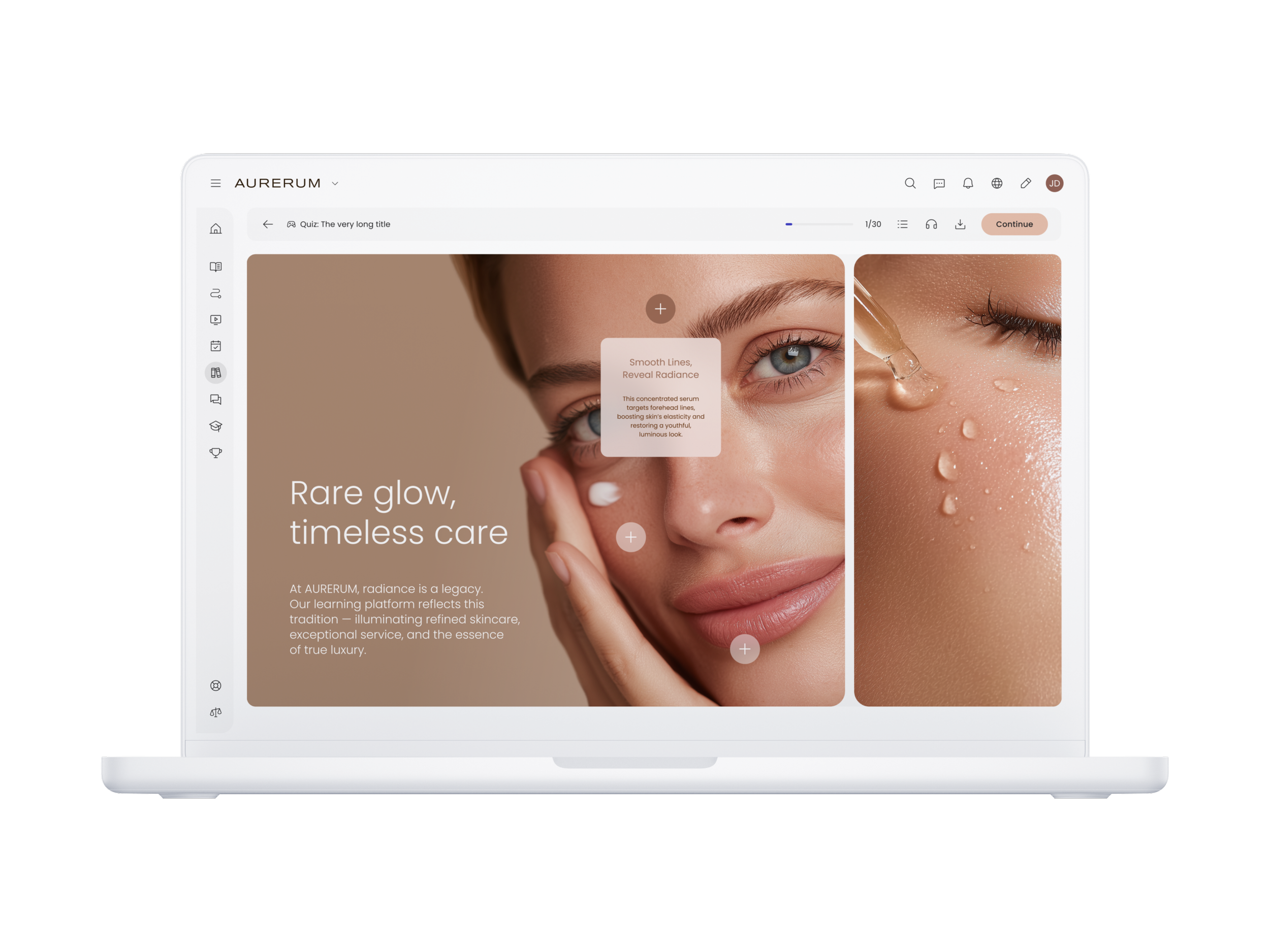
Built specifically for retail and luxury brands, The Learning Lab goes far beyond traditional LMS platforms that focus primarily on content delivery and compliance training. Our platform is designed to help beauty brands develop modern advisors through immersive, branded learning experiences that mirror the realities of the sales floor.
With video-based learning, microlearning journeys, interactive scenarios, social learning, assessments, coaching tools, certifications, and AI-powered learning experiences, brands can train advisors not only on what to know, but on how to apply that knowledge in customer conversations. Advisors can practice consultation techniques, learn storytelling strategies, master clienteling approaches, and develop the soft skills that drive performance in today’s beauty environment.
Equally important, The Learning Lab understands the unique requirements of beauty retail. Product launches, seasonal campaigns, omnichannel initiatives, loyalty programs, and customer experience standards can be delivered quickly and consistently across global retail networks through engaging mobile-first learning experiences. Whether advisors are in a flagship boutique, a department store, a travel retail location, or working remotely, they can access learning that is relevant, personalized, and immediately actionable.
As beauty retail continues to evolve, learning can no longer be viewed as a support function. It has become a strategic driver of customer experience and business performance.
The future belongs to brands that can transform product experts into relationship builders.
And that transformation starts with the right learning strategy—and the right learning partner.