

Rethinking the LMS: Why Simplicity Outperforms Complexity
Has the LMS Become Overcomplicated? What If Simplicity Was the Real Breakthrough
Over the years, we’ve turned LMS platforms into feature-heavy machines—layer upon layer of tools, dashboards, workflows, and now AI.
What started as a solution to enable learning has often become an ecosystem that demands time, attention, and effort just to navigate. In a world where learners are constantly interrupted and time-poor, this complexity can quickly become a barrier rather than a benefit.
The real question is no longer how many features an LMS can offer, but whether it helps learners access knowledge quickly, intuitively, and in the moment of need—or whether it simply adds to their cognitive load and fatigue.

A. When complexity becomes the real blocker
A.01 / Complexity for Teams: When the LMS Becomes an Operational Burden
As LMS platforms grow more sophisticated, they often become harder to manage for the very teams meant to run them.
Over-engineered architectures, complex hierarchies, and endless configuration options require constant maintenance, training, and governance.
Instead of accelerating learning delivery, this complexity absorbs time and energy, shifting focus away from content quality and learner engagement.
When internal teams spend more time managing the system than supporting learners, the LMS stops being an enabler and becomes a bottleneck.
Key Impacts of LMS Complexity on Teams
Increased administrative workload
Complex LMS setups increase admin time by 30–40%, reducing capacity for strategic learning initiatives.
Slower execution and updates
Content updates, launches, and changes take longer due to dependencies and rigid structures.
Higher risk of errors
Multiple configurations and permissions increase the likelihood of mistakes and inconsistencies.
Greater training needs for admins
Internal teams require continuous upskilling just to operate the platform effectively.
Reduced agility
Overly complex systems make it harder to react quickly to business, product, or market changes.
Lower team satisfaction
Admin frustration leads to disengagement and under-utilisation of the platform’s potential.
When simplicity is replaced by complexity, teams lose speed and focus. Streamlined LMS structures free up time, reduce friction, and allow learning teams to concentrate on what truly matters: creating impactful learning experiences for learners.
A.02 / Global LMS Feature Overload: When More Capabilities Create Less Value
Many global LMS platforms compete on the promise of “everything in one place.”
Over time, this leads to an accumulation of features designed to satisfy every possible use case—often at the expense of clarity and usability.
While feature richness looks impressive in demos, research shows that the majority of these capabilities remain unused in real life.
Instead of empowering learners and teams, excessive features clutter interfaces, complicate workflows, and dilute the core purpose of learning: quick access to relevant knowledge.
Key Impacts of Feature Overload in Global LMS Platforms
Low feature adoption
Studies indicate that around 60% of LMS features are rarely or never used by learners or administrators.
Increased user confusion
Complex menus and multiple options slow down navigation and increase cognitive load.
Lower learner engagement
Feature-heavy interfaces contribute to higher drop-off rates and lower completion levels.
Slower onboarding for users
New users take longer to understand how to use the platform effectively.
Reduced return on investment
Organizations pay for features that deliver little to no practical value.
Inconsistent usage across regions
Global platforms often see fragmented adoption, with teams using only a small subset of tools.
A global LMS doesn’t need more features—it needs the right ones. By focusing on usability, relevance, and real learner behavior, organizations can reduce noise, improve adoption, and create learning experiences that actually deliver impact.
A.03 / Unclear Learning Duration: When Training Exceeds Learners’ Attention Span
One of the most common mistakes in digital learning design is underestimating how long learners can realistically stay focused.
In today’s mobile-first, interruption heavy environments, attention is limited and fragmented.
When learning sessions are too long or poorly structured, engagement drops rapidly especially for frontline and retail teams. Without clear, intentional learning durations, training becomes something learners postpone, rush through, or abandon altogether.
Key Impacts of Poorly Defined Learning Duration
Limited attention span
Learners can maintain focused attention for 5–10 minutes per session, particularly on mobile devices.
Higher disengagement rates
Learning modules longer than 15–20 minutes see significantly higher drop-off and incomplete rates.
Reduced knowledge retention
Long sessions overload working memory, reducing retention by up to 40%.
Lower mobile adoption
Mobile learners are far more likely to engage with short, focused learning moments than long courses.
Increased procrastination
Long learning paths discourage starting altogether, especially in high-pressure work environments.
Better outcomes with microlearning
Short learning formats improve completion rates by 50%+ and fit naturally into daily workflows.
Clear learning durations are not a limitation—they are a design principle. By respecting attention spans and designing for short, intentional learning moments, organizations can increase engagement, retention, and real-world application of knowledge.

A.04 / Cognitive Overload & Heavy UX: When the Interface Works Against Learning
Learning platforms are meant to support understanding not compete for attention.
Yet many LMS interfaces are overloaded with menus, options, and visual noise that overwhelm learners before learning even begins.
When users must spend cognitive effort navigating the platform, less mental capacity remains for absorbing information.
Research shows that complex interfaces significantly reduce knowledge retention and increase abandonment, turning learning into a frustrating experience rather than an effective one.
Key Impacts of Cognitive Overload in LMS Design
Reduced knowledge retention
Cognitive overload and complex UX can reduce retention by up to 40%.
Higher drop-off rates
Learners are far more likely to abandon courses when navigation is unclear or visually overwhelming.
Increased time to complete tasks
Heavy interfaces slow down access to content, increasing frustration and fatigue.
Lower engagement on mobile
Complex UX performs especially poorly on mobile, where screen space and attention are limited.
Reduced learner confidence
Confusing interfaces create hesitation and reduce learners’ sense of control.
Poor first impressions
Early friction leads to lower long-term adoption and repeat usage.
Simplicity in UX is not about removing value—it’s about removing friction. By reducing cognitive load and designing intuitive, clean interfaces, learning platforms can dramatically improve retention, engagement, and overall learning effectiveness.
can you write a title, paragraph and resume with bullet points and data: Overuse of AI, underuse of brand
AI-generated content without strong branding and personalization leads to generic learning experiences that fail to engage emotionally.
B. What if simplicity was the real solution?
B.01 / Short Cards & Scrollable Videos: Learning That Fits the Flow of Work
In time-constrained environments, learning must adapt to how people actually consume information.
Short cards and scrollable video formats mirror everyday digital behaviours quick glances, vertical scrolling, and instant access to key insights.
Instead of asking learners to “make time” for training, bite-sized content meets them where they are, allowing learning to happen naturally between tasks. This approach transforms learning from a scheduled activity into a continuous, low-effort habit.
Key Benefits of Short Cards & Scrollable Video Formats
Higher completion rates
Bite-sized learning formats improve completion rates by 50%+ compared to long modules.
Better alignment with attention spans
Short formats respect the 5–10 minute attention window typical of mobile and frontline learners.
Increased mobile adoption
Scrollable, vertical content performs significantly better on mobile devices.
Faster access to knowledge
Learners can find and consume information in seconds, reducing friction and cognitive load.
Improved knowledge retention
Short, focused content improves recall and understanding by avoiding overload.
Seamless integration into daily work
Learning moments fit naturally between meetings, client interactions, or operational tasks.
Higher repeat engagement
Easy, fast consumption encourages learners to return regularly.
Short cards and scrollable videos don’t simplify learning—they optimize it. By designing content for speed, clarity, and habit-building, organizations create learning experiences that are more engaging, more accessible, and far more effective in the flow of work.

B.02 / Netflix-Style Video Channels: How Curation Replaces Learning Paths
Today’s learners don’t want to “navigate” training they want to discover it.
Netflix-style video channels and layouts apply the logic of modern media platforms to learning: curated feeds, smart filters, and visual cues that guide attention without forcing rigid pathways.
Instead of long, predefined learning paths, learners explore relevant content on demand, driven by interest, context, and immediacy. This shift from structured navigation to content discovery aligns learning with how people naturally consume information every day.
Key Benefits of Netflix-Style Video Channels in Learning
Higher engagement rates
Curated video feeds increase engagement by 2–3× compared to traditional course catalogs.
Faster content discovery
Widgets and filters reduce time to content access by 30–50%.
Improved learner autonomy
On-demand exploration increases voluntary learning and repeat visits.
Better alignment with modern habits
Learners already spend hours per week consuming video via streaming platforms.
Reduced cognitive friction
No rigid paths means less mental effort and lower drop-off rates.
Stronger mobile performance
Visual, scroll-based layouts perform significantly better on mobile devices.
Scalable personalization
Filters, tags, and recommendations adapt content to role, interest, and context.
Netflix-style learning doesn’t remove structure—it hides it behind simplicity. By replacing rigid learning paths with curated video experiences, organizations create learning environments that feel intuitive, engaging, and aligned with how people actually learn today.
B.03 / And If Video Was King? Why Video Dominates Modern Learning
In a world shaped by streaming, social media, and visual storytelling, video has become the most natural and engaging way to consume information.
For learning, video removes friction by showing rather than telling making concepts easier to understand, faster to absorb, and more memorable.
As learners increasingly expect the same quality and immediacy they experience in everyday media, video-based learning is no longer a “nice to have” but a core driver of engagement and performance.
Why Video Outperforms Text-Heavy Learning
2–3× higher engagement
Video content generates two to three times more engagement than text-heavy formats.
Improved knowledge retention
Learners retain up to 65% more information when it is presented visually.
Faster understanding
Video accelerates comprehension by combining visuals, narration, and context.
Higher completion rates
Courses centered on video see significantly higher completion and lower drop-off.
Stronger emotional connection
Video conveys tone, emotion, and storytelling—key drivers of memory and motivation.
Better mobile performance
Video is the most consumed content format on mobile devices worldwide.
Consistent message delivery
Video ensures uniform communication across teams, stores, and regions.
If engagement is the goal, video is the answer. By placing video at the heart of learning experiences, organizations align training with how people naturally consume information—turning learning into something learners want to return to, not avoid.
B.04 / The Power of Podcasts & Audio: Learning Without Stealing Time
In busy work environments, finding dedicated time to learn is often the biggest challenge.
Podcasts and audio-based learning solve this by fitting seamlessly into daily routines during commutes, between tasks, or while performing low-attention activities.
Unlike screen-based formats, audio doesn’t demand visual focus, making learning more accessible, flexible, and less intrusive.
As a result, teams can significantly increase their learning time without feeling additional pressure or overload.
Why Audio Learning Works
Increased total learning time
Audio formats can increase overall learning time by 20–30% by utilizing “dead time” such as commuting.
High completion rates
Podcasts show higher completion rates than long-form digital courses due to their ease of consumption.
Reduced cognitive load
Audio learning allows focused listening without visual complexity, lowering mental fatigue.
Stronger habit formation
Regular podcast formats encourage repeat engagement and ongoing learning routines.
Improved accessibility
Audio supports inclusive learning for users who struggle with screen fatigue or visual overload.
Better knowledge retention
Story-driven audio content improves recall by reinforcing information through narrative and repetition.
Perfect complement to video and live learning
Audio reinforces concepts before or after training sessions without adding extra time demands.
Audio learning doesn’t compete with work—it flows around it. By leveraging podcasts and audio formats, organizations extend learning beyond the screen, creating continuous development opportunities that respect learners’ time and energy.
B.05 / Interaction Over Consumption: Why Learning Sticks When People Engage
Learning is not a passive activity. While consuming content is easy, real understanding and long-term retention happen through interaction discussion, reflection, and feedback.
When learners are invited to react, question, share experiences, and exchange perspectives, knowledge becomes active rather than theoretical.
Social and interactive learning taps into how the brain naturally learns, transforming information into shared understanding and practical skills.
Why Interaction Drives Better Learning Outcomes
Up to 30% higher retention
Discussions, feedback, and social learning increase knowledge retention by up to 30%.
Stronger application on the job
Interactive learning improves transfer of knowledge into real behaviors by 25–40%.
Higher learner engagement
Social formats generate higher participation and repeat usage than passive content.
Deeper understanding
Explaining ideas to others reinforces comprehension and long-term memory.
Faster problem-solving
Peer discussions surface real-life solutions and best practices more quickly.
Increased motivation
Feeling heard and involved increases intrinsic motivation to learn.
Better alignment with real challenges
Learner-generated discussions reflect real-world situations, not theoretical cases.
B.06 / Storytelling & Blended Learning: Where Knowledge Becomes Behaviour
Facts inform, but stories transform. Storytelling gives meaning to information, creating emotional connections that help learners remember and relate knowledge to real situations.
When combined with blended learning mixing digital content with live sessions, coaching, and real-world practice stories move beyond inspiration and drive real behavioral change.
This combination ensures learning is not only understood but applied, making it one of the most powerful approaches to sustainable performance.
Why Storytelling & Blended Learning Drive Real Impact
Stronger memory retention
Information delivered through stories is up to 22× more memorable than facts alone.
Emotional engagement boosts recall
Emotionally charged content significantly increases long-term memory retention.
Better transfer to real behavior
Blended learning improves on-the-job application by 30–40% compared to digital-only formats.
Higher learner engagement
Story-driven content generates higher attention and completion rates.
Deeper understanding of context
Stories help learners understand why behaviors matter, not just what to do.
Reinforced learning through practice
Live sessions, coaching, and in-field application anchor knowledge in real experience.
Stronger alignment with brand culture
Storytelling transmits values, heritage, and mindset—especially critical in premium and retail environments.
Storytelling makes learning memorable; blended learning makes it actionable. Together, they bridge the gap between knowledge and behavior, ensuring learning translates into real-world performance and lasting impact.

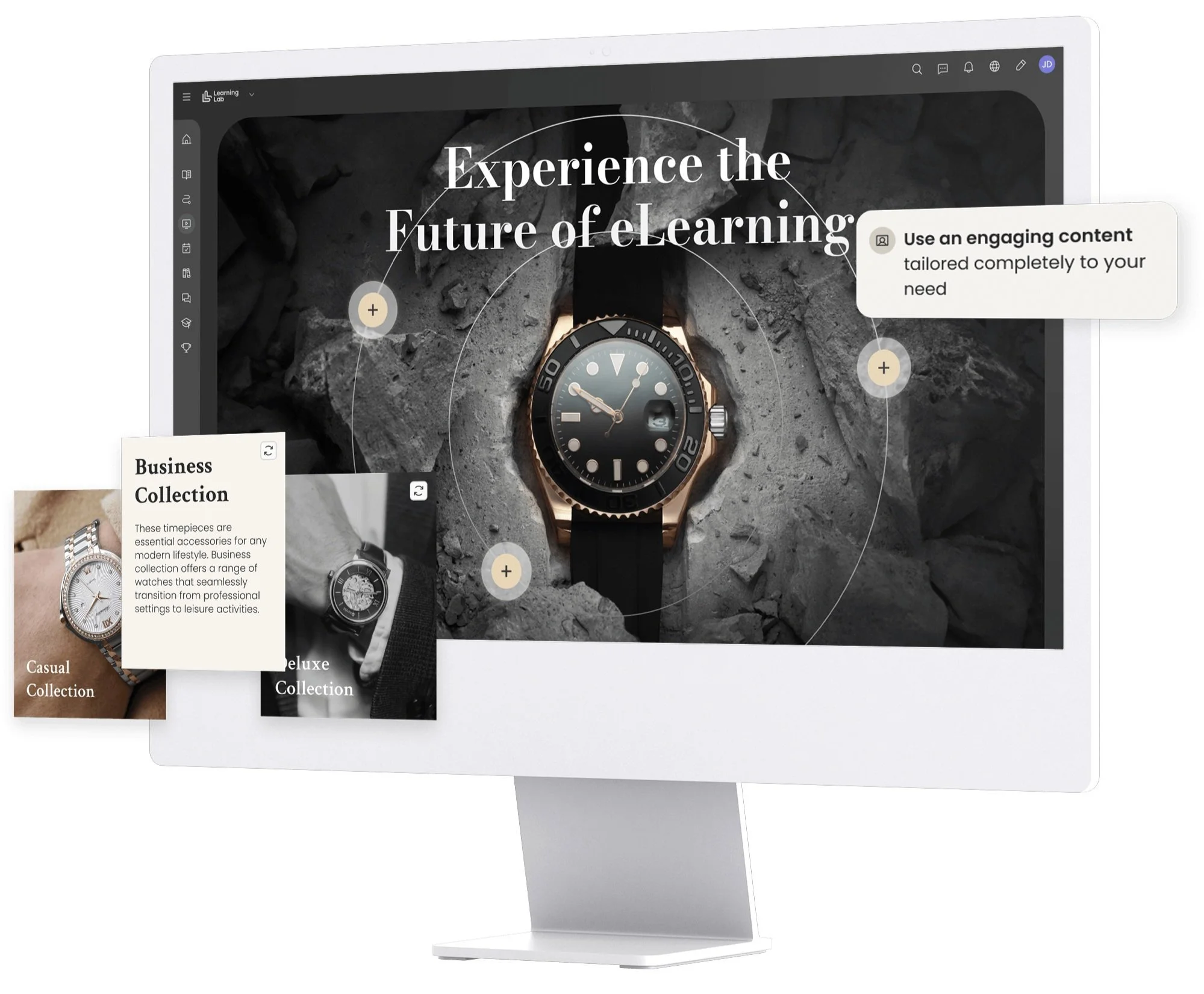
B.07 / Fully Branded, Truly Personalised: Why Learning Must Feel Like the Brand
Learning is far more effective when it feels familiar, relevant, and emotionally connected to the brand.
Fully branded and personalised learning environments go beyond aesthetics they embed brand values, tone of voice, and culture directly into the learning experience.
When learners recognize themselves and their brand in the content, engagement increases and knowledge sticks.
Personalisation ensures that each learner receives the right content, in the right format, at the right moment driving faster adoption and stronger impact.
Why Branded & Personalised Learning Drives Better Outcomes
Higher knowledge retention
Learning aligned with brand identity is remembered 20–30% longer than generic content.
Faster learner adoption
Personalized learning experiences increase adoption rates by 30–40%.
Stronger emotional connection
Brand-consistent design and storytelling create emotional memory, a key driver of recall.
Improved engagement
Personalized content increases engagement and completion rates by 25%+.
Greater relevance for learners
Role-based and context-aware content reduces noise and cognitive overload.
Better alignment with culture and values
Branded learning reinforces expected behaviors, service standards, and mindset.
Consistency across regions
Central brand identity combined with local personalization ensures global alignment with local relevance.
Higher perceived value of training
Learners perceive branded, tailored experiences as more premium and meaningful.
When learning looks, feels, and sounds like the brand, it stops being “training” and becomes part of the culture. Fully branded and truly personalized learning experiences accelerate adoption, deepen memory, and turn learning into a powerful extension of brand identity.
Provocative Conclusion: Rethinking the LMS. Why Simplicity Outperforms Complexity
Learners don’t lack motivation: they lack time.
In overloaded schedules and attention-scarce environments, complexity doesn’t inspire learning; it blocks it.
Social media didn’t win because it’s shallow.
It won because it’s simple, intuitive, emotional, and habit-forming.
If learning platforms want to compete for attention, they must stop asking learners to adapt to the LMS — and start adapting the LMS to how people naturally consume content today.
Less friction. More relevance. More emotion. More simplicity.
The real innovation in learning isn’t adding more features.
It’s removing everything that gets in the way.