

When AI Goes Too Far: The Hidden Risks for Premium Retail Training
Over-Automated Learning: How AI Can Dilute Brand Culture in Luxury Retail
In the premium retail space, the allure of automation generating training modules swiftly, personalising at scale, deploying across regions can seem like a magic bullet.
But when training development becomes fully automated, the risks multiply. Research shows that companies doing “personalisation done right” can see a 10-15 % lift in revenue.
Yet ironically, when training is automated without direct learner input (surveys, store-floor interviews, coach-to-learner dialogue), it becomes generic and unanchored to the brand’s lived-experience.
In a luxury retailer, where store stories, human craft, brand heritage and emotional connection matter, this dilution means that the modules may tick boxes but fail to resonate.
The consequence: learners feel the training was “made by machines for machines,” engagement drops, and the brand culture quietly erodes under the guise of “efficiency.”
When Automation Becomes Abdication: The Performance Pitfalls of Fully AI-Driven LMS in Premium Retail Training
In organisations that adopt a fully AI-supported Learning Management System where content development, learner management and learning-page workflows are entirely automated the promise of scale and speed often masks serious performance deficits.
Research in higher-education environments highlights that whilst AI-augmented LMS can deliver impressive efficiencies (one study found automation + analytics accounted for 76 % of variance in institutional efficiency) , the same systems struggle when it comes to human-centred outcomes: for example, predictive models trained on click-stream data achieved only ~78.7 % accuracy in identifying at-risk learners, and significantly worse for predicting high achievement. Source
In the context of premium retail where brand culture, human expertise, boutique storytelling and emotive connection are essential these performance gaps translate into real risk: training modules may be technically delivered but fail to engage learners, drive behaviour change, or protect brand identity.
When automation replaces crucial human-driven elements like learner surveys, coach-to-learner dialogue, store stories and craft narratives, the result is generic, detached learning journeys that deliver neither brand uplift nor measurable business impact.
Summary / Résumé with data
Fully automated AI-LMS approaches promise operational efficiency: one study reports that automation + data-analytics features in AI-LMS explained ~76 % of institutional efficiency variance.
But in practice, such systems exhibit weaker results in learner-centric metrics: e.g., models trained on LMS click-data predicted at-risk learners with ~78.7 % accuracy, and struggled to reliably identify high achievers.
In premium retail training, this gap is amplified: brand culture, human relationships, tacit knowledge and store-floor stories are hard to automate yet central for impact.
Risk: learning becomes mechanistic, detached from the brand experience, resulting in lower engagement, weaker retention, and minimal uplift in behaviour or sales.
Conclusion: Automation should support, not replace, the human-driven design, storytelling and personal connection central to premium-brand retail training.
AI & Online Training:
A Dangerous Liaison for Premium Retail (Fashion, Luxury, Cosmetics, Watches…)
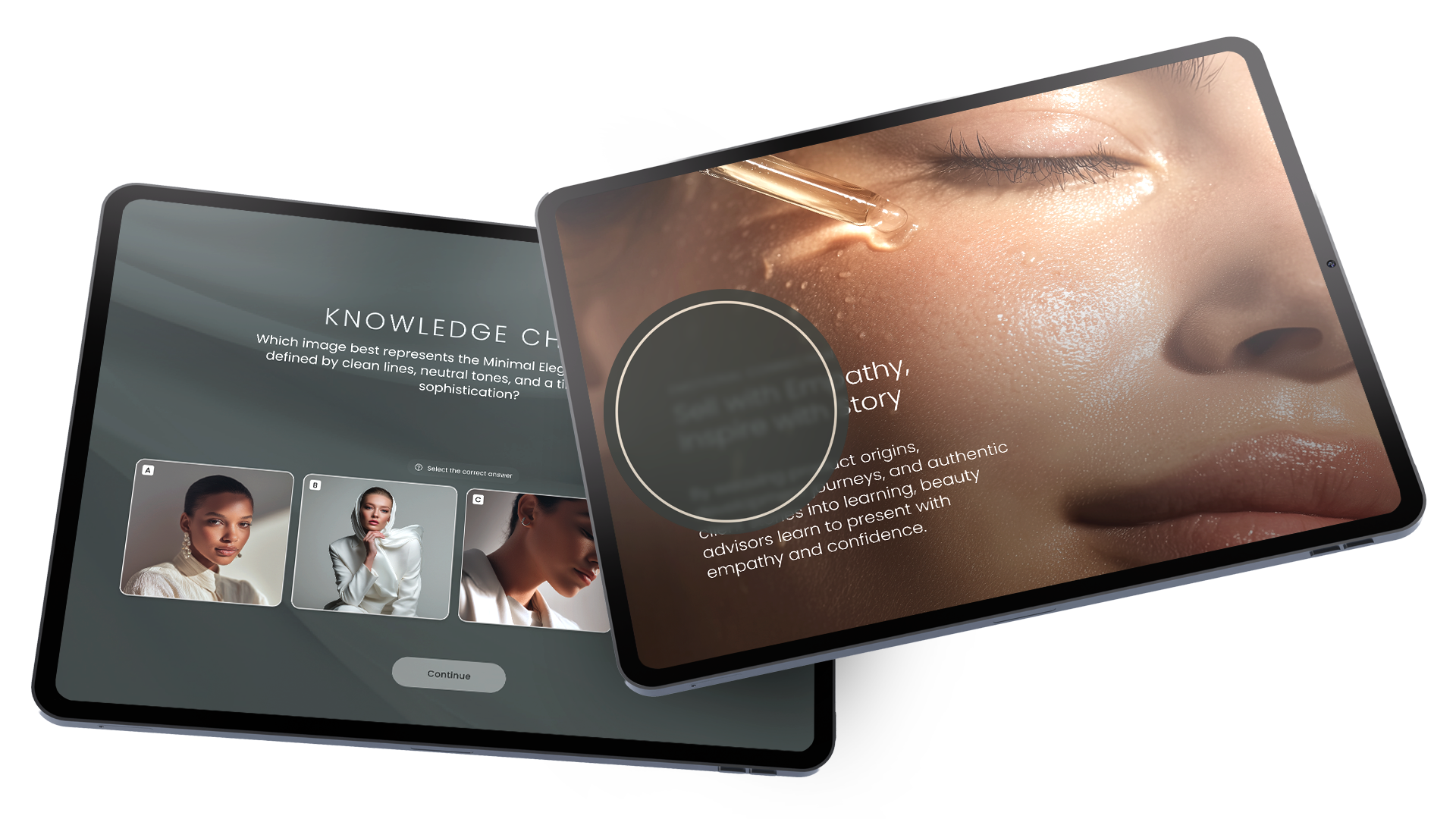
When Brand DNA Fades: How AI Can Dilute Luxury Storytelling and Retail Culture
AI can accelerate content creation, but in the luxury sector it often comes at a hidden cost: the dilution of brand DNA.
Studies show that 82% of consumers expect brands to share their values and identity clearly, and over 70% say emotional connection strongly influences loyalty and purchasing (Harvard Business Review, Deloitte).
Yet AI-generated training materials tend to flatten tone and rely on pattern replication—producing repetitive, generic narratives rather than the nuanced stories rooted in heritage, craft, or maison culture. Research on generative models shows that up to 60–80% of generated text clusters around the same linguistic patterns, reducing stylistic diversity and personalisation.
This “copy-paste” storytelling is particularly damaging in premium retail, where product narratives, atelier craftsmanship, and boutique anecdotes are essential to client experience.
When training becomes a stream of automated modules without human interviews, floor insights, or artisan voices, the result feels inorganic to both store teams and clients.
Luxury brands don’t thrive on sameness they thrive on uniqueness, authenticity and precision. To preserve brand culture, AI must remain an assistant, never the author: brands need curated stories, human dialogue with learners, and open communication that keeps the craftsmanship spirit alive.
Résumé
82% of consumers expect brands to clearly express their identity and values — emotional storytelling matters (HBR).
70%+ of purchasing decisions in luxury are influenced by emotional connection (Deloitte).
AI models naturally gravitate toward repetitive, averaged text patterns studies show 60–80% linguistic convergence in generative outputs.
This leads to generic, flattened brand tone instead of Maison-specific storytelling.
Heritage, craftsmanship, boutique anecdotes, and human expertise are elements AI cannot authentically recreate.
Automated training without surveys, interviews, or store-floor input results in generic “copy-paste” narratives that feel disconnected from reality.
For luxury brands, the consequence is erosion of brand culture, emotional impact, and story-driven product value.
What brands need:
Uniqueness — not averaged content
Authenticity — real stories, real voices
Precision — brand-specific tone and details
Human communication — open dialogue with learners, not just automated workflows
AI as an assistant — never the primary creator of cultural or storytelling content
When Expertise Disappears: How AI Weakens Human Knowledge in Premium Retail Training
Premium retail training is built on human expertise the sharp observational skills of store managers, the coaching finesse of trainers, and the lived boutique experience that only artisans and product specialists can transmit.
Yet as organisations over-automate learning creation and management, this irreplaceable human layer begins to fade. Research shows that 70% of workplace learning comes from on-the-job experience and human coaching, not formal content (70-20-10 model; CCL). Meanwhile, employees rate peer and manager guidance as up to 3× more impactful than digital modules alone (Bersin).
Definition: The 70-20-10 model (CCL) states that 70% of learning comes from on-the-job experience, 20% from coaching and feedback, and 10% from formal training, highlighting that real development is driven primarily by practical, human-centred learning.
When AI replaces these voices, training becomes theoretically “smart” but operationally irrelevant: it lacks floor reality, human nuance, and the storytelling that turns a product into a client experience.
Studies in retail also show that frontline teams retain 40–60% more information when knowledge is shared through real examples and expert scenarios, compared to generic digital scripts.
In luxury, expertise is the story — and only experts can tell it. Without human input, AI-generated content becomes detached from what truly drives performance: mastery, emotion, and real-life experience.
Why Human Expertise Matters
70% of learning in retail comes from real experience and human coaching (Center for Creative Leadership).
Peer and manager guidance is 2–3× more effective than digital modules alone (Bersin Institute).
Real boutique examples (storytelling) improve retention by 40–60% compared to generic content (retail learning studies).
What AI Overuse Creates
Training that feels “smart” on paper but irrelevant on the shop floor.
Loss of store stories, client moments, product anecdotes — the essence of luxury culture.
Generic AI-generated scripts that cannot replicate artisan knowledge or brand savoir-faire.
Reduced emotional impact because only experts can deliver authentic storytelling.
Key Risk: When human voices disappear, brand culture disappears.
AI cannot replace a store manager’s intuition, a trainer’s craft vocabulary, or an artisan’s story.

Disrupting Recommendation Engines: Hybrid Adaptive Learning for Strategic Skill Acquisition
Current AI-driven learning platforms suffer from a critical flaw: their dependence on past data results in Generic Recommendations and Misaligned Learning Paths.
This approach frequently overlooks crucial, unquantifiable elements like current floor realities, specific team needs, and essential emotional soft skills.
When recommender systems suggest irrelevant "next modules," learner trust erodes, and the entire learning journey becomes robotic rather than strategic.
The Learning Lab addresses this by introducing the Hybrid Adaptive Learning feature: a new need concept where the human manager guides the overall algorithm, enabling the AI to serve as a powerful assistant that tailors content delivery, ensuring learning paths are both relevant and emotionally intelligent.
The Legacy Problem: Fully Automated Learning Paths
Reliance on Past Data: Recommends modules based purely on completion rates and past cohorts, ignoring the dynamic, real-time context of the learner's current role and organizational shifts.
Irrelevant Module Suggestions: Frequently suggests irrelevant "next modules," leading to learner frustration and a direct drop in platform engagement and credibility.
Skill Deficiency: Fails to recognize or nurture critical "emotional soft skills" and on-the-floor tacit knowledge, resulting in technically proficient but strategically weak employees.
Eroding Trust: Learning journeys feel robotic and dictated by the machine, leading to passive compliance rather than active, motivated skill acquisition.
The Learning Lab Solution: Hybrid Adaptive Learning (HAL)
Human-Managed Algorithm: The platform incorporates human oversight where subject matter experts (SMEs) or managers define high-level strategic learning goals and contextual constraints.
AI-Assisted Personalization: The AI focuses on its strength—analyzing content, tracking progress velocity, and recommending micro-adjustments within the human-defined strategic corridor.
Focus on 'Need' Concept: Introduces a 'Need' layer, allowing human input to specify immediate organizational gaps or emerging skills required, bypassing generic historical data.
Strategic Journey: Ensures the learning journey remains strategic, with the human element validating relevance and the AI ensuring efficiency and personalized pacing.
Combating Skill Atrophy: Reintroducing Human Ingenuity via Social Learning
The increasing reliance on automated training tools has inadvertently created a new risk: Over-Reliance on Automation Creates Skill Atrophy.
When digital coaching becomes the default, human trainers may cease innovating or stop providing crucial qualitative feedback, while store managers rely too heavily on algorithmic guidance instead of essential in-person role-play.
This inaction risks the erosion of foundational leadership, effective coaching skills, and the unique, valuable "boutique savoir-faire" that defines high-performing teams.
To reverse this, the Learning Lab proposes leveraging Social and Peer-to-Peer learning through dynamic, User-Generated Content (UGC) activities, shifting the platform's focus from passive consumption to active, collaborative skill demonstration and exchange.
The Legacy Problem: Passive Automation Dependency
Trainer Innovation Stagnation: Human trainers stop creating and innovating content, relying on the platform's automatic flow, leading to stale and non-contextual material.
Qualitative Feedback Loss: The emphasis on automated scoring (e.g., completion percentages) displaces the need for trainers to provide valuable, nuanced qualitative feedback.
Erosion of Foundational Skills: Managers lose confidence and ability in critical soft skills like in-person coaching, role-playing, and immediate situational correction.
Risk of Boutique Savoir-Faire Loss: Unique, niche, high-value knowledge (savoir-faire) that cannot be codified in an algorithm is lost as human mentors become less active.
Low Stakeholder Buy-in: Key personnel (trainers, managers) feel sidelined by the technology, leading to low investment in the training process.
The Learning Lab Solution: Social and UGC Activities
Empowering Peer-to-Peer Exchange: Introduces features for easy sharing of best practices, success stories, and on-the-floor tips directly between frontline employees.
Structured UGC Campaigns: Launches high-impact activities (e.g., video submissions of role-plays, qualitative critiques of peer performance) that force active skill practice.
Manager as Validator/Coach: Managers shift from being content deliverers to expert curators and validators, providing high-value qualitative feedback on peer-generated content.
Re-Engaging Qualitative Feedback: Metrics shift to include peer ratings, manager feedback depth, and frequency of practical application submissions, rewarding qualitative effort.
Preservation of Savoir-Faire: Creates a digital repository of unique, hard-to-codify knowledge captured through authentic employee submissions.

The Emotional Divide: Reconnecting Brand Culture and Digital Training
A critical challenge for premium sectors, such as Luxury Retail, is the Disconnection Between Brand Culture and Digital Training.
Luxury is fundamentally built on human connection, deep empathy, and inspiring personal presence.
Excessive reliance on generic AI and automation can make training feel transactional, delivering facts but failing to instill the core emotional values of the brand.
This creates the severe risk that frontline teams lose the emotional bond with the brand, translating into standardized, uninspired service that compromises the luxury experience.
The solution lies in shifting training focus from compliance to inspiration, utilizing high-fidelity, emotionally resonant content, and integrating rituals that celebrate human connection and empathy within the digital curriculum.
The Legacy Problem: Transactional Digital Training
Value Misalignment: Digital training focuses on functional knowledge (SKUs, policies) rather than aspirational brand narratives, heritage, and emotional resonance.
Loss of Empathy Focus: AI-driven pathing measures efficiency over effectiveness in emotional engagement, failing to train for nuanced human interaction.
Training as Compliance: Content is consumed as a required task, feeling transactional and uninspiring, directly contradicting the luxury brand promise.
Risk to Brand Integrity: Teams lack the emotional tools and personal presence required to deliver a truly luxury experience, leading to generic customer interactions.
Erosion of Emotional Bond: Employees feel disconnected from the brand's soul, viewing their role purely as a function rather than as a custodian of an experience.
The Learning Lab Solution: Emotional & Aspirational Content Integration
Inspirational Narrative Integration: Every module is framed not by a task, but by a story of the brand's heritage, craftsmanship, and emotional impact.
High-Fidelity Content: Utilizes premium, visually rich, and emotionally engaging media (masterclass videos, virtual heritage tours) that mirrors the quality of the luxury product.
Empathy Simulation Modules: Incorporates structured role-play scenarios that are peer-reviewed for emotional tone and authenticity, not just technical correctness.
Culture Rituals Digitized: Integrates specific brand rituals (e.g., daily inspirational briefings, "moment of magic" sharing) into the platform flow.
Metrics of Connection: Tracks metrics related to emotional engagement, such as participation in reflective journal prompts and peer recognition of "on-brand" behavior.
Conclusion: AI as a Tool, Not a Driver
The Learning Lab's integrated solutions Hybrid Adaptive Learning (HAL), UGC and Social Learning, and Cultural Integration all share a foundational principle: AI has immense potential, but only when paired with human expertise, brand guardianship, and creative direction.
The true innovation is not found in full automation, but in establishing a human experience assisted, but not led, by AI. The manager, trainer, and frontline employee must be restored to their central roles as strategic guides, qualitative experts, and emotional custodians of the brand.
Our platform is designed to elevate their impact by handling the heavy lifting of personalization and content delivery, ensuring that human intervention occurs at the most valuable, strategic, and emotional points of the learning journey. The AI acts as a smart, scalable infrastructure; the human provides the soul, the context, and the strategic direction.
This approach mitigates the three key risks identified: generic paths, skill atrophy, and cultural disconnection. By making the human the driver and the AI the tool, the Learning Lab ensures that digital training consistently delivers both measurable efficiency and irreplaceable human quality.
Preview: Achieving Balance in Luxury Training
The next article will explore in depth how to achieve balance between technology and humanity in luxury training.We will detail the specific frameworks for governance and oversight that ensure the AI remains subservient to brand values. This includes protocols for qualitative feedback loops, designing UGC campaigns that capture 'boutique savoir-faire,' and implementing the metrics of connection that prove a luxury learning journey is truly inspirational, not just instructional.