

8 Creative Authoring Tool Features Every Retail Brand Needs
In modern retail, the speed, quality, and relevance of training depend directly on the power of the authoring tool behind it.
Retail brands must be able to create engaging, fully branded, and interactive learning content quickly, while adapting to constant product launches, evolving client expectations, and global deployment.
A next-generation authoring tool enables teams to design immersive experiences using video, branching scenarios, and interactive formats, while simplifying collaboration, translation, and multi-device optimisation.
By empowering learning teams to create and manage content efficiently, the authoring tool becomes a strategic engine that ensures training stays aligned with the brand, supports frontline performance, and scales seamlessly across markets.

1. Branded Slides Library: Create Learning That Reflects Your Brand
Consistency is a critical driver of brand perception, and training plays a key role in reinforcing it.
A branded slides library allows teams to create learning content using pre-approved layouts, typography, colours, and visual components that fully reflect the brand identity, ensuring every module feels like a natural extension of the brand universe.
This not only accelerates content production by up to 40–60%, but also improves learner engagement, as studies show that visually consistent and branded learning experiences can increase completion rates by over 30% and improve knowledge retention by up to 50%.
By providing ready-to-use, on-brand templates, organizations empower their teams to produce high-quality, immersive learning content quickly, while maintaining the premium standards expected in retail and luxury environments.
2. Full Video Capabilities: Transform Video into Interactive Learning
Video is the most effective format for retail training, but its real power emerges when it becomes interactive.
Advanced video capabilities allow teams to embed quizzes, hotspots, decision points, and interactive elements directly into video content, transforming passive viewing into active learning.
This approach significantly improves engagement and retention, studies show that interactive video can increase learner engagement by up to 3x, while improving knowledge retention by 40–60% compared to traditional video.
For retail teams, this means advisors can practice product storytelling, observe gestures, and make decisions within realistic scenarios, accelerating confidence and readiness on the shop floor while ensuring learning translates directly into performance.
3. Branching Scenarios: Simulate Real Retail Situations
Branching scenarios place learners in realistic client interactions where they must make decisions and immediately see the impact of their choices, creating a safe environment to practice and learn from experience.
This active approach significantly improves learning effectiveness research shows that scenario-based learning can increase knowledge retention by up to 75%, compared to around 10–20% for passive content.
In retail, this allows advisors to rehearse key moments such as welcoming clients, presenting products, handling objections, or delivering personalized recommendations, strengthening confidence, accelerating time to performance, and ensuring more consistent, high-quality client experiences across every store.

4. Automatic Translation: Scale Learning Globally with Speed and Accuracy
Global retail brands must deploy training across dozens of countries and languages, often within days of a product launch.
Automatic translation powered by AI, combined with human validation, enables organizations to localize learning content up to 10x faster while reducing translation costs by 50–70% compared to traditional manual workflows.
This hybrid approach ensures accuracy, preserves brand tone, and maintains cultural relevance, allowing teams worldwide to access training in their native language without delay. By accelerating global deployment and ensuring consistency across markets, automatic translation helps brands maintain operational alignment and deliver a unified client experience everywhere.
5. AI-Supported Authoring: Accelerate Content Creation and Optimisation
AI-supported authoring dramatically accelerates the creation and optimization of learning content by assisting teams in generating structured modules, drafting scripts, suggesting interactions, and improving clarity and consistency.
This can reduce content production time by up to 50–70%, allowing learning teams to respond faster to product launches and evolving business needs. AI can also recommend improvements based on engagement data, helping optimize content for better comprehension and retention.
By removing manual bottlenecks and enhancing quality, AI empowers teams to scale high-impact, personalized, and continuously updated retail training programs with greater efficiency and precision.
6. PowerPoint Export and Import: Bridge Existing Content with Modern Learning
Most retail organisations already have years of valuable training content stored in PowerPoint, but traditional slides are often static and not optimised for modern, mobile-first learning.
The ability to import and convert PowerPoint presentations into fully designed, interactive learning modules allows organizations to modernize existing materials up to 5x faster, while preserving their content investment.
Interactive enhancements such as video, quizzes, and hotspots can then be added to increase engagement and retention, which can improve learning effectiveness by over 40%. This capability accelerates digital transformation, reduces content redevelopment costs, and enables brands to scale high-quality training efficiently across global teams.
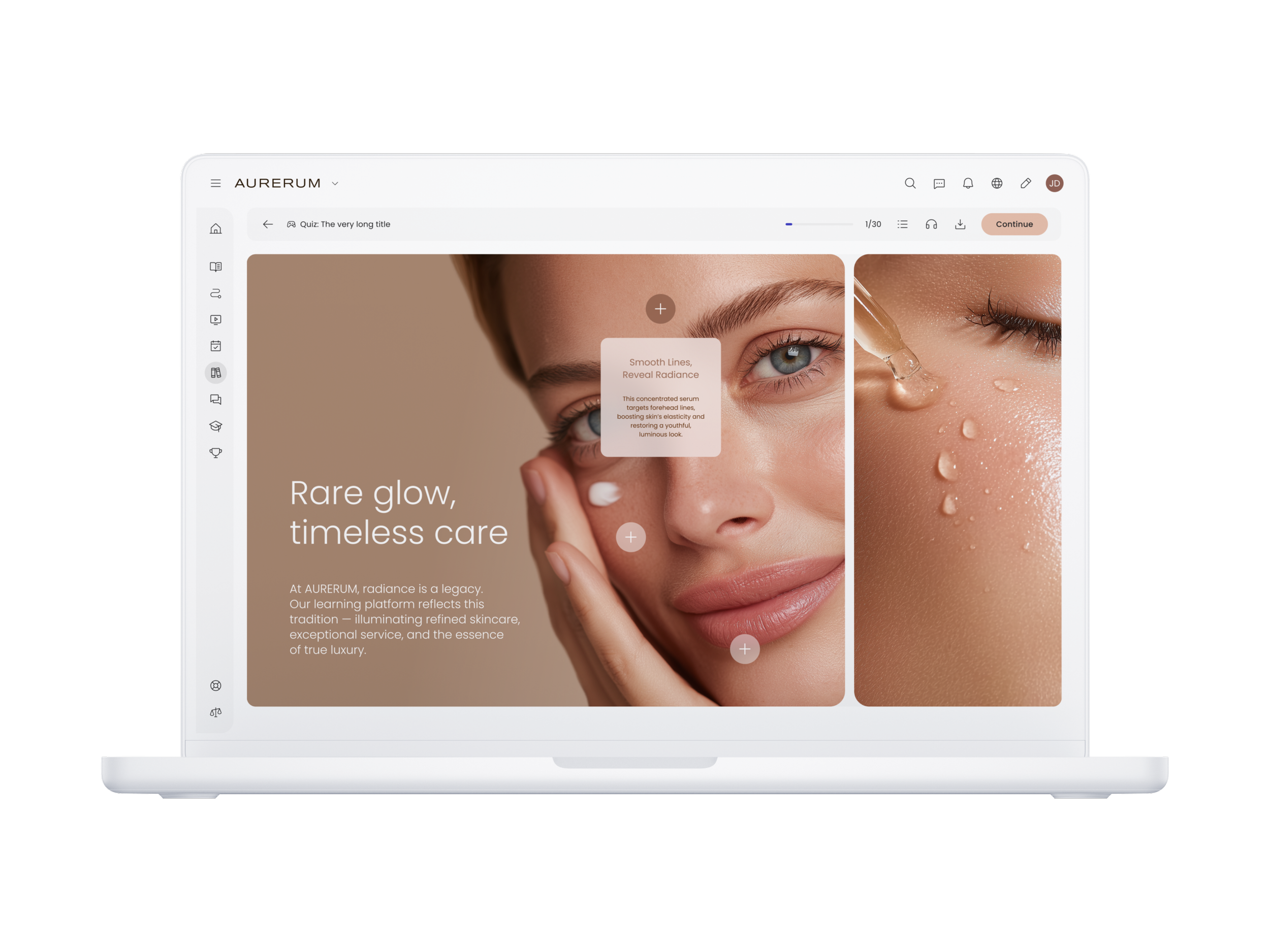
7. Multi-Device Formatting: Optimize Learning for Mobile, Tablet, and Desktop
Retail teams primarily access learning on mobile devices, with over 70% of frontline employees using smartphones as their primary learning tool.
Multi-device formatting ensures that learning content automatically adapts to mobile, tablet, and desktop screens, providing a seamless and intuitive experience without requiring manual redesign.
This responsiveness significantly improves accessibility and engagement, as mobile-optimised learning can increase completion rates by up to 45% and reduce friction in daily use. By ensuring content is always clear, interactive, and easy to navigate on any device, organizations enable continuous learning directly in the flow of retail operations.
8. Integrated Project Management: Streamline Collaboration and Validation
Creating high-quality retail training often involves multiple stakeholders, including learning teams, brand managers, product experts, and regional reviewers.
Integrated project management features allow teams to comment, review, and validate content directly within the platform, reducing feedback cycles and accelerating deployment.
This centralised workflow can shorten production timelines by up to 30–50%, while ensuring greater accuracy and alignment with brand standards.
By simplifying collaboration and validation, organizations can launch training faster, maintain content quality, and keep learning continuously aligned with product launches and business priorities.

Conclusion: The Authoring Tool as the Engine of Modern Retail Training
In today’s fast-moving retail environment, the ability to create high-quality, engaging, and scalable training content is no longer optional it is a strategic necessity.
Features such as branded slide libraries, interactive video, branching scenarios, AI-supported authoring, automatic translation, and integrated collaboration tools empower organizations to produce immersive learning experiences faster and more efficiently. These capabilities ensure training remains aligned with the brand, accessible across all devices, and adaptable to global deployment, enabling frontline teams to continuously develop their expertise and deliver exceptional client experiences.
Our authoring tool offers many more features designed to empower teams to create, manage, and scale their online retail training programs with speed, creativity, and full brand alignment.
From advanced interactivity and AI-assisted content creation to seamless collaboration and global deployment, it provides everything needed to design immersive, high-impact learning experiences.
Built specifically for the realities of retail, it enables organizations to continuously update content, engage frontline teams, and deliver consistent, branded training across every store, market, and device — transforming learning into a true driver of retail performance and brand excellence.