

How to Design Engaging Retail eLearning Courses with AI
From Store Floor to Screen: Designing Engaging Retail eLearning with AI
Designing engaging retail eLearning with AI starts by respecting the realities of the store floor.
AI should support learning teams in creating short, relevant, and actionable experiences that fit into daily retail rhythms not long, disconnected content.
By analysing performance data, customer interactions, and learner behaviour, AI helps identify the moments that matter most: product storytelling, selling techniques, service excellence, and operational consistency.
Used as an assistant, AI accelerates content structuring, adapts learning paths by role or market, and supports rapid localisation, while human experts ensure authenticity, brand voice, and real-life relevance.
The most effective retail eLearning blends AI-supported digital modules with human elements such as store manager coaching, peer stories, user-generated content, and live sessions—turning learning into a practical, continuous companion that supports performance on the shop floor.
AI-Assisted eLearning Design for Retail Training: Enhance Expertise Without Delegating Creativity
AI is reshaping retail training but its real value lies in assisting expertise, not replacing it.
In a retail context, where brand voice, human interaction, and in-store realities matter, AI works best as a design accelerator rather than a creative decision-maker.
Used correctly, AI helps learning teams structure content faster, personalise learning paths by role or market, analyse performance data, and localise programs at scale while humans remain fully in control of storytelling, pedagogy, and brand expression.
This balance ensures retail eLearning stays practical, authentic, and emotionally engaging, supporting store teams without diluting the craftsmanship behind great training.
Why AI Assistance Works in Retail Learning
Keeps brand DNA intact: humans define tone, values, and service standards
Accelerates design cycles without sacrificing quality
Supports role-based learning (sales advisors, managers, visual merchandisers)
Improves relevance through data-driven insights, not generic content
Scales globally while preserving local nuance and cultural accuracy
The Risk of Overusing AI in Premium Retail Training: Why Luxury Learning Must Stay Human
In luxury, fashion, watchmaking, and cosmetics, training is not only about knowledge transfer it is about craft, emotion, posture, and storytelling.
Overusing AI in premium retail training risks flattening what makes these brands exceptional.
Fully automated content may be fast and visually polished, but it often lacks nuance, lived experience, and the subtle imperfections that build trust and aspiration. Store teams quickly detect generic language, synthetic visuals, or uniform narratives, which can weaken engagement and dilute brand authority.
In premium retail, where excellence is felt in details, learning must reflect the same standards as the products themselves.
Where Overuse of AI Creates Risk in Premium Retail
Brand dilution: generic phrasing and visuals undermine unique brand codes
Loss of emotional transmission: AI struggles to convey passion, heritage, and craftsmanship
Reduced credibility: synthetic voices and content feel distant from real store realities
Lower long-term engagement: novelty fades quickly when content lacks human depth
Misalignment with service culture: luxury selling relies on posture, intuition, and relationship
What Data and Field Observations Show
Fully automated learning content shows a decline in engagement of 20–30% after initial rollout
Luxury training programs that include human storytelling, expert interviews, and coaching report up to 25% higher completion and recall rates
Learners are 2× more likely to trust and apply content featuring real ambassadors, craftsmen, or store managers
Blended learning models (AI + human interaction) deliver 15–20% stronger behavioral transfer on the sales floor
How Premium Brands Should Use AI—Without Compromising Excellence
Use AI to support research, structure, localisation, and iteration
Keep brand voice, storytelling, and service rituals human-led
Integrate real people: artisans, designers, store managers, top sellers
Combine digital learning with live online sessions, onsite workshops, and coaching
Treat AI as a backstage tool, never as the face of the brand
In essence: premium retail training must feel as crafted as the products it represents. AI can accelerate and scale learning, but when overused, it risks eroding authenticity and emotional connection. The most successful luxury learning strategies use AI discreetly—enhancing efficiency behind the scenes—while keeping human expertise, imperfection, and presence at the center of the learning experience.
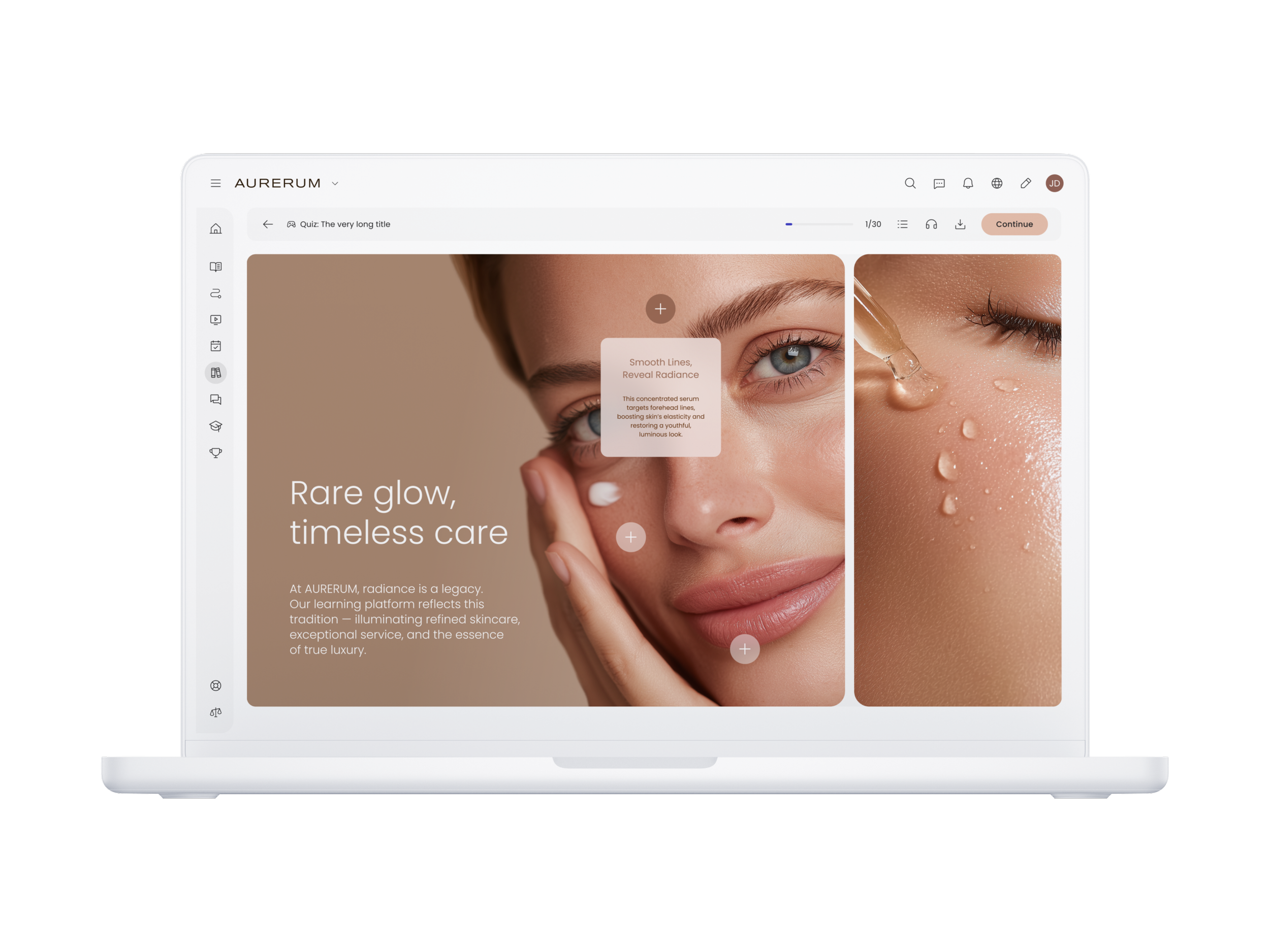
Image Generate with AI
Keep It Human: Why Retail Training Needs Real Faces, Real Voices, and Real Presence
Retail learning only works when learners feel personally concerned and the human brain is remarkably good at detecting when content is not real.
When training relies too heavily on AI-generated text, voices, or avatars, learners subconsciously disengage: the content feels generic, impersonal, and not meant for them.
Neuroscience and learning science show that attention, memory, and motivation are strongly activated by social cues-eye contact, authentic voices, lived experience, emotion, and imperfection.
When these signals are missing, the brain categorises the content as low relevance, leading to weaker engagement and poorer transfer to the shop floor. In retail—where learning must influence posture, behavior, and customer interaction—AI-only content risks becoming noise rather than support.
Why AI-Only Content Triggers Disengagement
The brain looks for human intention to assess relevance
Synthetic voices and generic phrasing reduce emotional resonance
Learners struggle to identify with non-human examples
Content feels interchangeable, not tailored to their reality
Motivation drops when learning lacks social connection
AI Learning Chatbots in Retail Training: Real-Time Support for Learners—Before, During, and On the Shop Floor
When designed correctly, AI chatbots become a powerful extension of retail training—supporting learners not only during formal learning moments, but also when they are facing real customers.
Embedded within the LMS and accessible on mobile, an AI chatbot can answer product questions, clarify service guidelines, suggest selling techniques, or retrieve key information in seconds.
During training, it acts as a learning companion helping learners revise, test their knowledge, or navigate content. On the shop floor, it becomes a discreet support tool—reinforcing confidence without replacing human judgment.
The key is positioning the chatbot as an assistant, not an expert: it supports recall and decision-making, while experience, empathy, and relationship-building remain human.
How AI Chatbots Add Value in Retail Learning
Just-in-time support for product features, pricing logic, care instructions
Guided reinforcement of selling steps, service rituals, and brand posture
Contextual answers based on validated training content and brand guidelines
24/7 availability across markets and time zones
Reduced cognitive load for store teams during peak hours
During Training vs. In Front of the Client
During training
Answer questions and clarify concepts instantly
Propose quizzes, scenarios, or recap key takeaways
Help learners navigate modules and learning paths
On the shop floor
Support memory recall (“What’s the key difference between these two models?”)
Reinforce confidence before or after a client interaction
Provide compliant, brand-approved answers—without improvisation
What Chatbots Should—and Should Not—Do
✔️ Support knowledge, recall, and navigation
✔️ Suggest best practices and learning content
✔️ Reinforce consistency and brand accuracy
❌ Replace sales judgment or human interaction
❌ Speak directly to clients
❌ Decide on emotional, relational, or complex service situations
Data & Observed Impact in Retail Environments
Retail programs using AI chatbots report 25–40% fewer repetitive support questions to managers or HQ
Learners with access to on-demand AI assistance show 20–30% higher confidence scores post-training
Just-in-time learning support improves knowledge retention by up to 25% compared to training-only models
Store teams are 2× more likely to apply training when help is available at the moment of need
In summary: AI chatbots work best in retail training when they stay invisible to the client and indispensable to the learner. Used as a silent assistant—during training and in real customer situations—they reduce friction, build confidence, and reinforce consistency. But the relationship, emotion, and trust that define great retail service must always remain human.

AI Avatars in Retail Training: Powerful for Scale and Fun But Not a Substitute for Human Presence
AI avatars that replicate your image and voice, and can deliver any script in any language or accent, open exciting possibilities for retail training when used with restraint.
These tools make it easy to localise messages, introduce content, share fun facts, or create lightweight explainers without repeated filming.
Solutions such as Synthesia or HeyGen allow brands to scale communication rapidly while maintaining visual consistency. However, in premium retail—luxury, fashion, watches, cosmetics—overuse carries risk.
When avatars become the main voice of training, learners quickly perceive the experience as synthetic, reducing emotional connection and credibility. Luxury learning, like luxury service, relies on authenticity, craftsmanship, and real human transmission.
Where AI Avatars Create Real Value
Multilingual scaling: one script, many languages and accents
Speed & consistency for updates, product refreshers, and micro-content
Engaging “fun facts” or cultural anecdotes that add lightness
Intro/outro videos that frame learning without heavy production
Cost-efficient localisation without repeated filming
Where Overuse Becomes a Risk in Premium Retail
Reduced authenticity when avatars replace real experts or managers
Lower emotional engagement compared to real faces and voices
Perceived artificiality that conflicts with luxury brand codes
Weaker trust in content meant to transmit craftsmanship or service posture
Data & Field Observations
Training content featuring real people generates up to 2× higher perceived credibility than synthetic-only formats
Programs that rely heavily on AI avatars see engagement drop after initial novelty, often by 15–30% over time
Blended approaches (AI avatars + real interviews/coaching) show 20–25% stronger retention than avatar-only content
Learners rate content as more “for me” when they see recognisable peers or leaders, not digital doubles
Best Practice for Premium Retail Brands
Use AI avatars sparingly and intentionally
Reserve them for fun facts, transitions, announcements, or quick explainers
Keep craftsmanship, storytelling, and service culture human-led
Balance avatars with real interviews, store stories, and live coaching
Treat AI avatars as a format, not a voice of authority
In essence: AI avatars are excellent tools for scale, localisation, and moments of light engagement—but they should never replace the human presence that defines premium retail training. Used selectively, they add efficiency and creativity. Overused, they risk distancing learners from the very excellence and emotion luxury brands seek to transmit.
Branded AI Avatars & Visuals in Retail Training: Scale Content While Staying True to Your Brand
AI avatars and generative visuals now make it possible to create fully branded training content that looks and feels like your brand from the avatar’s appearance and posture to the environment, styling, and product context.
Unlike generic stock visuals, AI-generated imagery and avatars can be designed to reflect your brand universe and place your real products in authentic usage situations: a sales advisor presenting a watch on the wrist, a beauty consultant explaining a skincare ritual, or a fashion associate styling a silhouette on a client.
When guided by strict brand inputs—visual codes, tone, gestures, environments, and product references—AI becomes a powerful production accelerator.
However, especially in premium retail, these assets must be used with intention: they are ideal for illustrating concepts, fun facts, micro-learning, or multilingual explainers, but should complement—not replace—real human presence, craftsmanship, and lived experience.
What Fully Branded AI Visuals Enable
100% brand-controlled output (colors, posture, styling, environment, tone)
Products shown in real customer-use situations, not abstract visuals
Fast localisation of the same visual concept across markets and languages
Consistency at scale across modules, launches, and updates
Creative freedom without recurring photo or video shoots
Where It Works Best in Premium Retail
Product introductions and visual storytelling
“Did you know?” and fun facts modules
Microlearning capsules and refreshers
Visual scenarios to illustrate best practices
Multilingual explainers with consistent brand imagery
Where Caution Is Required
Avoid using avatars and AI visuals as the sole voice of authority
Do not replace real experts, artisans, managers, or top sellers
Be careful with over-polished or repetitive visuals, which feel synthetic
Always validate realism, posture, and emotional tone
Data & Field Insights
Branded visuals increase content recognition and recall by up to 30% compared to generic stock imagery
Learners are 2× more likely to engage with content showing real products in realistic contexts
Overuse of synthetic visuals leads to 15–25% engagement drop once novelty fades
Blended content (AI visuals + real human stories) drives 20% stronger behavioral transfer on the shop floor
Bottom line: AI-generated avatars and images can be fully branded, realistic, and product-centric—making them powerful tools for modern retail training. Used selectively, they elevate visual storytelling and scalability. Overused, they risk distancing learners from the authenticity premium brands depend on. The strongest learning experiences combine AI-crafted visuals with real people, real products, and real stories—because in retail, credibility is felt in the details.

One-Click Global Learning: Using AI Inside the LMS to Translate Training Programs at Scale
AI integrated directly into the LMS is transforming how organisations manage multilingual training turning what was once a complex localisation process into a seamless, one-click operation.
Instead of exporting files, coordinating multiple vendors, and managing version chaos, learning teams can now translate entire programs instantly within the learning platform.
AI handles first-pass translation, updates, and synchronisation across languages, while humans retain control over terminology, brand voice, and sensitive content through validation workflows.
By working with specialised localisation partners such as Lionbridge, organisations can easily add human proofreading and linguistic validation on top of AI translations—ensuring accuracy, cultural relevance, and brand consistency.
This hybrid AI + human approach dramatically reduces time-to-market and operational friction, while preserving the quality standards required for global retail and premium brands.
The result is a scalable, agile learning ecosystem where training programs can be updated, translated, and deployed worldwide—quickly, consistently, and with confidence.
Conclusion: Augmenting Retail Learning with AI—While Keeping the Store at the Center
Designing engaging retail eLearning with AI is not about moving learning away from the store floor—it is about bringing the store into the digital experience with greater relevance, speed, and consistency.
When used with intention, AI helps learning teams transform real retail knowledge into short, actionable, and contextual learning moments that fit naturally into daily store operations. It accelerates content creation, supports localisation, improves access to knowledge, and provides just-in-time assistance—without replacing the human relationships that define great retail service.
The most effective retail learning strategies treat AI as a supporting layer, not a substitute. Human expertise remains essential to transmit brand culture, service posture, craftsmanship, and emotional intelligence—elements that no algorithm can authentically replicate.
Over-automated learning risks becoming generic and disconnected, while blended approaches—combining AI-assisted digital learning with real stories, user-generated content, coaching, and live interactions—create experiences that feel credible, practical, and meaningful to store teams.
From the shop floor to the screen, the future of retail learning lies in augmentation, not delegation. AI enables scale and efficiency; humans bring judgment, authenticity, and connection.
When these forces are aligned, retail eLearning becomes more than training—it becomes a daily performance companion that supports confidence, consistency, and excellence in every customer interaction.