

Why Fractional Learning Is Redefining Retail Training
From Full-Time to On-Demand: How Fractional Learning Transforms Retail Performance
Retail performance today is shaped by speed, seasonality, and constant transformation realities that traditional full-time Learning & Development models struggle to match.
Fractional Learning shifts the paradigm from fixed headcount to on-demand expertise, giving retail organisations access to senior learning leaders precisely when and where they are needed.
Rather than maintaining permanent structures that are often under or over utilised, brands can activate high-impact learning support during key moments such as product launches, market expansions, onboarding waves, or transformation projects.
This model accelerates decision making, sharpens execution, and keeps learning tightly aligned with business priorities ultimately turning L&D into a flexible performance lever that adapts to the rhythm of retail rather than slowing it down.

What Is Fractional Learning & Development?
Fractional Learning & Development is a flexible model that gives organisations on-demand access to senior L&D expertise, without the constraints of a full-time role.
Rather than hiring permanent resources, companies engage experienced learning leaders when and where they create the most value.
Their involvement is scalable and targeted from defining learning strategy and designing high-impact programs, to enabling teams, supporting rollouts, and coaching leaders.
The model is outcome-driven: brands invest in measurable impact and results, not in headcount, making Fractional L&D particularly well suited to fast-moving, performance-led environments such as retail.
On-demand access to senior L&D expertise
Scalable involvement:
Strategy
Program design
Enablement
Coaching
Paid for impact and outcomes, not headcount
Why Fractional L&D Fits Retail Perfectly
Fractional Learning & Development fits retail perfectly because it mirrors the reality of the business.
Retail operates in cycles seasonal peaks, frequent product launches, evolving service expectations, high staff turnover, and complex multi-country operations.
Skills must be built continuously, yet traditional full-time L&D structures are often too rigid to respond at the right pace.
Fractional L&D adapts naturally to these constraints. It scales up during high-impact moments and steps back when less support is needed.
It aligns learning initiatives with business rhythms, designs programs grounded in store realities, and adjusts approaches based on market maturity levels. The result is learning that is timely, relevant, and operational — designed to support retail performance where and when it truly matters.
Retail reality:
Seasonal peaks
Product launches
High staff turnover
Multi-country operations
Continuous skill evolution
Fractional L&D adapts to:
Business rhythms
Store realities
Market maturity levels

Key Benefits of Fractional L&D in Retail
1. Cost Efficiency Without Compromise
Senior expertise without full-time cost
Reduced fixed payroll burden
Up to 40–60% cost savings vs full-time L&D roles
2. Faster Impact, Less Ramp-Up
Fractional experts are immediately operational
No onboarding curve
Time-to-impact reduced by 30–50%
3. Access to High-Level, Cross-Brand Expertise
Exposure to:
Best practices
Market benchmarks
Innovation trends
Brands using external senior L&D expertise innovate 2× faster
4. Flexibility Aligned with Retail Cycles
Scale up during launches
Scale down in quieter periods
No underutilised resources
5. Objective, Strategic Perspective
External view = fewer internal blind spots
Stronger alignment between:
Business
Operations
Learning
Strategically aligned L&D programs drive up to +20% performance uplift
Fractional L&D in Practice
Fractional Learning & Development comes to life through very concrete retail use cases.
It is particularly effective during moments of change, acceleration, or transformation, when expertise is critical but permanent structure is not.
In practice, Fractional L&D supports retail organizations by:
Launching a new category or entering a new market, ensuring teams are trained quickly and consistently while adapting to local realities
Rebuilding clienteling skills, aligning service behaviors with brand expectations and modern customer journeys
Rolling out a new LMS or digital tools, providing strategic guidance, adoption planning, and change management
Supporting Store Managers as coaches, strengthening their role as daily performance enablers
Redesigning onboarding at a global level, creating scalable, branded, and performance-driven onboarding experiences
By intervening at these critical moments, Fractional L&D delivers immediate impact while remaining agile, cost-effective, and closely aligned with retail operations.
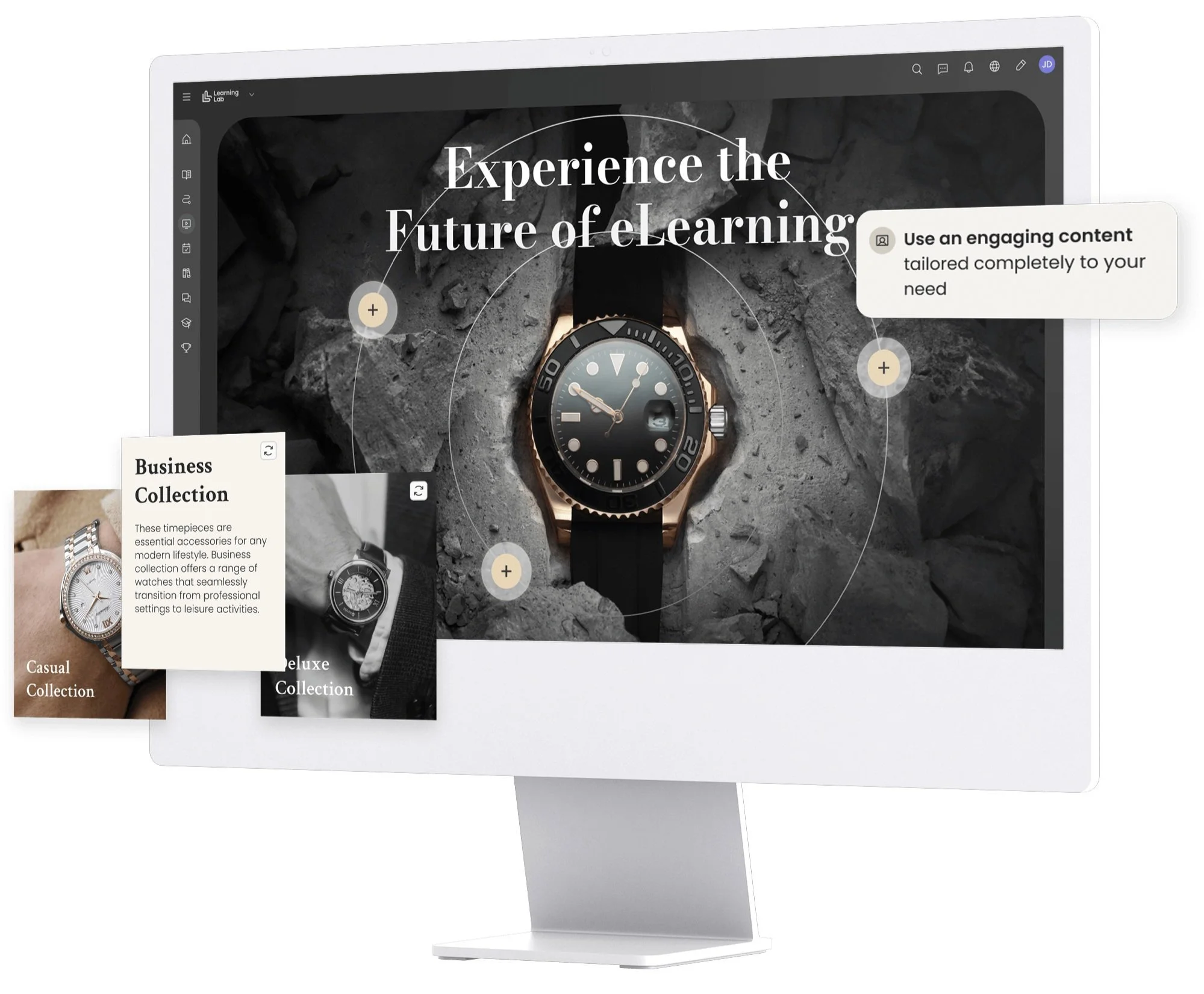
Fractional L&D + Digital Platforms = A Powerful Combination
Fractional Learning & Development reaches its full potential when combined with digital learning platforms.
Fractional experts bring strategic clarity, business alignment, and deep learning design expertise, while LMS and digital tools ensure scalable, consistent execution across stores, markets, and regions.
In this blended model, human expertise defines the “what” and the “why” learning strategy, priorities, and impact while technology delivers the “how”, enabling rapid deployment, tracking, personalisation, and continuous access for frontline teams.
The result is a powerful balance: learning that is strategic yet operational, human yet scalable, and capable of driving measurable retail performance without the rigidity of traditional structures.
Fractional experts design the strategy
LMS and digital tools scale execution
Blended model:
Human expertise
Technology efficiency
When Fractional L&D Makes the Most Sense
Fractional Learning & Development makes the most sense when organizations need agility, speed, and senior expertise without long-term structural commitment.
It is particularly well suited for growing brands that need to professionalize learning quickly, international expansion where consistency and local adaptation must coexist, and transformation phases involving new strategies, tools, or operating models.
It is also a strong choice for brands seeking agility over structure — organizations that prioritize impact, adaptability, and business alignment rather than fixed hierarchies. In these contexts, Fractional L&D provides the right level of leadership and execution at the right moment, supporting performance while preserving flexibility.
Growing brands
International expansion
Transformation phases
Brands seeking agility over structure

Conclusion: From Structure to Impact
Retail does not need more hierarchy or rigid structures it needs precision, adaptability, and relevance.
In an environment defined by constant change, learning must move at the same pace as the business. Fractional Learning & Development answers this need by replacing fixed models with targeted expertise and outcome-driven engagement.
By design, Fractional L&D reduces risk, increases speed, and elevates the quality of learning initiatives, ensuring that effort is focused where it creates real value. It allows brands to stay agile, align learning with performance, and respond intelligently to evolving market demands.
The future of retail learning is neither fully internal nor fully outsourced — it is intelligently fractional.
Retail doesn’t need more hierarchy
It needs precision, adaptability, and relevance
Fractional L&D:
Reduces risk
Increases speed
Elevates quality
The future of retail learning is not full-time or outsourced — it’s intelligently fractional.