

From LMS to Workday Companion
How the 2026 learning stack becomes a performance layer at the moment of need
If your LMS still behaves like a content library, it will keep losing to the workday.
In 2026, the winning model is a Workday Companion: a performance layer that shows up before a client interaction, during a task, and after a mistake, without asking people to “go do training” on top of everything else.
Two signals make this shift hard to ignore. First, organizations are actively trying to simplify the learning-tech experience because the ecosystem has become noisy and overlapping: Brandon Hall Group reports that 65% of organizations struggle to stay current because learning technology evolves rapidly, and 61% struggle because tools increasingly overlap in functionality. Second, the adoption gap is real on the learner side: research summarized by Whatfix (citing Growth Engineering) notes that 68% of learners prefer to train on the job, yet only 12% of L&D programs support learning in the flow of work. These are not “L&D problems.” They are performance and productivity problems, especially in retail and customer-facing environments.
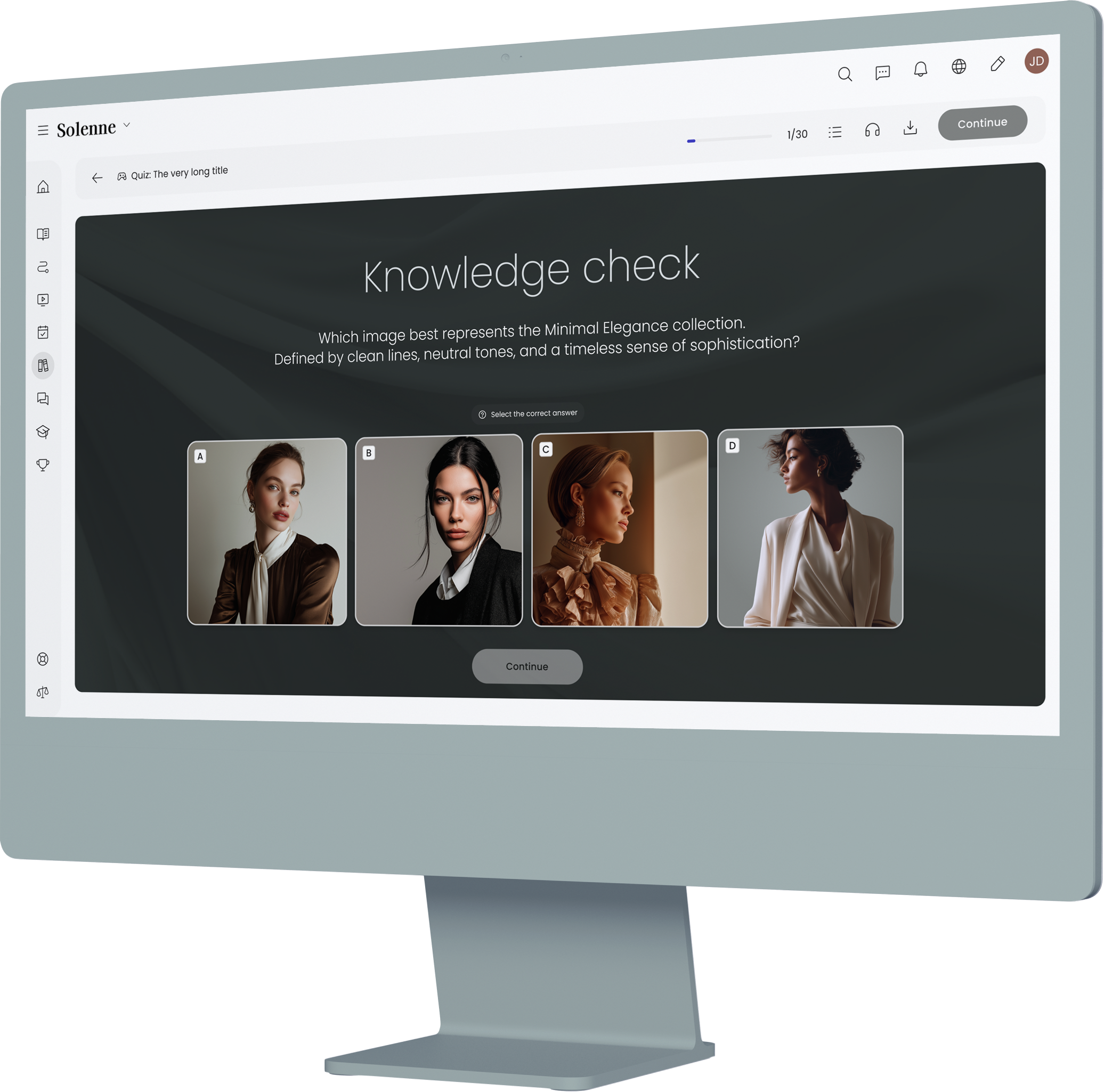
For Penceo, this is a positioning advantage. The Learning Lab can be framed as the brand’s daily enablement system: fast, mobile-first, visually consistent, and designed around real moments that decide outcomes, not around course catalogs and completion rates.

The library LMS is obsolete
Why access to content doesn’t equal readiness
Most LMS programs still optimize for delivery: push a module, track a completion, issue a certificate. But frontline performance rarely fails because people never saw the information. It fails because they can’t retrieve it under pressure, or because they can’t translate it into the exact behavior needed in a real interaction.
Training transfer breaks when the “how” is missing, not when the “what” is missing.
Frontline time is fragmented, so long modules compete with the shift, not support it.
If the platform requires too many taps, logins, or searches, it becomes optional.
The real opportunity is to stop treating training like a destination and start treating it like a support system. With Penceo’s approach, the LMS stops acting like a warehouse of knowledge and starts acting like a guide for brand-right actions in real scenarios. When people can access the right prompt in seconds, they don’t just remember more, they hesitate less, and that changes the quality of the client experience.
What “Workday Companion” actually means
A performance layer that sits beside the task.
“Learning in the flow of work” is the idea. Workday Companion is the promise: employees get help in the rhythm of their day, without stepping out of the moment. It’s the difference between “Here’s a course on objections” and “Here’s the one phrase and one choice point that matters right now.”
Before: quick preparation, product story refresh, a single focus for the day.
During: decision prompts, objection handling, service standards, visual reminders.
After: micro-debrief, coaching triggers, spaced reinforcement, repair of mistakes.
To make this feel human, the companion can’t talk like policy. It has to talk like the brand and like the floor. Penceo can win here by designing short, confident, brand-aligned formats that sound like what your best manager would say in a pre-shift brief. If the learning tone matches the brand tone, adoption becomes natural, because it feels like support, not compliance.
The three moments that decide performance
Before the client, during the task, after the mistake.
Frontline excellence is shaped by a few repeatable moments. You can build an entire learning ecosystem around them and instantly reduce complexity for both learners and stakeholders. Instead of “more content,” you design better timing.
Before: pre-shift clarity, one priority, one story point, one product hero insight.
During: on-the-floor prompts, “if they say X, try Y,” quick comparisons, checklists.
After: fix the drift, reinforce the best behavior, normalize coaching, reduce repeats.
Here’s the strategic insight: these moments are where confidence is created or lost. A Workday Companion should reduce “uncertainty spikes” at the exact second they appear. That’s when learning becomes performance. Penceo’s advantage is building those spikes into the design: short scenarios, precise wording, and decision practice that mirrors reality, so the learner doesn’t just know, they can do.
What features make it real
The building blocks beyond courses.
This model fails if it’s just a new label on the same old LMS. The Workday Companion needs capabilities that make support fast, usable, and consistent. Brandon Hall Group’s point about unifying learning technologies is relevant here: when the ecosystem is fragmented, learners face extra friction and organizations lose clarity in measurement and experience. (The “too many tools” problem isn’t theoretical; it’s now a major reason organizations struggle to stay current and coherent.)
Mobile-first experience that loads fast and works for shared devices.
Nano and micro formats, plus searchable job aids that are genuinely usable mid-shift.
Role-based delivery so people see what matters to their reality.
Deep linking and QR entry points so support can be accessed in seconds.
Analytics that surface confidence gaps and behavior risks, not only completions.
The most important feature is often overlooked: design consistency. If every team creates content in a different style, the companion becomes noisy and people stop trusting it. Penceo can package this as a brand system: templates, voice rules, scenario patterns, and visual identity that make every piece instantly recognizable. That recognition is what turns “content” into a habit.

Measurement that operations will respect
Prove confidence, reduce errors, protect brand consistency.
If you only measure quiz scores and completion rates, you’ll keep defending learning as a cost center. A Workday Companion earns its place by linking to operational outcomes and brand behaviors. Brandon Hall Group emphasizes that a unified learning ecosystem supports better analytics to identify gaps and evaluate effectiveness, which is the bridge you need from learning data to business language.
Time-to-confidence: self-report plus manager validation at 7 and 30 days.
Error reduction: fewer avoidable mistakes, fewer repeats, fewer escalations.
Consistency on the floor: observation checklists, mystery shopping, peer review.
Speed to launch readiness: days to baseline storytelling and top objections handling.
A practical strategy is to combine leading indicators (confidence, practice frequency, scenario accuracy) with lagging indicators (sales conversion, returns, NPS, compliance misses). Penceo can be explicit about this: learning success is not “people watched the video,” it’s “people performed the behavior.” When measurement is framed this way, stakeholders stop asking for more modules and start asking for sharper support in the moments that matter.
A 30-day operating rhythm that fits real shifts
Pre-launch, launch week, then reinforcement that prevents drift.
Retail execution isn’t short on energy during launch week. The drop happens later, when attention moves on and the floor improvises. A Workday Companion should be designed as a 30-day rhythm, because that’s how you protect consistency and confidence beyond the initial push.
Days 1–7 (pre-launch): story essentials, hero product, one scenario per day.
Days 8–14 (launch week): daily 2-minute focus, one fast practice moment, one job aid.
Days 15–30 (reinforcement): spaced prompts, “top 3 mistakes” fixes, manager nudges.
The best-case scenario is not that everyone becomes an expert in a week. It’s that the organization becomes reliably aligned in the language, behaviors, and decision-making style of the brand. Penceo can differentiate by treating reinforcement as a designed system, not an afterthought: small, repeatable, and manager-enabled. This is where the LMS becomes a companion, because it keeps showing up when real life tries to pull people back into old habits.
Penceo’s differentiation: brand performance, not generic training
Make it feel like the brand every day.
Most “in-flow” learning still looks generic. Same corporate tone, same flat visuals, same sterile scenarios. But employees experience the brand first, and in retail, how you speak is part of what you sell. Penceo’s edge is turning enablement into a branded experience that employees can embody with clients.
Visual identity: consistent templates, photography rules, product framing, icon system.
Voice identity: phrases employees can actually say, with pacing that fits live dialogue.
Scenario identity: choices that mirror real client dynamics and brand expectations.
This is also where emotional memory is built. People remember training when it gives them a clear identity to step into: “This is how we handle that moment here.” The Workday Companion should feel like a trusted colleague, not a policy document. When it’s done well, it doesn’t just improve knowledge. It strengthens belonging and confidence, which translates into calmer, more consistent client interactions and a more cohesive brand experience across stores and regions.
Build the companion, then earn the habit
In 2026, the LMS wins when it reduces uncertainty in real time.
A Workday Companion succeeds when employees stop thinking “I need training” and start thinking “I know what to do next.” The numbers reinforce why this is urgent: many organizations are struggling with learning-tech complexity and overlap (65% and 61% respectively in Brandon Hall Group’s reporting), while learners overwhelmingly prefer on-the-job support and rarely receive it at scale (68% preference versus only 12% program support, as summarized by Whatfix citing Growth Engineering). Those gaps show why the old model of “assign a course and hope for transfer” is no longer enough.
For Penceo and The Learning Lab, the strategic play is clear: position the platform as a daily performance layer that protects brand consistency and makes frontline behavior easier under pressure. Design for the three decisive moments, ship the 30-day rhythm, measure outcomes that operations respects, and keep the experience unmistakably on-brand in voice, visuals, and scenario realism. When people feel supported mid-shift, adoption stops being a campaign and becomes a routine, and that’s when learning finally starts behaving like a true business system.
